|
Original compositions digitally rendered in MP3 format
|
|
Click on the gramophone to play each item
|
|
|
This piece, completed in October 2001, is based on two motifs from the liturgical music for the Day
of Atonement (Yom Kippur), the most solemn occasion in the Jewish calendar. The title comes from a
mediæval poem embodied in the service: Unetanneh tokeph qedushath hayyôm, �Let us then proclaim the
holiness of the day�, whose traditional tune provides the theme and the four variations which follow.
In a contrasting central section, a solo horn plays the music associated with the words �The book of
records is opened, the still small voice is heard, and all the deeds of men are laid bare before you�,
which is expanded in a passage with a quality at once pleading and processional. Finally, a trombone
announces a modification of the opening theme which becomes the subject of an extended fugue.
|
|
|
|
|
Why should anyone bother to write a pseudo-Rachmaninoff concerto when it is so widely felt that Rachmaninoff
himself wrote at least one too many? I can only say that the second subject (given by piano and strings
after about a minute) forced its way into my head some years ago and was so obviously part of a late-romantic
piano concerto that I had virtually no choice but to build one round it. I am reserving it for a grand
apotheosis at the end of the whole work (if the work ever has an end), which is why it is only indirectly
hinted at throughout the rest of the movement.
|
|
|
|
This shamelessly Elgarian piece was written for Truro Sinfonia, an amateur orchestra in which I have
the honour to be sub-principal viola (i.e. No. 2 of 2 at concerts and generally no. 1 of 1 at rehearsals)*.
The title comes from Vergil's Æneid: Exspectate uenis (�Thou comest, O long-awaited!�). I have
tried to convey something of doubt and foreboding in face of the unknown future, as well as triumph.
*They played it, too.
|
|
|
|
|
|
Some clown pretending to be Gounod pretending to be Mozart.
|
|
|
|
|
This quartet was my first completed work (1995). This recording begins with a short and rather mysterious
(I think) transitional passage, ending with a quiet quotation of the main theme of the first movement
and leading straight into the Rondo. This has a slightly eerie principal subject with three episodes,
the third being a darkened and accelerated version of the first, while the second provides a moment of
quirkish relaxation. The coda again quotes from the beginning of the whole work (in extended note-values
on viola and cello while the violins, overhead, tear the rondo theme to pieces) before all the instruments
are drawn into the fury of the closing bars.
|
|
|
a n d
A Q U E R Y
(MIDI file : should play almost instantly)
|
|
|
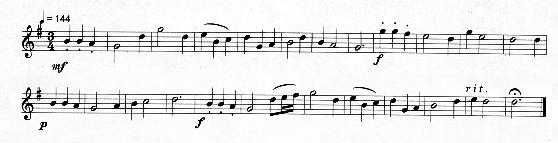
What is this tune?
I remember it from forty years ago, sung in the school chapel to the words of
a hymn, �Praise to the Lord, who made all beauty / For all our senses to enjoy�; but I feel certain
that this was only a borrowing and that I have at some time heard it sung to other words. It sounds
like an Irish folk-melody.
The notation is given below. The last two bars may seem abnormal;
this is because my impromptu arrangement for wind quartet (flute, two clarinets, bassoon) gives the
melody to the first clarinet here.
|
|
|
|