OSTEOLOGY
Dr. R. Menaka
.......................................................................................................................................................................................
Osteology deals with the components of skeleton. Bones are the principal components of skeleton. Skeleton is responsible for locomotion of the individual. Skeleton defined as hard framework of the body which supports soft structures. The skeleton is divided into two parts.
1. Appendicular skeleton- which comprises of bones of forelimb and hind limb.
2. Axial skeleton - which comprises of bones of skull, vertebral column, ribs and sternum.
Classification of Bones:
Based on their shape, size and structure of bones.
1. Long bones: They are long, weight bearing bones. It has shaft and two extremities. The shaft contains medullary cavities. Mostly they are present in limbs. Example: femur, humerus etc.
2. Short bones: These are small in size. They are present in the joints. example: carpals and tarsals.
3. Flat bones: They are irregular flat shape and composed of two bony plates. example: scapula and some of skull bones.
4. Irregular bones: They presents an irregular surface and generally found in the vertebral column.
5. Sesamoid bones: These are small seed like structure an develops within the tendon. They work like pully and to avoid friction. Example: Patella (largest sesamoind bone in the body).
6. Pneumatic bones: Some of the long bones of birds have communication with the air sacs through pneumatic foramen. Example: Humerus of fowl.
7. Visceral bones: Bones which are present in the visceral organs. These are species speciifc.
Examples:
a. Os cordis- Heart of ruminants (Chordae tendinae)
b. Os penis- Penis of Dog (part of penile tissue )
c. Os rostrum- Snout of pig (Part of nasal septum)
d. Os phrenum- Diaphragm of camel (tendinous portion)
e. Os opticus - Eye of fowl (scleral rings
Structure of Bone:
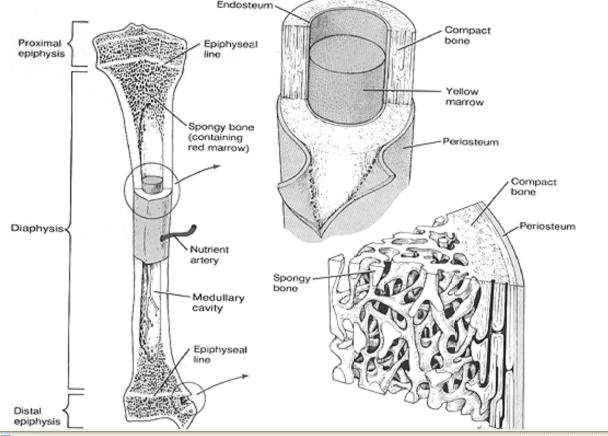
Bone is living tissue. It has two type of substance i.e. known as compact substances and spongy substances. The external surface of the bone is covered by periosteum. The articular area is covered by articular cartilage. The medullary cavity contains bone marrow and covered by endosteum.
The compact substance presents in the compact bone. These substances are arranged in concentric layer or bony lamellae i.e. known as "osetone or Haversian system". The concentric layers are arranged in longitudinal pattern and forms Haversian canal. There is a space between the bony lamella known as lacunae which accommodates the osteocytes (Mature bone cells). The lacunae is communicated with small process known as canaliculi. The Haversian canal, lacunae and canaliculi - Haversian system. The Haversian canal communicates transversely with medullary cavity known as "Volkmann's canal".
The spongy substance presents in the spongy bone. Very small interrelated spongy substances are irregularly arranged. There is no Haversian system.
Bone marrow - are two types. Red marrow and yellow marrow. The red bone marrow is presents in young animals and yellow bone marrow is presents in adult animals. The red bone marrow is the main source of manufacturing blood cells. The adult red bone marrow only present in skull, ribs sternum and vertebrae. The yellow marrow gradually replaces the red bone marrow with age advances. The yellow bone marrow consist of connective tissue, blood vessels, fat cells and some mature and immature blood cells. Picture