Theatre in Melbourne 1891
|
"Mr. James MacMahon, of the theatrical firm of MacMahon brothers, of the Melbourne Opera House, has just returned to melbourne after his trip to America, where he purchased a number of new pieces and effected several important engagements for Australia. The visit has not been wholly one of pleasure, althoug every facility for enjoyment was provided wherever Messrs. James and Joseph MacMahon went. In San Francisco they did not remain long as the standard of entertainment was found to be so much lower than Australia."
(Table Talk April 17th, 1891) |
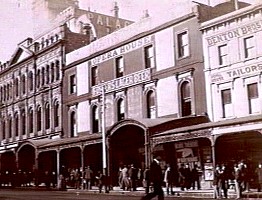
The Opera House exterior, Melbourne, 1890s
 An examination in the bankruptcy of Mrs. C.K. M. Mayer, operatic singer, known professionally as Miss Clara Merivale, was held before Judge Worthington, in the Melbourne Insolvency Court on Monday and Tuesday, August 24 and 25. Mrs. Mayer said that on March 28 she entered into an agreement with Charles and James MacMahon to produce operas at Her Majesty's Opera House, Bourke-street. The rent of the theatre, of which Messrs. MacMahon were the lessees, was £120 a week. Falka was the first opera produced. The weekly salaries paid to the principals were - Miss Merivale (insolvent), £10; Mr. Snazelle, £30; Mr. Goulay, £22 10s; Mr. Ford £12; Miss Liddiard, £20; Miss Salvini, £8; Mr. Knight Aston, £20; Mr. Wallace, £15; Mr. Harris (the conductor) and Mrs. Harris (Miss Aggie Kelton), £20; Mr. Woodfield (as a retainer, he not playing), £15. The salaries for the male chorus came to £53 15s, all receiving £3 each. The members of the orchestra received from £6 to £3 a week the total being £66 10s. The female chorus totalled £45 15s, salaries ranging from £2 10s to £1 and the ballet cost £18. The total expenses for the first week were £1336 1s 4d, and the receipts £1269 18s; for the second week receipts were £849 2s 7d; the third week receipts were £507 16s 6d, expenses £749 5s 3d; and the fourth week receipts were £485 19s 6d, and expenses £792 13s 9d. Insolvent was to receive 60 per cent of the gross receipts up to £1,000, and 70 per cent on all takings over that sum. When the opera of Poor Jonathan was produced Mr. Snazelle received £30 per week. Mr. Lenmane £21 and Mr. Hamilton Clarke for conducting £20 per week. The right to produce Falka was hired from Mr. George Rignold at £40 per week. A retaining fee of £125 was paid for the operas of Poor Jonathan and the Gipsy baron. Charles McMahon, examined, said his firm paid £100 per week rent for the theatre and £20 per week for electric lighting. The orchestra ordinarily cost £40 to £50, but a manager always had to pay the members more when they played in opera. Players in the theatrical orchestra belonged to a union which regulated the rates of payment. After evidence in detail of the business relations between Messrs. MacMahon and insolvent, the examination closed.
 From the Clara Merivale Insolvency hearing as quoted in Table Talk newspaper on August 28th, 1891 |
Theatre in Melbourne started to suffer during 1891. Banks closed and money was difficult to come by. Financial panic causes bankruptcies and mergers. Theatres are often dark and several companies fold or struggle to survive. Click on a month and check what was happening in Melbourne theatres for the year 1891. All reviews are from 'Table Talk' unless otherwise stated.
| January | February |
| March | April |
| May | June |
| July | August |
| September | October |
| November | December |
| Theatre Royal |
The pantomime 'Aladdin' was revived with delight for the thousands of holiday makers in the city. "As a spectacle, or rather a series of spectacles, it is magnificent...Mr. George Walton, as the widow Twankey, frolics from the beginning to the end of the piece."
| Bijou |
The facial comedy, 'Dandy Dick' proved itself to be a worthy of the reputation that had preceeded it. "Mrs Brough, as the sporting widow, has never before shown such versatility, and yet manages to retain that quality of womanliness which is essentially her own." The four week run concluded on the 23rd.
On the 24th Myra Kemble (1857-1906) made a reappearance in Melbourne after a two year absence with her own comedy 'Dr Bill'. This work had proved successful in both London and Sydney. The Melbourne Age said "All the members of the company are throughly at home in their parts. Miss Kemble's impersonation of the caustic young wife, replete with the shrewd experience of professional life, honestly loving her husband, while bored at the humdrum existence he wishes her to lead, is admirable comedy acting."
| Princess Theatre |
'Marjorie', by Walter Slaughter, proved reasonably successful. "The dresses are an exact reproduction of the period, and in their way are a true historic study." On the 17th of January 'The Pirates of Penzance' was revived with Elsie Cameron, Howard Vernon and Charles Ryley. "Mr. Charles Ryley is the best Pirate King since Guglielmo (Signor) Verdi." On the 24th 'Iolanthe' was revived. "The inclusion of three such principals as Miss Elsie Cameron, Mr Charles Ryley and Miss Flora Graupner, is of itself enough to give new life to any piece."
| Opera House |
'Chilpéric', by Florimond Hervé,
was produced on boxing day by the Nellie Stewart company. "As scene after scene passes there is an ever-varing harmony of colour that would gladden the soul of Millais himself...Mr. Plumpton's excellent conducting, as usual, wins the admiration of the whole audience." It was Plumpton who had taken it upon himself to revise the original score for the Australian market as so often happened with imported works at that time. 'Chilpéric' concluded on the 16th. The following nights were given to revivals of 'Boccaccio', 'La Fille de Madame Angot' and 'Paul Jones'. The last performance of the season is on the 23rd after which Nellie Stewart prepared to leave Melbourne for England. The company temporary disbanded most of whom joined the J.C.Williamson group.
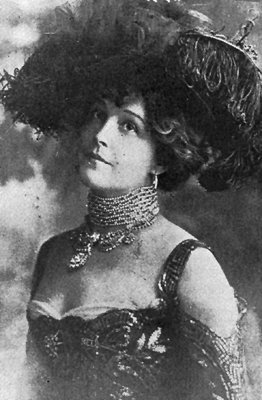 |
Nellie Stewart (1858-1931) was born in Sydney. She made her debut as an actress at the age of five. After touring abroad with her family she was lead in Coppin's 'Sinbad the Sailor' in 1880 in Melbourne. She eventually took the lead in Offenbach's 'La Fille du Tambour Major' for producer George Musgrove, with whom she became closely associated for the rest of her career. Nellie spent a year studying in London (1887/88) returning to Australia to play Marguerite in 'Faust'. She returned to England in 1891 and made her London dé in 1892 taking the title role in the operetta 'Blue-Eyed Susan'. This had been especially written for her by George Sims, Henry Pettitt and Osmond Carr. She returned to Australia in 1893. In Melbourne in 1902 she first played Nell Gwyne in 'Sweet Nell of Old Drury', which was to become her most famous role. |
On the 24th J.L. Toole (John Lawrence) commenced a season of twelve nights. Mainly double bills including 'Dearer than Life', 'Off the Line', 'The Serious Family' and 'The Steeeplechase'. The Age said "On making his appearance, the audience at the Opera House rose to welcome his return to Melbourne and interrupted the play for several minutes by their reiterated demonstrations of applause." [Editor's note: J.L. Toole had taken the title role in the original production of Gilbert and Sullivan's 'Thespis']
| Alexander |
The Dampier season continued with 'The Phantom Ship'. "The incidents of the story have all been well treated, while, having due regard to the holiday season, considerable interpolations have been made in the way of attractive dances and well selected music, while the scenery and mechanical effects are well worthy of prolonged attention." On the 10th the domestic drama 'The Workman' by Frank Harvey was produced by the company. "Miss Dampier is to be warmly complimented on her work, which commencing with light comedy runs through a variety of phrases, until it touches the region of passionate aandemotional acting." 'The Black Flag', by Henry Pettitt, opened on the 23rd. "The Black Flag is a powerful play, full of well devised situations, but it wants a little pruning here and there."
| Theatre Royal |
'Aladdin' continually its succesful season. "..with its brilliant stage pictures, its captivating dances, its wonderful mechanism, its magnificent transformation and its bright faced Miss Jeannie Lee, does not know any other state of existence but crowded houses." (Table Talk) The last days were announced and the pantomime finally finished on the 20th.
The Cartwright-Nethersole company then took over the theatre for a two month season. The drama 'The Middleman', by Henry Arthur Jones, opened on the 21st. "Produced under the direction of Mr. Charles Cartwright himself, who has thus gained the effects he desires while the action of the play is materially helped out by the admirable scenery."
| Princess Theatre |
'Iolanthe' finished on February 6th. On the 7th 'Princess Ida' was staged. "The revival of Princess Ida was expected to be good, but it was not expected that the management would be able to surpass the first production, and this they have done." The work was only on the stage a week. On the 14th 'The Yeomen of the Guard' was revived. "Mr. Elton, as Jack Point, has always been admitted to be an actor of extraordinary versatility, but it is doubtful if ever he has done or will do anything better than his final scene at the end of the second act." On the 21st 'The Gondoliers' was revived. There was only one substitution from the original cast. Sydney Deane took over the role of Luiz from Knight Aston.
| Alexander |
'The Black Flag' continued at this theatre. "(This) production is a sufficient proof, if any were wanting, of Mr. Dampier's resolve to supply the public with the best sensational plays in the market." (Table Talk) 'Black Flag' finished on the 13th. On the 14th 'The Miner's Right' took the stage. This was a dramatisation of the Rolf Boldrewood story by Alfred Dampier and Garnet Walch. "Mr. Dampier and Mr. Walch have thrown into their work the real breeziness of the Australian bush." [Editor's note: Rolf Boldrewood was the pseudonym of a New South Wales magistrate, Thomas Alexander Browne]
 |
Garnet Walch (1843�1913) was born in Tasmania but was educated in England. He returned to Australia and practised as a journalist in New South Wales. It was here that he began to write translations, adaptations, burlesques and pantomimes for the theatre. In 1872 he moved to Melbourne. His last work was 'Sinbad the Sailor' which opened in Melbourne's Theatre Royal on Boxing night 1893. He then retired from the theatre. |
| Bijou Theatre |
'Dr Bill' continued to draw the crowds all month. "It would not have made such a success if it had not been one of the best pieces of its kind, and played by a company that are admittedly equal to any of the leading comedy companies in London.".
| Opera House |
A new season by John Gourlay and G.H. Snazelle commenced on the 7th. The first work was the George Sims comedy 'Skipped by the Light of the Moon'. "It is perhaps better performed now than it ever has been in Melbourne, for not only does the company consist of favourites, but the management has secured a regular operatic conductor in Mr. W.H. Harrison."
| Opera House |
'Skipped by the Light of the Moon' finished on March 6th. On the 7th the musical comedy 'Kindred Souls' was produced with the company strengthened by the addition of Fannie Liddiard and John Wallace. "From beginning to end, all is bright, ludicrous and entertaining."
On the 28th the Clara Merivale Opera season commenced. The new company was identical to Nellie Stewart's company as Williamson had kept the singers together and not allowed them to disband. The first work up was 'Falka', by Francois Chassaigne, originally written in 1883.
| Theatre Royal |
'The Middleman' finished on March 6th. On the 7th 'The Fortune of War' was staged. According to the local papers this was an adaptation, by Henry Hamilton, of 'Les Drapeaux' by Victorien Sardou (1831-1908). However there are no listings for such a title in the plays of Sardou. Probably drawing on works of other french authors. This was heralded as a first performance in an English speaking country and "is the most picturesque military drama that has ever been produced in the city". On the 28th there was a dramatisation of the novel 'Moths', by English authoress Ouida, the pseudonym for Louise de la Ram�e (1839-1908).
| Princess Theatre |
'The Gondoliers' finished its run on March 13th. 'Pepita' opened on March the 14th. The cast included Flora Graupner, Violet Varley, Elsie Cameron, Charles Ryley and William Elton. "Henry Bracy's stage management is noticably good, and the musical director M. Caron is uniformly successful throughout."
| Alexander |
'The Miner's Right' played until March 16th. On Tuesday the 17th the Dampier company revived 'Shamus O'Brien'. "The piece is well put together, and has become popular as much on account of the clever intermingling of pathos and humor, as it has through its historical interest." (Table Talk) On the 21st 'The Green Lanes of England', by Henry Pettitt, was revived. "The scenery has been especially well prepared - the snow landscape and the second act scenery receiving loud applause." (Table Talk) On Easter Saturday 'All For Gold, or, Fifty Millions of Money' opened. This was a dramatisation of Eugene Sue's story by F.R.C. (Francis) Hopkins and first seen in Melbourne in 1877. "Mr. Dampier, is, needless to say, thoroughly successful."
| Bijou Theatre |
The husband and wife team of Janet Achurch (1864-1916) and Charles Charrington returned to Melbourne for a new season at this theatre. First up was 'Devil Carefoot' a dramatisation of Rider Haggard's novel 'Dawn'. "Charged with intense interest, well acted all round, and placed upon the stage with handsome appointments." On the 14th 'Forget-me-not', by Herman Merivale and F.C. Grove, was staged. The Age said "Miss Achurch's Stephanie de Mohrivart is one of those delineations that stamps itself indelibly upon the mind." On Easter Saturday the 28th the comic melodrama 'Maskes and Faces', by Charles Reade and Tom Taylor, was staged. This was a play that had not been seen in Melbourne for several years. The Age said "The performance as a whole merited the favor bestowed upon it, and should be gladly welcomed by patrons of the drama as an opportunity for renewing acquaintance with as admirable a piece of comedy writing as can be found in the entire volume of modern dramatic literature."
| Opera House |
'Falka' continued its success playing most of the month. "The music is bright, and abounds in pleasant melodies and certainly gains from the slight alterations which have been made...the libretto should be treated as the costumes of the opera. Costumes wear out, so do jokes." (Table Talk) At the end of the season the company then headed for Sydney.
On the 27th Edward Rices's popular American comic opera company took the boards of the Opera House. The first production was an Australian premier. This was 'Evangeline' by Rice himself. The cast included Fannie Liddiard, George Fortescue, Joseph Harrison, Virginia Earl and members of the greater part of the Clara Merivale company. "Mr. Rices's music was far ahead of Mr. Cleaver Goodwin's libretto...the music is eminently agreeable - tuneful and 'catchy'...of the American section of the company, Mr. Joseph Harris is the success of the production."
|
Her Majesty's Opera House:
Originally the Prince of Wales Theatre in Bourke Street. It opened, with a seating capacity for 2,200, in August 1872. The first production was the Boucicault comedy 'London Assurance'. W.S. Lyster took over the theatre for his opera companies in 1873 when it became the Prince of Wales Opera House. After Lyster's death in 1880 it was run by George Musgrove. Electric lighting was installed in 1882. In 1884 it became Her Majesty's Opera House and from 1886 it was the Melbourne base for the Brough-Boucicault Comedy Company. After several redesigns it became the Tivoli Theatre in 1912. The theatre closed in 1966. |
| Princess Theatre |
'Petita' continued to attract good houses. The season finally concluded on Friday April 10th. On the 11th 'The Old Guard', by Robert Planquette, was mounted to glowing reviews. "If the company continue working with th same spirit of unanimity The Old Guard will end in being an opera that will always be on revival."
| Alexander |
'All For Gold' finished on the 10th. On the 11th there was a five night season of 'Belphegor the Mountebank' by Benjamin Webster. [Editor's note: This was an adaptation of the popular French drama, 'Paillasse'] On the Friday evening the Dampiers put on the first of their successful Shakespeare programmes. 'As You Like It' played on Fridays during the season. On the 18th Frank Harvey's 'Wages of Sin' was mounted. The Age said "Some effective scenery was used, and the production as a whole met with a good reception." On the 25th 'The Lyons Courier' was staged.
| Bijou Theatre |
'Masks and Faces' continued until the 7th, after which a few performances of 'A Doll's House' were reproduced. On the 11th 'The Wager', adapted from Alexander Dumas' 'Mdlle de Belle-Isle', was mounted. The season finished with a benfit performance of 'Forget-me-not' on Friday the 17th.
On the 18th the Brough and Boucicault company reappeared in the comedy 'Schoolmistress' by Pinero. Maggie Moore was in the title role. "Miss Moore sets about her work quietly and undemonstratively, and makes a telling effect in scenes where a less skilful actress would make no impression at all." This ran for two weeks.
| Theatre Royal |
'Moths' proved successful. "It is placed upon the stage with accessories that well deserve commendation." The season concluded on the 17th of April and the Cartwright-Nethersole company headed for Adelaide.
On the 18th George Darrell and his wife, Christine, commenced a season of plays. First up was a production of Darrell's own 'Transported For Life'. This was first staged in 1878. The Age said "Mr. Darrell took the part of the hero, and played it in a somewhat lymphatic fashion...an emasculated colorless style of acting.". This was followed a week later by 'The Sunny South'. "The sentiments put into the mouths of the stage puppets are not always agreeable to evenly balanced minds." (The Age) Both these plays were written by Darrell himself.
| Bijou Theatre |
Herman Meivale's comedy 'The Butler' opened on the 2nd of May with G.W. Anson (1847-1920) in the leading part. In spite of the large attendances the play was withdrawn after a week. On the 9th 'The Pickpocket' opened for a week. This was followed by 'Comrades' and on the 23rd the society drama 'The Idler'.
| Theatre Royal |
'The New Rush' opened on the 2nd. Reviewers stated that this was the best production in George Darrells present season. Another of Darrell's pure Australian dramas, 'Back From the Grave' was mounted on the 9th and the season concluded with a benefit performance on Wednesday the 13th of May.
The theatre went dark briefly allowing rehearsals for the mounting the following weekend of 'Bridget O'Brien, esq'. This was the new comedy featuring 'the widow', J.F. Sheridan, in a work very reminiscent of his popular 'Fun on the Bristol'.
| Opera House |
There was no stopping the success of 'Paul Jones'. The theatre was filled each evening.
| Alexander |
'The Lyons Courier' drew to a close. The big event of the month was the engagement of rifle sharpshooter (and former partner of 'Buffalo Bill' Cody) 'Dr' W.F. Carver and his Wild America Troupe. The Dampier company joined with the Americans in an entirely new and sensational romantic drama. 'The Scout' opened on the 9th and played to packed houses all month. The show was certainly spectacular. "A real horse, falling from a real bridge into real water"
 |
W. F. (Doc) Carver (1840�1927) left home at the age of seventeen and headed to Minnesota where he lived among the Sioux and Pawnee Indians. At age 35 Doc Carver migrated to California and became a famous buffalo hunter and a companion of Buffalo Bill Cody and other popular figures of the day. He became an outstanding sharp-shooter and toured extensively around Europe and Australia during the latter part of the 19th century. He spent the last thrirty years of his life giving exhibitions of his uncanny talent as an animal trainer. |
| Princess Theatre |
'The Old Guard' continued at this theatre. The operetta had clocked up 42 performances. The last night was on Friday the 29th of May after which the company then headed for Sydney.
On Saturday the 30th was the first appearance in Australia of Sarah Bernhardt with a company of French players. The first work was 'Camile'. "(There are) calls, recalls, and cheering at the end of each act."
| Princess Theatre |
Sarah Bernhardt continued to play to packed houses each evening. 'Camile', 'La Tosca', 'Fedora', 'Cleopatra', 'Frou-Frou', 'Adrienne Lecouvreur', 'Jeanne D'Arc' and 'Theodora' were the works performed. "The welcome that has been extended to her on the nights of each of her productions is sufficent to show how deeply Melbourne playgoers feel the honour of the celebrated artists presence in this part of the world." The season finshed on the 26th.
| Alexander |
'The Scout' still drew large audiences. "The Dampier Company, collectively and individually, give as much care and attention to their work as if they were playing in a Shakesperian piece." The production terminated on Friday the 19th and on the 20th another Carver, Dampier presentation, 'The Trapper', was mounted. "The result is a piece which baffle coherent description...is the tank water changed sometimes, and is it warmed, might we enquire?"
| Opera House |
The Opera House saw the Clara Merivale company in residence for a season of comic opera. The first production was 'Poor Jonathan' by Carl Millocker. "The music is rather better than the Beggar Student, by the same composer, and the libretto has the merit of being fresh and uncommon...The success of the piece is Miss Ida Osborne whose acting is sparkling, coquettish, and full of humour...Miss Merivale is not big enough in person or voice for the lead." The season suddenly concluded on the 26th. [Editor's note: The orchestra members refused to play unless their salaries were guaranteed. In August Clara Merivale filed for bankruptcy.]
On the 27th Jennie Lee appeared in the comedy 'Run Wild'.
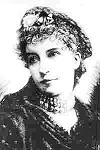 |
Clara Kath Merivale received her musical training in Paris. She returned to England appearing briefly with the Carl Rosa Opera Company in Liverpool and London, then devoted herself to the concert platform. In 1880 she joined the D'Oyly Carte Opera Company apearing in New York, Europe and throughout England. Although contracted to start work with the J.C. Williamson company in July 1889 Clara did not actually take the stage until September. She took over the principal soprano roles from Nellie Stewart. Clara's first season was in Brisbane (Sept 1889) for five weeks. Her first stage appearance was in 'Dorothy'. Reviewers said: "Clara was of pleasant appearance, with a piquant face, a high tuneful voice, and acted in a totally unaffected manner." She set up her own company in 1891 but became insolvent later that year. After this Clara all but disappeared from the theatre scene. In 1895 she applied her talents to the invention of a new kind of soap, 'The Wallaby', which seemed to be popular for a while. |
| Theatre Royal |
'Bridget O'Brien, Esquire' had "gathered together all the old admirers of the widow, and the result that to a great extent the present up-to-date edition of 'On the Bristol' is more entertaining than the piece that has been a perennil production." Reviewers praised the supporting artists of Gracie Whiteford and Alfred James. The season finished on the 27th.
The theatre then passed from the direction of J.C. Williiamson and George Garner to George Coppin. It was then closed for a month during which alterations were made to the auditorium.
| Bijou |
'The Idler' played until June 8th. On the 9th 'The Profligate', by Arthur Wing Pinero, was staged for just over one week. 'Moths' was brieftly revived and the season concluded on the 19th after which the Sydney section of the Brough and Bouccault company returned to play 'Betsy', by Francis Cowley Burnand, followed by the facial comedy 'The Magistrate', by Pinero.
| Princess Theatre |
The Farren and Leslie London Gaiety company returned to Melbourne. They opened on June 27th in 'Ruy Blas and the Blasé Roué'. This was a take off of Victor Hugo�s play 'Ruy Blas'. "Fred Leslie can make a very distorted pun sound passing fair, and his skill at apparently impromptu for business is unexcelled." The production was a success and ran all of July.
| Alexander |
'The Trapper' concluded on the 10th when Carver and the Indians retired. On the 11th 'For the Term of his Natural Life' based on the Marcus Clarke story played for a week. Then, on the 18th, 'East Lynne', the adaptation of Mrs. Henry Wood's novel, played for just a few peformances. The last night of the season (the 25th) was a single performance of Pettitt's drama 'A Royal Pardon'. The company then headed off on a tour starting in Bendigo.
| Opera House |
The comedy 'Run Wild' continued. "Miss Jennie Lee gives us a picture of a bright Irish hoyden with a delicious brogue and a heart overwhelming with love for all her relatives." This production concluded on the 10th. On the 11th, the American drama, 'The Country Fair', by Neil Burgess, opened. The cast includes Abigail Prue, Frank Currier and George Carey. "It is a pity that with such good dialogue, interesting characters and effective scenery the author should have furnished so flimsy a plot." One novely in this production saw real horses racing on treadmills in front of a moving cyclorama. [Editor's note: There was incorrect information over this particular play. The correct title was 'The County Fair' and the author was Charles Barnard (1838-1920). This was written especially for the female impersonator Neil Burgess who was associated closely with the work. Hence the confusion over the author. The first peformance was in New York in March 1889]
| Theatre Royal |
The Theatre Royal reopened on July 25th, after renovations, with 'The Dancing Girl' by Henry Arthur Jones, author of 'The Silver King'. The company, from London, included Laura Villiers, A. Clifton Alderson, May Thorne and Julius Knight. Mr Amory Sullivan, who studied the piece in London, was the stage manager.
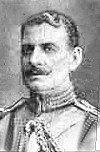 |
Julius Knight (1863-1941) was born in Scotland. His real name was reportedly McFarlane. His first Australian visit was in 1891 with the Laura Villiers company. He returned on four subsequent visits to both Australia and New Zealand between 1897 and 1916 and became a well-known and respected actor turning into a popular matinee idol for the J.C. Williamson company. |
| Bijou |
'Caste' was revived on July 4th and on the 11th the drama 'Diplomacy', the English version of Sardou's play 'Dora', was mounted. On the 18th the popular 'Sophia' returned. "The great attraction of the piece is undoubtedly Mr. Titheradge's impersonation of Partridge." 'Dandy Dick' plays on the 25th and on Friday the 31st the English version of Victorien Sardou's comedy 'Nos Inlimes' ('Peril').
| Theatre Royal |
'The Dancing Girl' continued. "The play runs smoothly enough now but Miss Villiers has not yet raised the part of the Dancing Girl above mediocrity." On the 8th the Jerome K. Jerome comedy-drama 'Woodbarrow Farm' was produced. "Miss Laura Villiers's voice is so monotonous and her gestures so conventional that she fails to bring her part into prominence the author evidently designed it to have." On the 22nd the French drama 'A Celebrated Case', by A. R. Cazauran, was produced.
| Bijou Theatre/td> |
'Peril', the adaptation by Saville Rowe, continued to good houses. "Peril is certainly the wittiest and best adapted of Sardou's plays that has been presented to an English audience." It is successful enough to run for three weeks. On the 22nd 'Devotion', by Dion Boucicault, was presented. "A somewhat disappointing production, for neither plot nor situations show any originality, and the dialogue is but mediocre...Mr. Titheradge gives an excellent rendering of the easy-going valiant man-of-the-world of the 17th century."
| Princess Theatre |
'Ray Blas' continued successfully until Saturday the 15th of August. On the 22nd the Gaiety company gave Melbourne audiences a world première. The burlesque 'Cinder Ellen, up too late' was produced. According to Fred Leslie the cost of mounting this work was around £3,000. "The dresses and the scenery surpass anything ever before presented on the Melbourne stage."
| Opera House |
'The Country Fair' finished on Tuesday the 11th. On the 15th John L. Sullivan, the famous heavyweight boxing champion, appeared in the drama 'Honest Hearts and Willing Hands', by Duncan B. Harrison, who also took a part. The audience at the opening night were some of the most ill-behaved that had ever filled a Melbourne theatre. "The well dressed men in the dress circle had no exccuse for their rudeness in passing jeering comments on the actors, and making such ostentatious display of their disapprobation, as reading a newspapre while the curtain was up." This was probably due to boxing fans having to wait until the very end of the play before the actual boxing match was staged.
| Alexander |
Madame Fanny Simonsen's Italian opera company opened for a season on Saturday the 8th. The opening performance was 'Il Trovatore' which "was entirely satisfactory to the audience, although keen musicians detected various defects, the chief being a want of smartness in the orchestra, which wavered at times, especially in piano passages, and a nervousness in the chorus." Next were productions of 'Martha' and 'Un Balla in Maschera'. 'Lucia di Lammermoor' was performed for the first time on the 29th.
| Princess Theatre |
'Cinder Ellen' finished on the 11th. The Gaiety company then headed for Sydney.
Maggie Moore returned to the Princess. On the 12th, for the first time in Australia, the farcical comedy 'The Late Lamented' was mounted. This was an adaptation of Alexandre Bisson's 'Feu Toupinal' by Fred Horner. This successful French play had been successful in London. "There is not an actor in the cast who is unsuited to the character he or she presents...Miss Maggie Moore is really excellent as the still handsome widow."
However the work failed to draw crowds and finished on the 25th. On the 26th the musical farcical comedy 'Kindred Souls', by William Manning, opened. The performance was "carried through with the vivacity so essential to the success of such pieces...Mr. Snazelle is thoroughly at home in the part of the elderly militia officer, and his singing is very good."
| Bijou |
'Jane' opened on the 5th. "Mr. Cecil Ward, appears to be too concious of the utter absurdity of his part, and wavers between trying to take it seriously and traeting it as a part in a harlequinade...Miss Pattie Browne never fails in her brightness, and appears to enjoy the fun as much as the audience." The play grew in popularity during the month and finished on October 2nd. [Editor's note: Pattie Browne was a popular actress with the Brough-Boucicault Company. She went on to have a sucessful career on the English stage débuting at the Court Theatre, London, in 1893. She returned to Australia in 1898. During a rather rorcus performance in Newcastle she said "I have visited many places, but have had to return to my own country, and to Newcastle, to find
the must insulting audience I have ever met." ]
| Opera House |
'Honest Hearts' terminated on the 4th and the theatre was closed for the rest of the month for renovations.
| Alexander |
Madame Fanny Simonsen's Italian opera company continued their season with performances of 'Lucia di Lammermoor', 'Un Ballo in Maschera', 'Les Huguenots', 'Il Trovatore' and later in the month 'Rigoletto'.
| Theatre Royal |
The Laura Villiers Dramatic Company put on 'Lost in London', by Watt-Phillips, on September 5th. "Although only to be presented for ten nights the scenery and mounting of the piece is admirable." 'Fedora' played on Wednesday the 16th which was the last night of the Laura Villiers company which then headed up to Sydney. This season was a disastrous one for manager George Coppin who was trying to recover from recent bank collapses.
The theatre was closed on the 17th and 18th to allow preparations for George Rignold's production of 'The Merry Wives of Windsor'. This opened on the 19th with George's brother, William (1836-1904), as Falstaff, and Kate Bishop, as Mistress Ford.
OCTOBER 1891
| Theatre Royal |
'The Merry Wives of Windsor' played for the last time on October 9th. On the 10th the drama 'The Lights o' London', by George Sims, opened. "The scenery is perfect, and the attempted drowning of Seth, with his rescue by Harold, was represented with wonderful realism. In its original production in london this work ran for 228 consecutive performances and made the playwright extremely wealthy. The first Australian production was in Sydney in 1882.
| Alexander |
The opera season continued with 'Un Ballo', 'Norma', 'Lucia', 'Ernani' and 'Rioletto'. 'The Barber of Seville' appeared for the first time this season. On the opening performance reviews said: "The performers were disconcerted by the noise the heavy rain made upon the roof...Signor Sisco, as Figaro, is admirable, and his singing and acting arew all that could be desired." There was also a new production of 'La Traviata': "Signora Cuttica rendered the part of Violetta and her singing was admirable, while her acting was considerably above the standard so customary in Italian opera."
| Bijou |
On October 3rd Sydney Grundy's (1848-1914) latest comedy, 'A Pair of Spectacles', was produced. This had a successful season recently in London. It only ran one week. 'Modern Wives', the farcial comedy adapted from the French original, was revived on the 10th. This also only played for one week. On the 17th the comedy 'New Men and Old Acres', by Tom Taylor, played for two weeks after receiving good reviews.
| Princess Theatre |
The farcial comedy 'Our Flat' written by Mrs H. Musgrave opened on the 3rd. "The performers run with briskness from the rise to the fall of the curtain." This played until the 23rd. On the 24th J.C. Williamson appeared back on stage after after a four year absence. The double bill was 'Kerry', by Boucicault, and an adaptation of Washington Irving's 'Rip Van Winkle'
| Opera House |
The Opera House reopened with the Opera Bouffe Company. They mounted a production of Rice and Braham's comic opera 'The Corsair'. Extra performers were hired for both the chorus and orchestra. "The libretto is an amusing medley of puns and comic songs, with a sentimental ballad or so thrown in...Miss Fannie Liddiard dances and sings gracefully."
| Theatre Royal |
'The Lights o' London' continued. "A great deal of the continued favoiur in which Mr. Sims' drama is held by the public is undoubtedly due to the admirable acting of Mr. George and Mr. william Rignold, ably aided as they are by a competent and well trained company." (Table Talk) The last performance was on November 13th. On Saturday the 14th William Bentley made his first Melbourne appearance in the drama 'Rob Roy'. This was originally written as an 'National Opera' by Daniel Terry in 1818. Mr. Bentley's "elocution is good, though his Scotch accent is not always maintained." 'Rob Roy' ran for three weeks.
| Bijou |
'A Night Off' opened on October 31st. This was an adaptation of by Augustine Daly from a German comedy by Von Schouton. "Mr. Brough's professor is a humorous personation and the other members of the company sustain well the interest of the play" On the 21st Myra Kemble reappeared in the farcial comedy 'Dr Bill' "Myra Kemble plays with undiminished piquancy." This played for two weeks.
| Opera House |
'The Corsair' continued successfully at this theatre. The season finished on Tuesday the 10th after which the company headed for Sydney.
On the 11th, and for the following three nights, H.M. Stanley lectured on "How I found Livingstone"
On the 28th George Darrell commenced a short dramatic season. First up was 'Hue and Cry' written by Darrell himself. "As a literary produiction it is more remarkable for its ingenious patchwork than for its originality of plot or dialogue."
| Alexander |
The Simonsen company continued. 'Faust' was played for the first time this season which concluded on the 13th. On reviewing 'Faust' the Age said "This is as fine an operatic performance as has been witnessed in Melbourne for many a long day."
On the 14th the company gave a farwell concert in the Town Hall for "those who do not go to theatres."
On the 21st the Dampier Company opened in a new drama called 'The Great City'. This depicted Melbourne and suburbs which according to newspaper ads was a "sensational drama demanding romatic realism, exciting situations, exalted sentiments, much humorous dialogue of the variety so familiar in comic papers, and a plot, or rather story, of virtue triumphant and villainy vanquished." The Dampier Company succeed in every respect.
| Princess Theatre |
On October 31st the Comic Opera Company commenced their Christmas season. 'The Old Guard' by Planquette opened. Two new faces were in the cast. Local lass, Jeannie Opie, and from London, Allan Morris. Audiences flocked to see their old favourites: "Mr. Elton made his jokes and acted the incidents with such inimitable humour, that even those who knew the point coming could not help but laugh at the development." (Table Talk) This finished on the 20th after which 'The Gondoliers' returned. "Mr. Ryley played and sang the part of Guiseppe on the opening night with verve and close attention to details of singing and acting not always noticeable in his impersonations. As a consequence he was heartily encored for almost every number."
| Bijou |
The successful comedy 'The Silver Shield', by Sydney Grundy, opened on December the 5th. "The dialogue is clever, often witty, and always to the point." On the 12th 'Led Astray', an adaptation from the French by Dion Boucicault, opened. "The comedy is a masterly exposition of character. On Boxing night the Brough-Boucicault Company mounted 'Much Ado About Nothing'. "All the actors were 'letter perfect', the scenery 'set' without a hitch, and the accessories were all in due position...the Beatrice of Mrs Brough is very clever, and her by-play shows that she has studied the part carefully, but her personation lacks light and shade." The Brough-Boucicalu season finished on February 12th, 1892.
| Opera House |
The last nights were announced of Darrell's Australian play 'Hue and Cry'. The theatre then closed for several weeks reopening under the lesseeship of George Musgrove on Monday, February 15th, 1892.
| Princess Theatre |
'The Gondoliers' continued. At several performances the role of Tessa was taken by Selima Osborne, sister of the more famous Ida. On the 5th 'Marjorie', music by Walter Slaughter, was revived. "Miss Marie Elster, the new soprano, made a very successful debút as Marjorie, and gained hearty applause for her really excellent singing." On the 12th 'Iolanthe' was revived on a double bill with 'Charity Begins at Home' and on the 19th 'The Yeomen of the Guard' was produced for a week. On the 26th was the first production of 'The Merry Monarch' with a libretto by Cheever Goodwin and music by Chabrier and Woolson Moorse. The cast included all the favouries, William Elton, Violet Varley, Charles Ryley, Howard Vernon and Sydney Deane. "Mr. Elton's fooling is very entertaining, and he never flags in wit and fun...the music to the Nautch Dance, by Leon Caron, is very much superior to anything presented by Messrs. Chabrier and Morse, the composers of the opera." This had a most successful run finishing on Friday the 22nd of January. The following night 'The Old Guard' was revived followed on February the 6th by 'Iolanthe' on a double bill with the popular 'Charity Begins at Home'. The cast included the favourites Howard Vernon, Sydney Deane, Henry Bracy, Charles Ryley and Flora Graupner. The Argus said "The performance was an entire success nandin addition to frequent individual encores the finale of the first act was re-demanded."
| Alexander |
'This Great City' continued to draw large audiences. On Saturday the 12th 'East Lynne' was revived yet again.
A few performances of Mozart's 'The Marriage of Figaro' were staged during the pre Christmas week by a local operatic company.
On boxing night 'Jack the Giant Killer; or, Harlequin Fe-Fi-Fo Fum, the Demon Spider and the Fairies of the Silver Lake', adapted by Garnet Walch in collaboration with Alfred Dampier, who stated that he spent £5,000 on this production. Rose Dampier played Princess Laughing Eyes, George Dean played the Dame and Aggie Kelton "makes Jack a most charming and attractive youth. She is always singing, dancing, or looking pretty, and many of her songs are very much above the average of topical songs." (Table Talk)
| Theatre Royal |
'Hamlet' opened on Wednesday the 2nd of December. "Very seldom indeed has the great tragedy been so well presented" Walter Bently's fine performance only lasts a week. On the 7th the drama 'The Bells' is mounted. "Mr. Bently ranks amongst the best actors of the day." Victor Hugo's 'The Fool's Revenge' opened on the 15th for five performances only. "As Bertuccio Mr. Bently brought into prominence the serious side of the character and altogether ignored the fact that he was also a jester." The Bently season closed his season on Monday the 21st with one performance of 'Otello'.
On Saturday the 26th the pantomime 'Whittington and his Cat; or, Harlequin the Demon Rat and the Good Fairies of the Bells, Picked Up and Put Together by a Very Old Hand and One of his Gals' was produced. This featured, from England, the music-hall performer Billie Barlow as Dick: "She is never at a loss to amse the audience and keep the performance going." (Table Talk) The other principals included Edith Vane, George Walton and J.R. Greville.
| Theatre in Melbourne 1890 | Theatre in Melbourne 1892 |