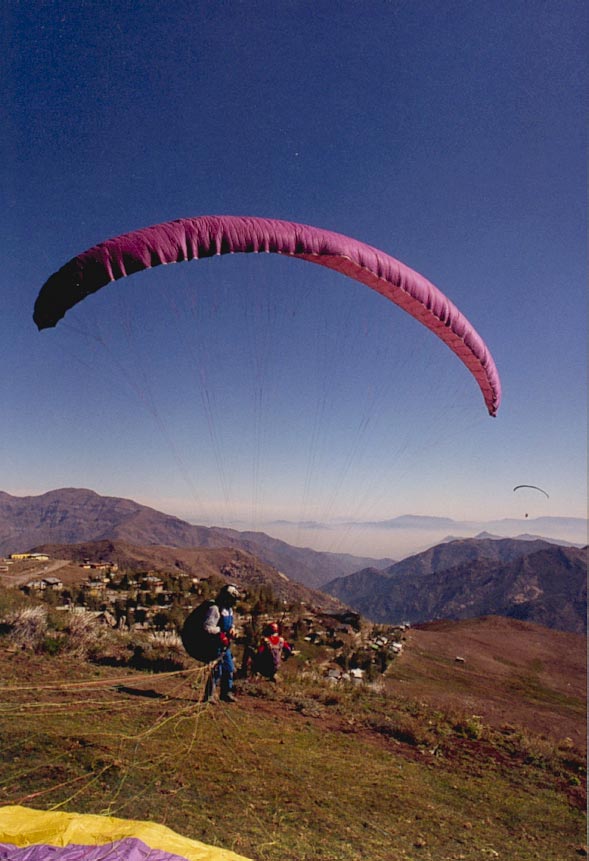
City: Santiago.
District: Lo Barnechea.
Location: Andes Mountain Central Area, 40km from Santiago.
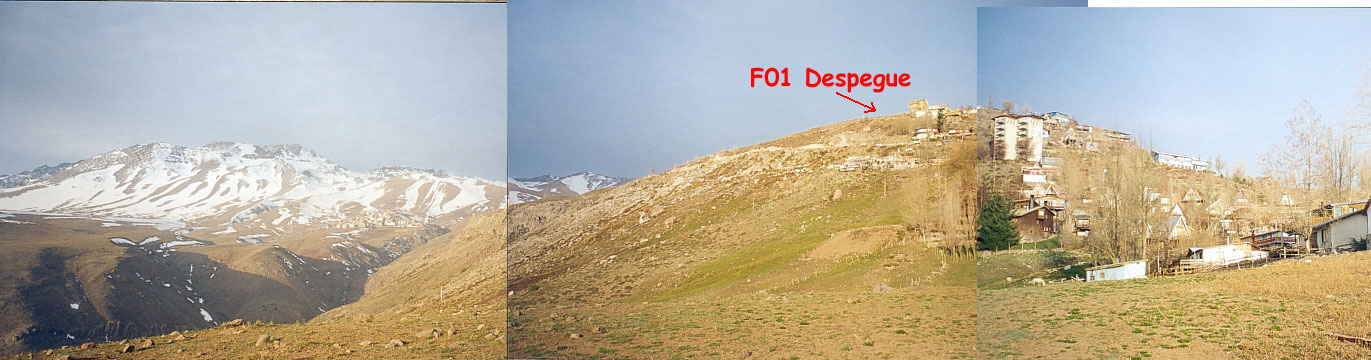
Launch:
Type: Room for two wings in separate spots, dirt surface and small bushes. , (Meshes available during the meeting)
Slope: lay-out and lift area with soft slope. First 20 m increases progresively with somewhat irregular terrain, then falls abruptly before the dirt road.
Orientation:WNW
Altitude: 2500 m (8200�)ASL
Elevation from landing (F02): 114 m (370�)
Prevailing wind in Launch: Valley Wind WNW, general wind WSW
CALLNAME: F01
Coordinates WGS84 (HDD/MM):33�20.958� S / 70�18.382� W
Comments:
Precautions:
Official Landing:
Type: Wavy outline , grass and dirt, suitable for hanggliders and paragliders.
Slope: Falls slightly and progressively towards the North.
Altitude: 2386 m (7820�) ASL
Prevailing wind: West
CALLNAME: F02
Coordinates WGS84 (HDD/MM): 33�20.945� S / 70�18.703� W
Comments: It is reached easily with minimal glide ratio since its immediate to the Launch, it has a slight wind gradient and is thermal active during peak hours.
Precautions: Not recommended with strong or SW wind, streams run down the NW face of the hill from the launch close to the landing area and also further W from the landing spot.
Farellones is a High Mountain Flying Site, that means, necessary considerations are to be taken prior to initiate flight, such as: 1-Most Launch and landing altitudes are above 2000m (6500�) ASL. Due to density reduction one must consider that all flying speeds will exceed 10% respect to the ground (It depends also on the temperature but, paragliders will average 42 km/h trim speed instead of 38 and will stall at 23 km/h instead of 21 at the same brake input).
2-There must be a basic understanding of micro and macro mountain meteorology and/or be thoroughly counselled by pilots that know the area and its conditions extensively.
3-There is a risk of Hipoxia due to consistent flying above 3000m (10.000�) and/or doing it in a inappropiate physical condition.
4-To take advantage of lift, is required experience in thermal flying and its associated active piloting skills specially at peak thermal hours, basically because is the main source of lift, ridge soaring is left to late afternoon flying. .
The upside of flying in such a place compared to deep in valley flying in Chile�s central area is that it allows early morning flights with smooth well organized thermals and light winds, this is mainly because most thermal sources and triggers are above the normal inversion layer, as oppose to valley flying, whereas quite some time must the surface be heated in order to brake this layer, and this is finally done usually at peak activity and wind.
Routes and landings.
The Launch and official LZ are located above a plateau split by two ravines at each side, el Manzanito creek and the Molina River (Cepo Canyon). Despite the low difference in height between the Launch and LZ, the good thermal active plateau allows lift to be accessed on a rather regular basis, besides theres a NW local wind established early in the morning.
The official LZ F02 is suitable for most conditions, however it is suggested to consider alternative landing F04 (road to V.Paulina) in case the wind picks up during flight, specially if it comes in a SW or S direction.
A normal flight right after take off consist of house thermal seeking along the ridge and away from it. It is not recommended ridge soaring unless is made in late afternoon and glass off on a normal day.
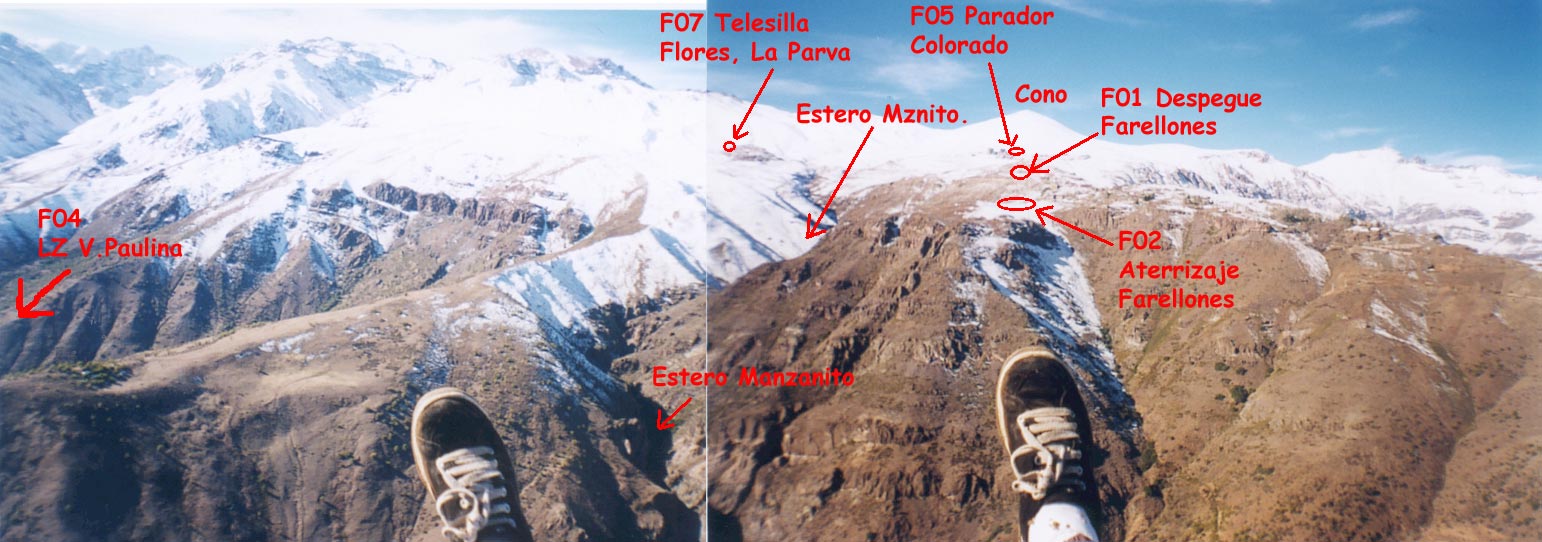
As it is seen in the picture (up) , in order to reach LZ F04 it is necessary to store some height (a few meters) above launch so to assure a safe crossing over the ridge that separates el Manzano Creek and Yerba Loca Canyon (V. Paulina). This landing is for paragliders (+30� slope) and works well with high wind and at peak thermal hours.It concentrates the W wind in an relatively ample area (it has 700m (2300�) difference in height with launch so its a fun sled ride too!). It is advised not to make unnecessary crossings above the mentioned ridge, let alone hovering above it, since it triggers a a rather nasty bullet thermal not much worthwhile to turn.
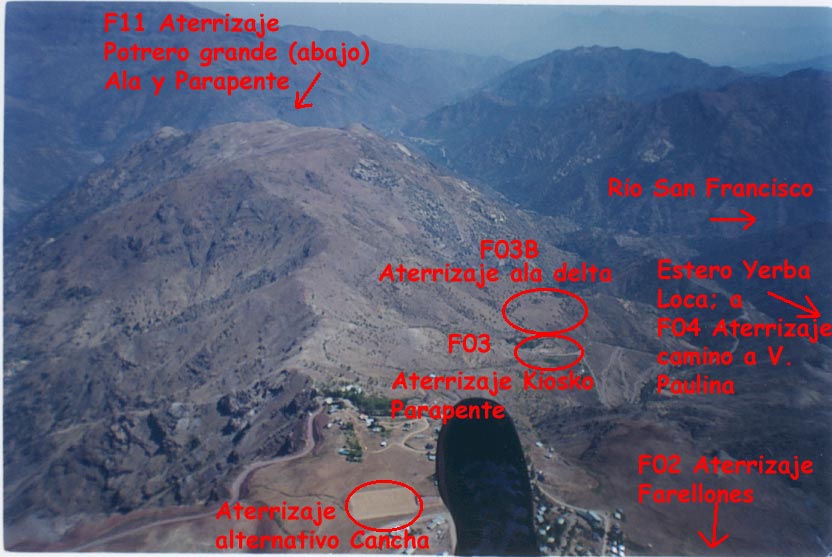
The following picture shows alternative LZs; El Kiosko "F03" (the stand) for paragliders and "F03B" for Hang Gliders; both serve in case of descending below the plateau towards the West.
On the lower left corner is the alternative soccer field LZ displayed on the left side of the village which is more exposed to SW wind.
The arrow on the right indicates that in that direction is found LZ F04 (1 km E).
F11 LZ Potrero Grande is the lowest lz alternative, it requires to depart towards it with sufficient height to be able to safely circle the last W end of the main ridge, normally it is used when low in the area (la hermita).
. Existent flying conditions ar prone to generate more thermal unstable days than in the valley, normally a thorough observation of wind speed , direction and buoyancy early in the morning (plus the local birds) gives an idea of what conditions to expect (accompanied by appropiate forecast information). after noon the thermal activity increases and W wind begin to establish, as long as it doesn�t go stronger than, say 20 km/h , thermals will continue to be well organized. In unstable conditions after a cold front the wind tends to keep calm as the day goes on, and spite wind increase thermals mantain themselves organized with cumulus formation later in the day. Ceilings vary from 2800m (9200�) to +4000m (+13200�) but normally +3000m (+9900�) is reached. over 2700m (8900�) is usually an important wind direction change and slight wind shear found, with no important turbulence. There is a local circulation effect normally in action that sets a mountain flow above the mentioned height, also mountain wind at surface level is found late in the afternoon and keeps going during night , stopping at dusk,(unless there is still an important area covered with snow, which tends to delay the onset of valley flow at surface).
Morning take off:
As oppose to valley windy take offs that local pilots are used to, take off in ideal conditions in Farellones involves light or calm wind take-off technics. It is recommended to watch thermal cycles and to seize the first soft inflow when it goes by the launch area, thermals off the ridge and the ones closer to launch tend to lift at the same time, so it is a good time to make use of this aid to lift the wing and take off to seek the thermal away from the mountain. Often, although this launch breeze might still blow, deciding to take off when the pilots already airborne have gained certain height above launch, means to have a quick journey to landing. It is suggested to wait �till the cycle anew itself before taking off.
Anyway coming back in vehicle takes no more than 5 minutes from F02, so it wouldn�t be such a drag.