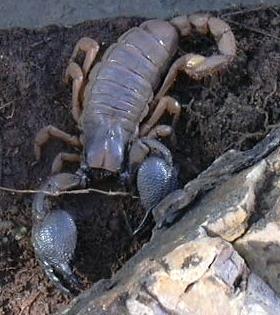
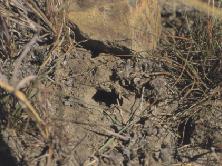
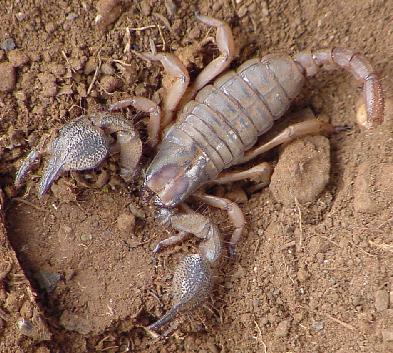
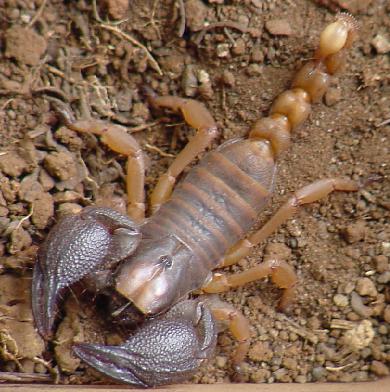
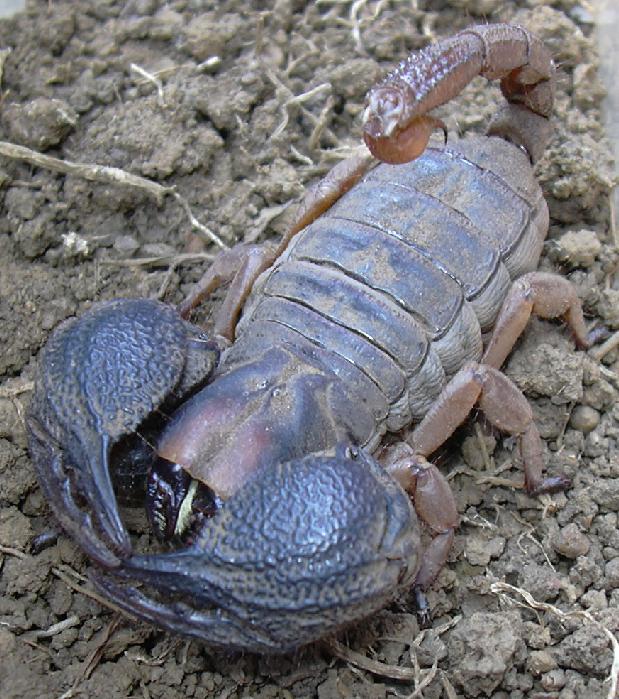
Burrowing scorpions (Family: Scorpionidae) are among the biggest scorpions encountered in South Africa. They are distinguished by their robust chela which have interlocking "teeth" on the fingers. Their burrows vary from species to species and depth is dependent on the substrate, but generally they have oval entrances and descend straight at an acute angle for approx 6cm before turning sharply or even spiraling. Often during excavation, they will collapse in on themselves, thwarting would-be predators and of course, clumsy collectors! Depending on the species, the entrances may be in the open, or at the base of rocks or logs. This Genus is unique in that its members can "hiss" by rasping their chelicerae together within the carapace. This is called stridulation and this gives them a fierce appearance, but they are slow to sting (although a nip from the pincers can be excruciatingly painful and can even draw blood). For the most part, prey is crushed in the powerful pincers, obviating the need to sting as well. Their venom is painful, but not life-threatening. Generally, females are more sedentary than males, preferring to remain within the same burrow for as long as is comfortable, while males are more peripatetic. Presumably they make "house calls" on the females in breeding season :).
As a rule of thumb, males tend to be more slender, with narrower pedipalps than females.
In some species they are dramatically elongated. Clues to sex may also be gleaned from
the burrrow without excavation - the size of the entrance and the amount and condition of
the food remnants in and around the burrow may indicate the length of occupancy. |