| McGRINGO's SCORPIONS |
| HUNTING BURROWERS |
| Burrowers are very common throughout South Africa. As they tend to be on the large side and are not highly venomous, they make good display specimens.Burrows vary from species to species and depth is dependent on the substrate, but generally all have oval entrances and descend straight at an acute angle for approx 6cm before turning sharply or even spiraling. Often they will collapse in on themselves, thwarting would-be predators and of course, clumsy collectors! The entrances are frequently concealed below rocks or logs. Generally an "active" or occupied burrow is free from obstruction e.g. cobwebs and frequently debris from past meals, e.g. beetle wing casings, millipede sements is scattered in or near the entrance. Turning over a rock often exposes the shallow corridor that leads from the burrow proper to the open air. Often the scorpion will use the underside of a rock as a kind of "ceiling" before excavating downwards and sometimes, if you are lucky, rolling over a big rock can reveal the entire burrow in cross section, with a surprised and angry scorpion at the end! |
 |
 |
 |
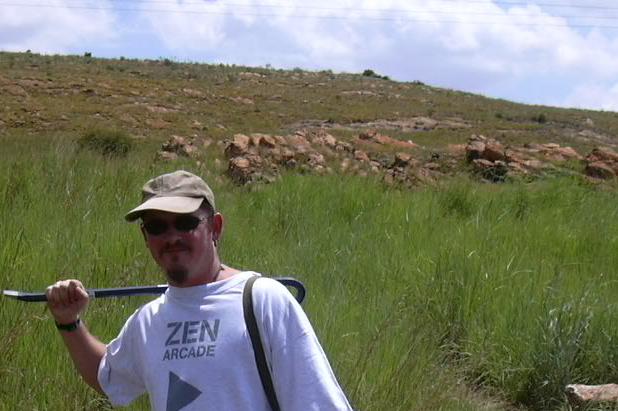 |
| Lovely weather for it! On the "koppie" in Melville, Johannesburg. Note rocky hillside - Opisthophthalmus pugnax burrows found throughout the veld (starting immediately on the other side of the long grass behind me) and as far up the hillside as the "X". Hadogenes gunningi encountered from dotted line all the way up to and incuding the top of the ridge. |
| ..................................... |
| X |
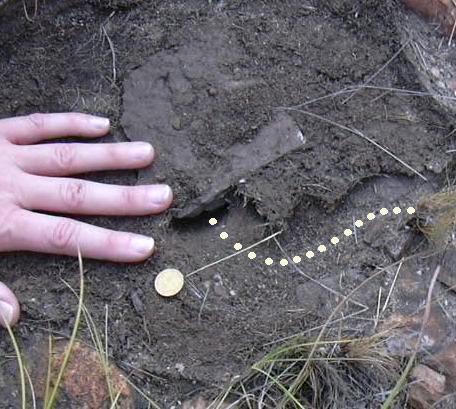
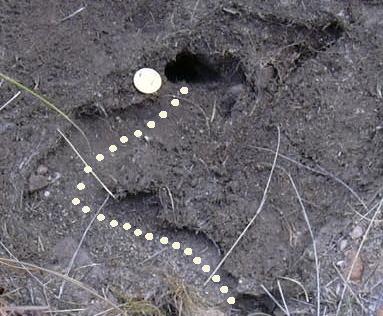
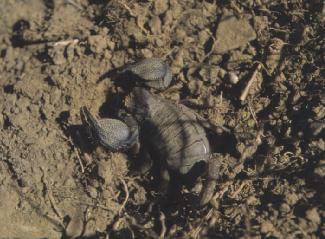
| Rolling over a rock reveals an O.pugnax burrow, elliptical shape clearly visible, with a well used corridor from the burrow to the open air indicated by the dotted line. Note that the burrow descends under another, flat rock. Lifting he second rock conveniently reveals a cross-section of the burrow, turning sharply right (pretty typical). The scorpion is only 5cm deeper, at the end of the burrow - an easy capture! O.pugnax scrambles indignantly out of the sand. Note that in most cases, you don't get so lucky - you have to dig the entire burrow a centimetre at a time. |
| 1. Identify an active burrow. 2. Remove any extraneous debris to clear a working space. 3. Gently insert a straw to determine the depth and direction of the first turn. 4. Dig carefully, continually confirming direction and depth with the straw. 5. It's a good idea to leave the straw in position as you dig, as the burrows frequently cave in - there's nothing more disappointing than losing a burrow in mid-dig! 6. I haven't tried it yet, but I read a suggestion that if you pour a trickle of water down the burrow, it helps compact the soil and makes it easier to stay on track. 7. When you uncover the scorpion, first get your container ready and then gently chivvy the scorpion into it. Alternatively, use surgical forceps to lift it by the tail and place it in the container. 8. Place the container in a dark bag, and keep it in the shade. |
| DO observe conservation laws and respect your environment at all times.DO be gentle and patient. DO replace rocks and other debris as you found them - they have their own microhabitats to support. DO be observant, you may pick up clues that will assist you in subsequent hunting. DON'T jab straws or anything else into the burrow. DON'T stick your finger into any hole - if you do you're just asking to be stung or pinched - or bitten, if the burrow has a different occupant e.g. a snake or spider. DON'T dig blindly - you will injure or kill the scorpion. Rather take it easy and enjoy the anticipation. DON'T rock stones to shift them - you'll crush whatever's underneath. Rather take a crowbar and lift rocks in one clean movement. DON'T reach under rocks - you don't know what might be there. DO lift rocks from the far edge and roll them towards yourself - you don't want to be standing between a cobra and what it perceives as the Exit. DO have a container handy and open already, so that you can bag the scorpion as quickly as possible without stressing it out. There's usually a few seconds before the scorpion decides to make a run for it and that's the time to grab it. DO use surgical forceps to handle Buthids. DO try to catch some of the local delicacies, e.g. millipedes, grasshoppers, beetles etc. DON'T be greedy - it's senseless and immoral to destroy local populations! DO release any specimens you don't absolutely, positively have to have. |
| METHOD |
| DO'S & DON'TS |