 |
|
|
|
|
|
|
|
|
|
|
|
|
|
|
|
|
|
|
|
|
|
|
|
|
|
|
Todays Golf Balls |
|
|
|
Golf ball technology has expanded by leaps and bounds in the past 20 years. Polymers have changed the golf ball drastically. Polymer, meaning many units, is a repeating structure, often with a carbon backbone. The repeating structure of a polymer results in chain like molecules. |
|
|
|
 |
|
|
|
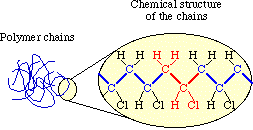
This shows how polymers are structured and notated. |
|
|
|
 |
|
|
|
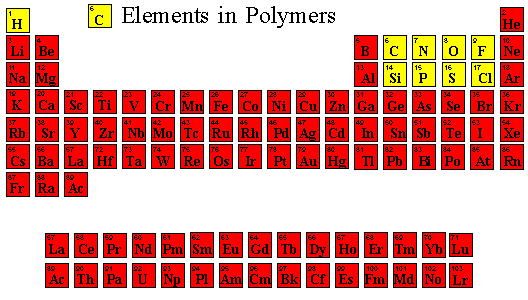
This Periodic Table of Elements shows which elements show up. Most of these elements are highly reactive which is why many of them show up in polymers. |
|
|
|
Video of Polymer Being Formed |
|
|
|
More Info on Polymers |
|
|
|
Polymers are very useful in golf balls they are corrosion resistant, easy to process at low temperatures, and generally inexpensive. They are very tough which, in golf, is a good thing because of all of the contact a golf ball endures. Todays balls have a shell made of a cut-resistant ionomeric polymer resin. Many ball cores are made up of polybutadiene, an elastomeric rubber polymer. Elastomers are long polymer chains above their glass transition temperature. They are crosslinked and can be easily deformed. They can be streched out but always return to a randomized state. The elasticity of the core directly impact the velocity of a golf shot. |
|
|
|
 |
|
|
|
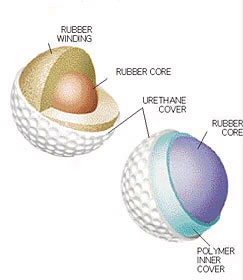
Two examples of ball cross sections. The major difference between the two is the layer between the cover and the core. One is wound and the other is a polymer inner cover. |
|
|
 |
|
|
|
|