
Reli
gions of Nepal
|
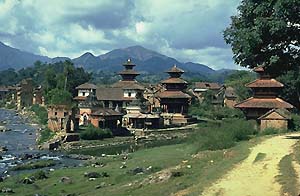
Hinduism and Buddhism, the two coexist harmoniously in a fusion of faith that is unique to this country. Hinduism is a guide to a virtuous life and a structure for social relationship rather than a formal "church". It originated nearly 4000 years ago with aryan peoples' who migrated to India from the vicinity of present day Iran. These people revered the force of nature personified by inumerable gods and goddesses whose activities and moral guide lines are cronicled in prayers, hymns and poetic sacred epics of great antiquity. |
|
|
At the heart of Hinduism is belief in a life essence and a common soul, atman, in which all living thigs, and a in re-incarnation, the soul's rebirth after death in another form. What the next form will be dependence on the some total of a person's action in his previous life, his karma. Following rituals such as purifying baths, making offering to the gods and honouring them in festivals will lead to reincarnation in a higher form. The highest is liberation from the nuisanse of repeated rebirth in this imperfect world. Most Hindu temples in Nepal are dedicated to the great gods Vishnu and Shiva or their consorts and offspring. Over the doorway is a semi circular panel called a torana with images of the resident god to help you identify who's who. Vishnu is a presever of life; Shiva is a destroyer whose destruction makes a new beginnings possible. The third member of the Hindu within "Trinity" is a Brahma, whose only task was to create the world. All this would be simple enough but for the fact that the gods have a appeared on earth in different incarnations, or avatar, with different names, forms and natures. Some even assimilate Buddhist and premitive non-Hindu local deities. |
|
Hinduism
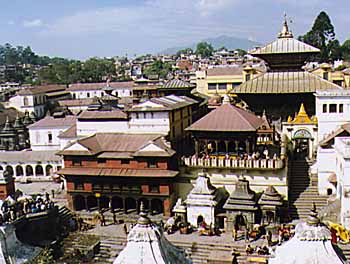
For the many Hindus who visit Nepal, the greatest attraction of this country is the temple of Pashupatinath. Pashupai, Lord of the Animals, is an aspect of God Shiva, beloved among the Hindu gods. His temple in Kathamandu is among the four greatest Shaivite pilgrimage places in the world, and must be visited at least once in a life time. |
|
|
The worship of Lord Shiva in this place dates back into unknown times. The present three tiered temple of Pashupati, lying along the holy Bagmati River, is more than three hundred years old. Surrounding it is a forest, long a dwelling place of religious mendicants. The temple complex stretches for half a kilo meter along the river banks and on the stone paved ghats the dead are cremated and the living offer prayers. There are lingams, ar phallic representations of Pashupati, shrines and status - some of which are more than a thousand years old - scattered throughout the complex. Every year thousands of people travel hundreds of miles to offer their prayers to Pashupati, especially on the festival of Maha Shivaratri. Although non-Hindus are not allowed inside the temple complex, many of the activities going on inside may be observed from across the Bagmati River. |
|
Buddhism Siddhartha Gautama was born a prince in the line of Sakya Kings in the sixth century BC near present day Lumbini. As a young man he was seltered from the harsh realities of life, until oneday he saw a sick man, then an aged blind man and finally a body being carried to burial. |

|
|
Proudly shaken, he left his wife and a small son and became a wandering begger, searching for the meaning of existence. But the life an ascetic and the wisdom of Hindu teacher stii did not satisfy his quests. Finally, seated in meditation beneath a peepal tree at Bodh Gaya in India, the "four Noble truths" were revealed to him. He became the Buddha, enlightened one, and embarked on travels to spread his beliefs. |
|
Buddha never claimed to be divine and infact emphasised that all men could by their own efforts follow his path too enlightenment the blissful state of Nirvana, released from the cycle of repeated birth and deaths. His "four noble truths" are : all life is suffering; suffering is caused by desires; desires can be supressed; and the way to be come free of desires is to follow eight "right" principlas-the eightfold path. These are right views, right intenion, right speech, right conduct, right livelihood, right effort, right mindfulness and right contemplation. After the Buddha's death at the age of 80 Buddhism eventually split into two main lines, those who sticktly followed his teachings, the Therveda or Hinayana school of Sri Lanka and south east asia and those who allowed new interpretation, Mahayan Buddhist of China, Japan, Korea, Tibet, India and Nepal. The Mahayana allowed whorship of Buddha and recognized other holy figures. This include a number of other Buddhas, to be approached for favour through mediation and saint like Buddhisattvas who achieved enlightenment but remained active to help human kind find the right path. In Nepal, Bodhsattvas often seems to blend with Hindu god and resemble them. |