
Legends of a Lake
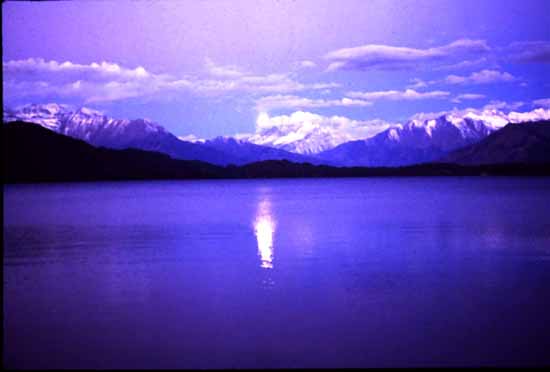
| Rara Lake lies in the Mid-Western Region of Nepal, in the heart of the district Mugu, glittering like a precious gem, set in an emerarld place of pine forests and distant snowy peaks. Mugu has long have been a forbidden land to the outside world, enclosed to the north by the peaks of the high Himalaya and to the south and west by the deep waters of the Karnali River and its tributaries. |
|
|
Rara Dahal is Nepal's largest lake (daha), lying within its smallest national park, Rara National Park. To the south of the park is the Sinja River, and to the north the Mugu Karnali, both flowing into the wide Karnali River which gathers the waters of Mid-Western Nepal and carries it to India. The lake lies among medium-sized (for Nepal) mountain ranges known as lekhs. The waters of Rara reflect the peaks of Ghurchi Lekh, lying to the south. To the north, across the Mugu Karnali, is Chankheli Lekh and in the distance to the east one can see the craggy peaks of the Sinse and Kanjirobi Himals.
The trek to Rara is one of the shortest major treks and one of the most lovely. One can fly from Kathmandu via Nepalgunj to Jumla with relative ease, and from there it is only three to four days to the lake, sitting amidst the pines at about 3,000 meters elevation. The westerly of the two alternative routes from Jumla takes one through the village of Sinja, once the summer capital of the Khasa kingdom which ruled much of western Nepal five hundred years ago. Unlike many of Nepal's lake such as Gosainkund in the mountains north of Kathmandu, Rara is not a pilgrimage place. But like most pilgrimage places, Rara is a place of myth and legend. There are two local legends about the naming of the lake. In the first, it is said that a king (supposedly of the Thakuri name) came to settle on the northern side of the lake. The lake was named Raja Daha, meaning King Lake which in the course of time became loosely pronounced as Rara Daha. A second legends attributes a rather peculiar origin to the name Rara. A group of Hindus came to settle in the vicinity of the lake. They conducted their worship by sacrificing goats, which they would singe, or burn, with straw and leaves beffore cooking. In the Tibeto-Burman dialect of the Bhotia people of the vicinity, ra means to goat and raa means to burn. Thus the word raraa was coined, which after a while came to be pronounced Rara. One of the most-told legends is of recent vintage, a new addition to the mytho-history of this strange and beautiful place. No one knew, it is said, the depth of the lake. One day a foreigner came to Rara to measure its depth. He bought seven water-buffaloes, slaughtered and skinned them, made a rope of the hides and tied a big stone to it. He let the rope sink into the water but it never reached the bottom. (So much for another develoment project ! ) Science has since managed to come to the bottom of the matter, or of the lake to be precise. According to an article in the Gorkhapatra newpaper dated July 13, 1983, the depth of Rara was measured with an echo-sounder by Hydeo Tawata, a professor at Japan's Kyoto University. It was found to be 167 meters deep. Of course no site is complete without its myth of origin," and Rara Daha has a couple. Legends has it that once a sage was passing through a village in Mugu and stopped by a cottage to beg for food. The old woman of the house was at that moment very busy with her housework and did not respond to the sage's deand. "Charity is a great virtue," he said, and repeated his request. But the old housewife, irritated at being disturbed, turned a deaf ear. The sage became angry with the housewife and told her that he would break open his own head if she would not give him alms immediately. The woman was angered in turn and shouted at the sage, "what does it matter? Go ahead and break it !" To the astonishment of the old lady, the sage broke his head into a thousand pieces and immediately the village was converted inot a lake and the villagers, old woman included, were transformed into aquatic animals. A more gentle legends also tells of the formation of the lake. Once a sage arrived in the village of Rara and made his rounds of the houses begging for alms. The people were busy tilling their fields and did not pay heed to the sage's request. However, there was a poor woman in the village who had no lands to till. She gave the sage shelter but, returning from her store room, apologized that she could not offer him food as she had no food in the house. The sage told her to return to the store and check once again. When the poor old woman checked, she found plenty of food there, although a minute before there was not a single grain of rice. The sage sent the virtuous woman to settle in a nearby village. He then poured somedrops of magic water from the water pot which he carried. In the twinkling of an eye, the village was instantly changed into a lake, drowning all the selfish villagers. Legends such as these, of irascible sages rewarding the good and punishing the bad, are common in the South Asian tradition,. and the legends of Rara are no exception. Visiting Rara Lake, one will be enchanted by the silence and the beauty of the surrounding hills, and over a hot cup of tea on a chily moonlight night one will easily understand how such a place gives rise to the supernatural and mythological. |
