Mirrors & Lenses/Diffraction &Interference of Light by Mindy·
Menu·
Mirrors and Lenses
- Intro to Mirrors
- Concave Mirror
- Convex Mirrors
- Parabolic Mirrors & Spherical Aberation
Have you ever wondered how mirrors work? We look at ourselves in the mirror, but we never pay attention to how the light reflects. When we look at ourselves in the mirror, we see our image ina plane mirror, which is a flat, smooth surface that reflects light ina regular way. Do you also know that we are the object. An object is a source of diverging light rays, most of the time its illuminated. An illuminated object diffusely reflects light in all directions.
A concave mirror is caved in and it is in the inner surface of a hollow sphere. The radius of the sphere is perpendicular to each mirror. This is why a ray reflects with equal angles of incidence and reflection when it hits the mirror. Since the sun is a source of parallel rays, all the rays will be reflected through a point by the focal point because the principal axis of a concave mirror is pointed at the sun.
A convex mirror is a spherical mirror that reflects light from its outer surface. These are diverging mirrors because the reflected rays spread apart. Convex mirrors form immages that are small in size, but reflects an enlarged field of view. The outside bottom of a spoon and rearview mirrors are convex mirrors.
Parallel rays only converge at the focal point of a sherical mirror if they are close to the principal axis. The image that the parallel rays form in a large spherical mirror is a disk and this is called spherical aberration. Parabollic mirrors don't have spherical aberration, but these mirrors can produce the parallel beans of light in car headlights and flashlights.
- Types of Images
- Virtual Images formed by Concave and Convex Lenses
Concave Mirrors can form real and virtual images. If rays converge and pass through the image its a real image. A virtual Image cannot be projected on a screen or captured on a piece of paper because light rays do not converge at a virtual image.
The image of an object closer than the focal point of a convex lens is virtual, upright, and enlarged. Magnifying glass is a convex lens. The focal lenght of a concave lens is negative. These lenses produce virtual images from real objects. Concave lenses are used in eyeglasses to correct nearsightnedness.
- Intro to lens
- Types of lens
- f=focal point
- do=distance of the object of the mirror
- di=distance of the image from the mirror
- References
- Internet Sources
- Magazines
- encyclopedia
- Popular Photography &Imaging
- Merrill-Physics Textbook-Principles and problems
Do you know that lenses are the most useful and important optical devices. A lens is made out of see-through material like glass or plastic, witha refractive index larger than that of air.
A Convex lens is a lens that is thicker at the center thtan at the edges. Convex lens are converging lens because they refract parallel light rays so that they meet. A Concave lens is thinner in the middle and it is called a diverging lens.
The Lens equation can be used to find the location of the image and the magnification equation can be used to find its size

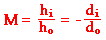
The ratio of the size of the image =hi to the size of the object=ho is called the magnification
If di and do are positive, then m and hi are negative, which means that the image is inverted
