|
When
we are talking about history of Molos, then we must know that Mastino
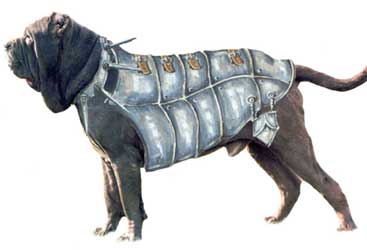
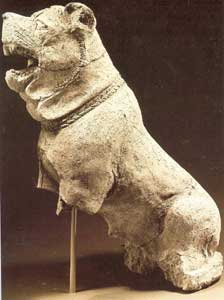
is the most recognizing live “antic” of that history. Neapolitan Mastiff, Mastino, “’O CANE ‘E PRESA” or simply “Neo”, is the “incarnation” of all those mysterious past and legends that are existing even now days. In the honor of all this, sincerely and with deep respect to all that we inherited, we must be very careful that our “Ego” don’t reinforce too much and that we don’t become some new powerful creators of “dolls” and that in return we throw dust to all those values which were, millenniums, the base and value of this noble Giant. Mastino history is extended over the smallest pores of ancient civilizations, but we will mention it form Alexander the Great. Royal family in ancient Epirus was called “Molos”, and there from was a king’s daughter Olympia – mother of Alexander the Great. Princess, according to stories and sagas, was breeding large defensive dogs which were very appreciated, respected and expensive. Alexander took these dogs with him in war campaigns, mostly as warriors and guardian dogs of equipment and soldiers. Conquering the Far East, Persia exactly, Alexander gets from their king, as a gratitude sign two females (2) of “fighting” dogs, who were according to inscriptions half dogs and half tigers. Trying the fist female Alexander was not too trilled, because of hers uninterest in fighting with bear. On suggest of Persian king that the opponent should be more inspiring, Alexander releases the second female first on a lion and then after a good done “job” on an elephant. Pliny (Pliny the Elder’s-“narurals Historia” book 8 ch. 4 AD 70) further say that a female had such a good tactic that after a long tiredness and escivating she went for a deadly attack, because the elephant was very exhausted! Overjoyed Alexander mates his warrior – guardian dogs with these fighting females, and here comes our Mastino! Later, in the ages of Rome this dog again becomes very popular and it is known that in the time of Diocletian were extremely popular fights of Mastionos with gladiators and beasts. Caesar used these dogs in conquering Gallia, we have thousands of inscriptions from that time. Quite later, in 1735 Buffon expressly mentions the dogs from Epirus as among the strongest and most powerful dogs in the world, “on s’en sert pour tires des voitures”. There are different meanings and opinions about the origin of the word “Mastino”, but the one closest to us and the one most acceptable is that it leads from Celtic word “MAS” – house and “TUIN” – guarding. So, this term is used all over Europe and world. One of the oldest appellation “Mastino” we meet in the year 1309 by Marco Polo on Toscana’s language. Some time later, Dante also in his book “Inferno” mentions this dog and how before mastino have never been seen dogs with such skill in chasing and hunting lions. At the same time Backache uses the same term in similar outline. It is not perchance that this dog is even today called on Neapolitan dialect “ ‘O CANE ‘E PRESA”. In the second half of XV century Neapolis was under Spanish administration. Even today in Neapolitans museums and churches there are many figures, sculptures and drawings from the late Middle Age, on which is shown a dog that indescribably looks like Neapolitan Mastiff. It’s very hard to put such distanced and rich history of this dignifying Giant in few lines, but we must mention begins and history of breeding. In the bottom of Vesuvius, around Neapolis all the way to Avelin, there is an ancient tradition about Mastinos. Among the peasants were and are exchanging dogs. These dogs were kept for centuries and rarely sold. Dog of Neapolis belongs to its inhabitants as Vesuvius, nut or vine does! Who is presenting himself as a non-Neapolitan and writes about these dogs, will have problems, as someone who tries to infiltrate in the old holy books of some nation. Who truly wants to know Mastino least he needs to do is to visit and know Neapolis, Vesuvius and the inhabitants of that region. Today, on our modest opinion this descendant of glorious ancestors has an extraordinary utility value while guarding the area and master. His intuitivity is fascinating and every mastinoman knows how much is this colossus faithful and loyal to his master and family. Mastino don’t need any working dressage or going to “camp-trainings” (he consider it as a betrayal from his master), because everything he needs is nearness of his master and love. With this contact, with firm authority, we come to actual results. With passive observation, of his genetic code history, we can successfully modificate trainings to his “lissom built” and come to fascinating results. Talking about modern Mastino and not mention dr. Soldat, and then dr. Piero Skanciani would be a real pity and shame. The first gentleman wroted and fighted for real standards, while Mr. Skanciani (the old breeder of English bulldog and boxer) wroted that the breeding foundation of Mastinos are female PACCHIANA and male GUANGLIONE. Later Piero manage o buy (after many attempt) Guanglione and he becomes the first official Mastino champion. Here we have to say that all today’s Mastinos don’t come only from this pair (as lots believe), yet the breeding foundation was this famous pair. Later, appear breeders and so the lines of Mastinos, but we won’t mention anyone particular, we will only say that from 1991. are held once a year a specialty show of Mastinos under the name ATIMANA. |
|
|
|
|
|
|
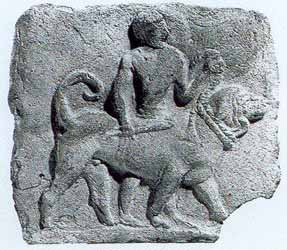
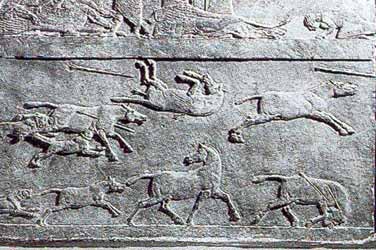 Assyrian Hunting Scene, 700 BC |
|
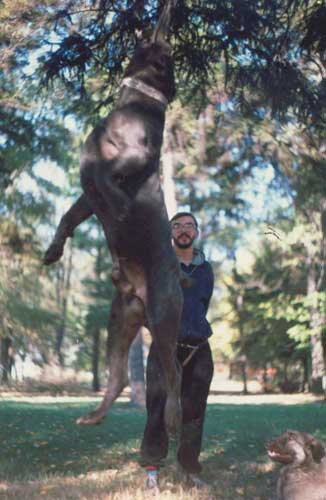
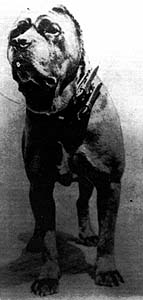 Guanglione |