Traditional Kobudő
Okinawan Weapons
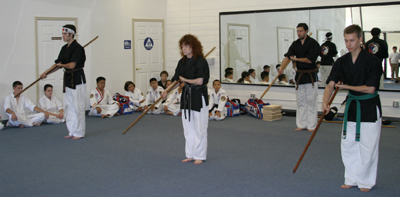
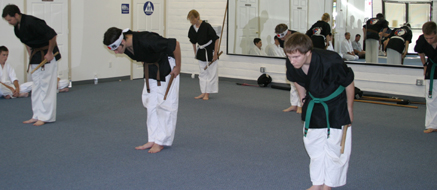
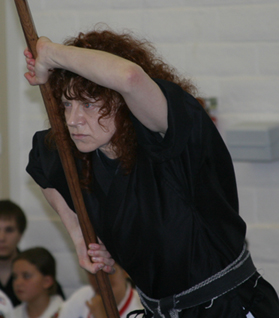 Kobudő means "ancient martial way" and refers to the practice of martial art weapons, as opposed to "empty hand" or "kara-te." This is a traditional martial art weaponry system from Okinawa, Japan. It stresses factors of practical application as a defensive art, fitness and health, and based on the yin-yang philosophy of the Orient. Almost all of those weapons come from common farmer tools (or fishermen tools, such as oar), with the exception of the sai. For example, the nunchaku, as a farmer's tool, was used to remove the outer shell from the soybean; as a weapon, it also protected life.
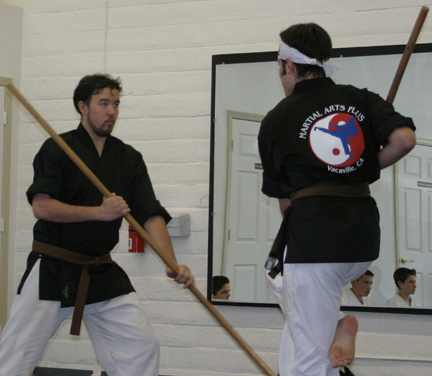
The techniques are powerful and speedy, each move designed for efficiency of motion and efficacy of power. The discipline, manners and physical fitness that is indigenous to the traditional karate taught at this school is also part of the kobudő training. A student is able to progress in belt ranks, just as in the karate system. The system consists of twelve weapons: the bo (staff), nunchaku, tonfa, sai, kama (sickle), iyeku (oar), kuwa (hoe), nunti (a long truncheon-type weapon as seen in the movie Karate Kid), timbei (sword and shield), suruchin (rock and rope), tekko (steel, small, hand-held weapon), and shu-chu (another small, hand-held weapon). A student will basically work on mainly seven weapons at first: the bo, tonfa, nunchaku, sai, iyeku, kama, and shu-chu.
You will learn a variety of techniques for each weapon, including:
- Basic movements
- Primary movements for developing the basics and using them in combination
- Forms and advanced technical combination drills
- Prearranged sparring
- Analysis of moves with a partner
- Free sparring, known as Sport Warrior, using saftey weapons.
- The student is qualified to test approximately every two months for progressive belt ranks.
Inquire about the Basic Program and the Black Belt Club
Equipment needed: a kobudő uniform and kobudő weapons.