Mars
Climate Orbiter
Description
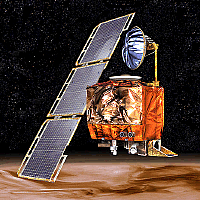
The Mars Surveyor '98 program is comprised of two spacecraft
launched separately, the Mars Climate Orbiter (formerly the Mars Surveyor '98
Orbiter) and the Mars Polar Lander (formerly the Mars Surveyor '98 Lander). The
two missions were to study the Martian weather, climate, and water and carbon
dioxide budget, in order to understand the reservoirs, behavior, and atmospheric
role of volatiles and to search for evidence of long-term and episodic climate
changes. The Mars Climate Orbiter was destroyed when a navigation error caused
it to miss its target altiude at Mars by 80 to 90 km, instead entering the
martian atmosphere at an altitude of 57 km during the orbit insertion maneuver.
Science Objectives
The Orbiter has as its primary science objectives to: 1)
monitor the daily weather and atmospheric conditions; 2) record changes on the
martian surface due to wind and other atmospheric effects; 3) determine
temperature profiles of the atmosphere; 4) monitor the water vapor and dust
content of the atmosphere and 5) look for evidence of past climate change.
Specifically it will observe and study dust storms, weather systems, clouds and
dust hazes, ozone, distribution and transport of dust and water, the effects of
topography on atmospheric circulation, atmospheric response to solar heating,
and surface features, wind streaks, erosion, and color changes. The orbiter will
use two instruments to carry out these investigations. The Mars Climate Orbiter
Color Imager (MARCI) will acquire daily atmospheric weather images and high
resolution surface images and the Pressure Modulated Infrared Radiometer (PMIRR)
will allow measurement of the atmospheric temperature, water vapor abundance,
and dust concentration. The orbiter will also serve as a data relay satellite
for the Mars Polar Lander and other future NASA and international lander
missions to Mars.

