So, here's a detailed description of my hometown which you'll never get anywhere on the 'Net or anywhere else for that matter. It is about an hour's slow drive from the nearest exit on the North-South Highway, which is the Sungai Petani Utara toll-house.
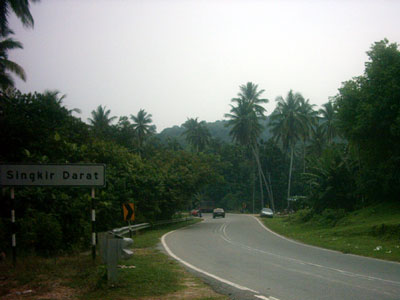
Singkir is actually a mukim or a cluster of villages and sometimes towns. Several mukims make up a district and several districts make up a state, etc. etc. These are the villages within Singkir, in alphabetical order:
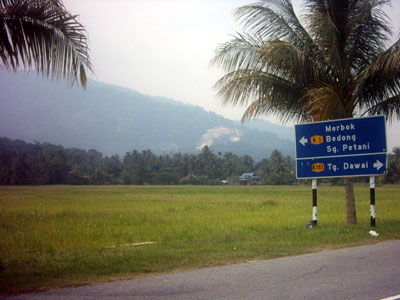
This is the first village you'll encounter, after passing through other villages and towns, of course. It is right smack at the bottom of the hills that are part of state's highest point, the Kedah Peak.
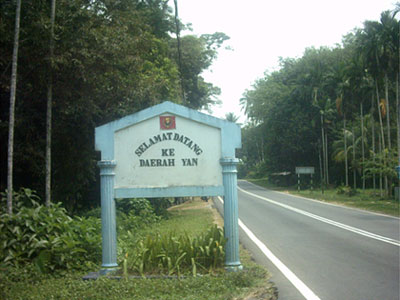
It may sound so romantic to be living near a hill but not so for the residents here. The location also means that we are being shadowed from broadcasting transmissions. So, switch on your car radio and just drive on. There's a blind spot somewhere along the road and if your radio stops playing momentarily, you know that you are entering Singkir Badong.
Badong is the name of a kind of gold or silver ornaments that children wear over their private parts, fig leaf style, in the olden days. My, those folks must be filthy rich to be able to decorate their kids' genitals with gold and silver. Of course, we don't indulge in that sort of kinky displays of wealth anymore now.
Most kids here now wear disposable diapers until they have been toilet-trained or nothing at all. I don't know how the village got its name -- maybe the village was inhabited by craftsmen churning out the best badongs for the whole state in those days. Or maybe someone found a a finely crafted ancient shield or tray and thought it was a badong for an adult...
This is my birthplace, it is located in the centre of all the other villages. Darat is land in Malay, indicating that this is the upper ground part of Singkir as compared to the other villages nearer to the sea. It is also the centre of all commercial activity here -- well, sort of.
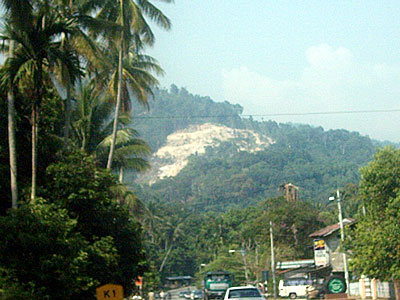
The town has three rows of shops with one row facing away from the main road. When the town was first built, the main road ran right through it. Subsequently, the government rebuilt the road to run behind the town and another row of shops just grew on the other side of the road. Out of about thirty shops there, only four are conducting any actual business activity.
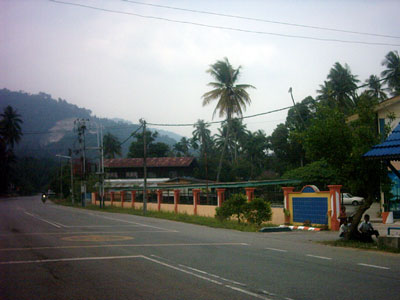
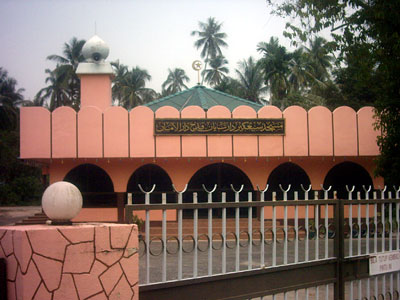
So, we have one motorcycle workshop, one grocery store and two coffee shops. The rest are used for residence and storage. You can imagine how very exciting the place is, with half the town's back doors facing the main road and only four shops open for business. If it wasn't for the village mosque and the primary school, people driving through would be hard-pressed to find for some signs of life in this town.
Located on the northwestern side, Singkir Genting is an interesting hill community set within the lush tropical forest. This is where you can find sparkling clear streams running through fruit orchards and rubber plantations. You can trek up to Gunung Jerai from here if you know what you're doing.
The village trail leads up to a pass, or genting in Malay -- hence the name, where you can cross over to the other villages on the other side of the hill. In the olden days, villagers used the pass to avoid badhats waiting in ambush in Tanjung Jaga.
This village comes alive once a year during the fruit season with people ferrying fruits such as durians, mangoesteens, cempedak, langsat, petai, etc. down to the buyers in Singkir Darat. Singkir used to be very well known for its excellent durians and cempedaks. Well, those were the days. The fruit season is also the best time for townsfolks to visit their village relatives and enjoy a picnic up on the hills.
The name may also remind you of the famous gambling resort near Kuala Lumpur. So perhaps there's also a gambling den somewhere up here, I don't know. But I heard some rumours about people riding up the hill for a game of cards or a round of mah-jong. Maybe, who knows?
Kedai Keling is Malay for Indian shop. So, Singkir Kedai Keling means Singkir-where-the-Indian-shop-is, or rather was, as there's not a single Indian shop anywhere here anymore. As a matter of fact, there's only one ethnic Indian in the whole of Singkir and she's married to one of the coffee-shop operators in Singkir Darat town. They made quite an odd couple because the husband is Chinese. The only other mixed couple around here lives in Singkir Laut.
Nobody knows what happened to the original Indian shopkeeper or his shop; maybe he moved further inland to start a chain of Nasi Kandar restaurants, maybe he went to Penang an founded the famous Kapitan Keling Mosque.
Keling is not a politically correct term nowadays ever since a certain Mr Velu in Kuala Lumpur took offense to the word, something which we never understood why. People in the southern part of the peninsular used to call all ethnic Indians as Keling but the northern folks have been been using the term to refer to Indian Muslims only for as long as we can remember.
The non-Muslim Indians are called Hindus, after their faith. The older folks used the term Hindu more along racial lines, and would ignorantly call Indian Christians as Hindus and their places of worship as Hindu churches as well. Explain to them that you're not a Hindu but a Christian and they'll say, "Oh, you're a Christian Hindu then!" No point arguing.
The right turn at the next junction after Kedai Keling will take you to Singkir Laut, which literally is Singkir-by-the-sea as laut is the sea in Malay. This is a fishing village facing the Straits of Malacca and if you have a boat, you can sail at your own risk to Penang or Langkawi; or if you're more adventurous you can even go to Medan or Acheh in Indonesia, Phuket in Thailand or even Myanmmar or India.
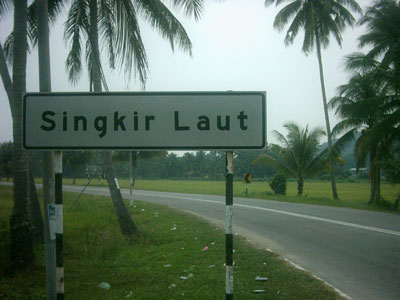
Not all the residents are fishermen as many of them work in the padi fields or on the farms up in Singkir Genting. There's still a short stretch of sandy beach in Singkir Laut where you can have a picnic or just laze about. The rest of it has been eroded making the sea unsuitable for swimming. At low tide you can see miles and miles of knee-deep mud which makes it a natural breeding ground for cockles. Some of the villagers made good living just by selling the cockles they found there during low tide.
Children love to play on the beach near the rivermouth as the water is much clearer and there's more sand underneath. Sometimes they would look for a kind of mollusks living just below the sand, which they would gather and take home for their mothers to cook. The mollusks are delicious in a soup or simply fried.
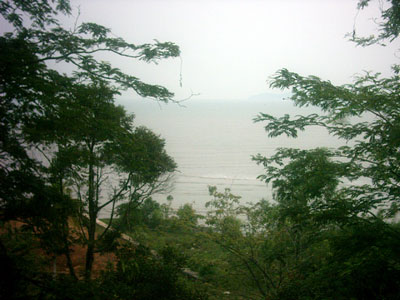
At the end of the village where the flatlands meet the foothills, there is a nice house where a mysterious Englishman called Daud lives with his Malay wife and a few cats. Well, mysterious because they keep pretty much to themselves. But they have a nice brick house, which the guy built himself with some hired help, facing the open sea and with the hills in the background. They have added a very well laid-out front yard ad I think it would look pretty on a postcard from any side.
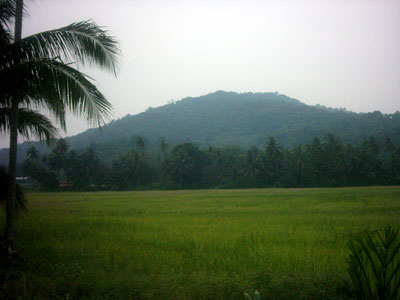
Across the main road from Kedai Keling is Singkir Paya. Paya means swamp in Malay, so this is the wettest and the most water-logged part of Singkir. This is also where most of the padi fields are -- you can see them for miles and miles around.
The only excitement around here comes only twice a year when these huge harvesters come to reap the ripe rice (sorry!). Watching those yellow mechanical monstrosities munch everything in their way like hungry pac-men and belch out empty padi stalks while moving to and fro day and night can be quite mentally refreshing. Much better than watching those silly programmes on local TV, I think.
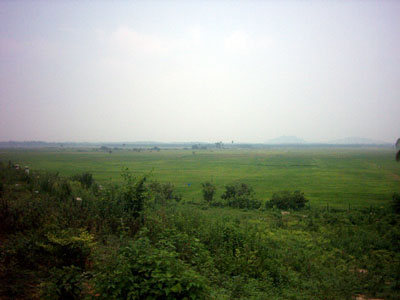
Before the irrigation trenches were built, the residents had to wade through knee-deep water and carry their bicycles on their shoulders during the rainy seasons to come to town for their groceries. I remember the older folks telling stories how they had to carry their books, pants and shoes over their heads, putting them on only when they reached the main road, on the way to school. No wonder not many girls attended school in those days.
I guess wet and soggy books were valid excuses for not turning in your homework, lucky them.
Tanjung is a cape in Malay and Jaga means to keep alert, so Tanjung Jaga is Cape Alert literally. It is not a village but a hilly outcrop that extends into the sea. In the olden days, Tanjung Jaga used to be the haunt of assorted robbers and off-duty pirates, waiting in ambush to prey on unwary travellers. The villagers on both side of the hill would warn travellers, "Beware of pirates!" or in the local vernacular, "Ada lanun, jaga oi jaga!" -- hence the name.
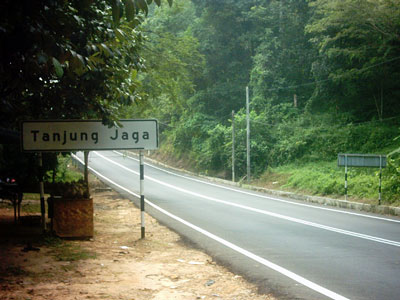
The pirates are no longer there in this modern time but some people insist that you still need to be on the lookout for, well, ghosts! One motorcyclist once reported that he was overtaken by an old man on a bicycle while going uphill!
The road cutting through Tanjung Jaga consists of blind corners weaving around huge rocks, sudden dips and long hill climbs. You can watch the beautiful sunset as you cruise along the coast as long as someone else is holding the steering wheel and watching the road. On the long climb to the highest point, you would probably have to change down to second gear if you're driving a manual or riding an old motorbike. The have widened the road and improved the gradient now due to the frequent cases of heavy vehicles stalling half-way up the hill.
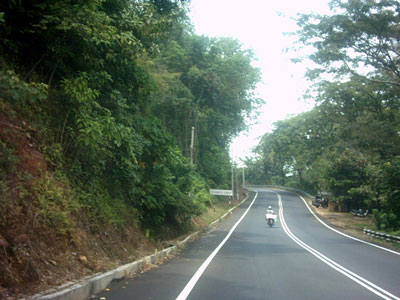
I remember a few years back when a truck laden with rotten fish meant for a manure processing factory stalled its engine while climbing the hill and backed into a ravine. A tow truck was summoned to pull it out of its embarassing situation but only managed to yank out the driver's cabin and the chassis, leaving the cargo box and its smelly load behind. The stench lingered around the area for weeks until the rain washed it down back to the sea.
There's an old bungalow on the tip of the cape overlooking the sea. It is a private property but nobody lives there, so don't count on stopping by foor a look-see. Somewhere along the ridges, there's a cave which is actually the mouth of an underground river. Many villagers said that it can take you up the source somewhere on the Kedah peak during the dry season. Nobody has attempted it, though.
Even if somebody had actually attempted it but no one had come back to tell the villagers about it, so let's just forget about doing it the hard way when you can just drive up the peak through Gurun town on the other side.
There's a broadcasting station up on the Kedah Peak serving most parts of the northern peninsular. Singkir and several other villages in this area are being shadowed from the transmission signals by a range of secondary hills running next to the Kedah Peak all the way to the sea at Tanjung Jaga. I guess it is a case of us being so near and yet so far.
This broadcasting shadow extends over almost of Singkir as we sometimes get only three TV channels -- either TV1 or TV2, either TV3 or NTV7 and another so blurry I can't make out what channel it is. "Either" because you can only tune in to one station, set your TV to receive TV1 and you'll lose TV2 altogether. Well, they said TV is bad for you, so there.
Even the mobile phone reception is bad in this place, you'll never find anybody talking on the phone while walking here. I have to switch to a major (and more expensive) mobile telephone service provider because of poor reception. On my previous cellular, I have to squat down to take calls, even out in the open.
Visiting your country cousins during the annual fruit season will not be complete without spending at least half a day up on the hills at the fruit orchards or dusuns. Relatives from the towns and cities would usually call a few days ahead of their arrival -- this is to give the hosts ample time to gather the best durians and pluck cempedaks, mangoesteen, langsat (or the hybrid dokong) so that more time can be spent eating them during the picnic.
Early in the morning of the picnic day, the women would be busy preparing the herbs and spices, pounding the sambal belacan (a potent chilli and shrimp paste mixture), and frying the salted fish (for the adults) and chicken (for the kids) so that they do not have to carry the heavy utensils to the picnic spot. As soon as the townsfolks arrive, everything would be ready to be taken up to the fruit orchard.
There the ladies would cook the rice using sparkling clear stream water over a makeshift stone stove. Then they would deftly cut up a young cempedak and turn it into a delicious curry with herbs, spices, and anchovies or shrimps prepared earlier. The firewood is in abundant supply as there are a lot of fallen dead branches around.
While waiting for the curry and rice to cook, everyone may either eat the fruits for starters or go exploring the dusun trying to identify the trees or pluck more fruits. The older ladies would look for edible young leaves, shoots or seeds of certain plants to be taken as salads or ulam to accompany the sambal belacan. The children would swim and play in the stream until their lips turn blue and their teeth chatter.
As soon as lunch is ready, everyone would gather round on straw mats for the best feast of their lives! Freshly cooked rice have never tasted so good with such plain accompaniment when eaten at these hill picnics. The sambal belacan is a must, usually mixed with the sweet flesh of mangoesteens to simmer down the fire, at these picnics.
After lunch, there would be more fruits and more dips in the stream with the adults joining in now, until it is time to go home. Those fruits that are not consumed would be tied together or put in sacks for the guests to take home. The townsfolks, especially their kids, would go home happy, promising to come back again the following year. If the hills are still here.
And that brings us to the question:
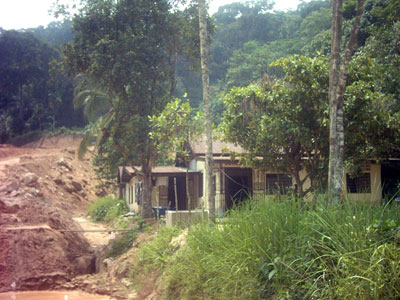
I have mentioned in my blog about the village making it to prime TV on June 26, 2004. A private company has been given the go-ahead to blow up a hill nearest to Singkir Badong. According to reports, the company has been given 100 acres of government land and forest reserve to extract rocks from for the next twenty years!
After shaving the hill clean of precious trees and probably making quite a bundle from the sale of the logs, they started to prepare the ground to build the quarry and a gravel dump. The initial earthwork had caused some damage to the fences and young fruit trees in the adjoining dusuns and to marine life in the main river that runs through Singkir Genting, Singkir Darat, Singkir Kedai Keling and Singkir Laut as its once clear water turned muddy.
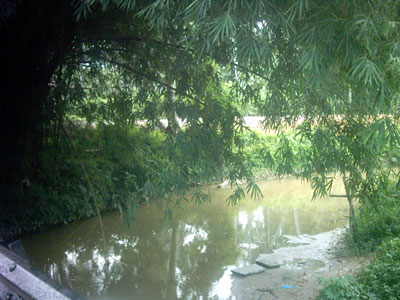
Apparently, the company must have cut more than a few corners. Heavy rains on June 25 and 26 brought down more rocks and soil into the river and eventually into our living rooms. The TV crew which happened to be in the neighbourhood recorded the whole disaster and we were on TV that night and in the major newspapers the following day. Click here to see pictures of the Singkir mudfloods.