These first graphs represent the relationship between chamber volume and muzzle velocity when barrel volume is held constant.
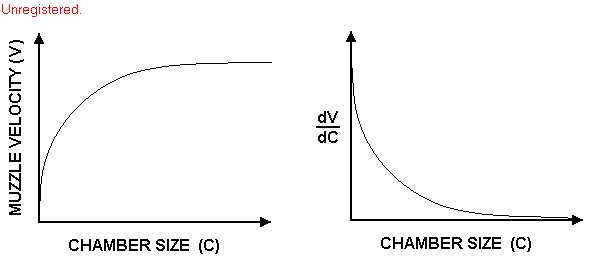
Note that V can never reach the theoretical maximum because there will always be a slight pressure drop no matter how large the chamber.
If you're not familiar with calculus, the graph on the right represents how much each extra unit of chamber volume contributes to muzzle velocity. With a small chamber, each extra cc (or cubic inch, or cubic whatever) gives a big velocity boost (dV/dC is high). With a big chamber, an extra cc gives very little boost (dV/dC is low). Since muzzle velocity can never peaks at it's maximum, dV/dC never actually reaches zero. Basically, this means that there isn't a certain chamber volume that will yeild maximum results. Once dV/dC gets very close to zero, a bigger chamber will only get you slightly closer to the theoretical max.
Maximization becomes a subjective question. You must set a limit for dV/dC. One person might say the gun is maximized when dV/dC falls below 1. Someone else might choose 0.1 or 3. With a constant barrel volume, it all comes down to what you think is good enough.
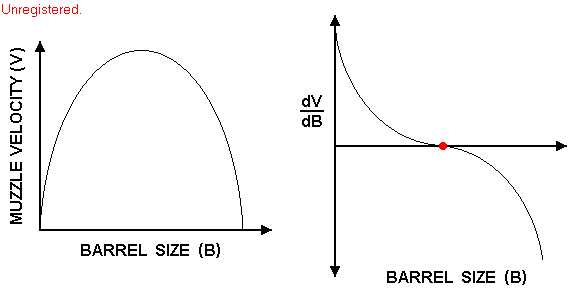
These next graphs are another story. They represent the relationship between BARREL volume and velocity when the CHAMBER is held constant.