
|
Home Articles Reviews About Us Links Extras |
| Controller Wars |
Note: this article was inspired by the following image. Special thanks to the geniuses at ign.com.
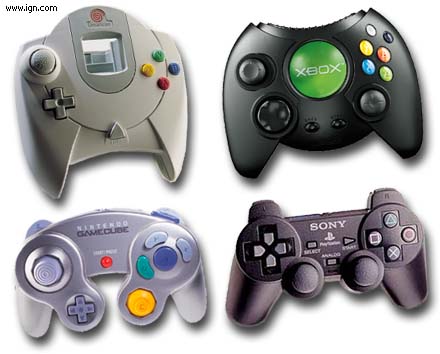
All this talk of processing power, DVD capabilities, and storage capacities. This many MegaHertz, that many polygons, this much RAM... numbers are great and all, but I want to see advancements in every facet of a console. They don't call them next-generation consoles for nothing.
So here's a small homage to the new controllers that come with the Dreamcast, XBox, Playstation 2, and Gamecube. I'll be looking at characteristics that every controller should have, rewarding those who have done a good job, and shunning those who haven't. Shame on them...
Analog in a digital world
First introduced by Nintendo on the N64 controller, the analog stick is now a necessity. It allows for incredible flexibility in movement, since the analog stick responds to small or large amount of pressure applied to it. The design of the analog stick has been improved from its N64 predecessor, and the Xbox, PS2 and Gamecube controllers feature dual analog sticks. Interestingly, the Gamecube and Xbox's analog sticks are placed asymmetrically on the controller; the smaller, yellow stick on the CG controller is supposedly an analog stick designed to control camera angles.
A recent innovation has surfaced from the minds of Sega. Analog triggers appear on the Dreamcast which act brilliantly as gas pedals for racing games. This undoubtedly lead Nintendo and Microsoft to include analog triggers and buttons on their controllers. Sadly, Sony missed out...
Layout
The left side of all four controllers are virtually identical. While the triggers are a helpful addition for Sega, the front layout of both the Dreamcast and PS2 controllers are pretty mundane. Nothing exciting, nothing risky. Microsoft has decided to go old school with their button layout, with the arcade-style six buttons. I was quite the fan of this layout on the 8-bit Genesis and N64 controllers, albeit a bit difficult to find the correct button.
Nintendo has come up with a very interesting solution, in a 3-over-1 button layout. The large middle button acts like a base position for your thumb. The outer bean-shaped buttons are simply located in relation to the base position. No more looking down at the controller to see where your thumb is, since Nintendo is betting that players will naturally return their thumb to the middle button. Double props to Nintendo for trying to fix a problem that so many, including myself, would have completely overlooked!
Comfort
One of the most important aspects of any controller is how it feels in a person's hands. The overall 'winged' shape is common to all four controllers. Fortunately, Xbox, Sony and Nintendo use this shape to improve the gamer's comfort. Major jeers to Sega for making the Dreamcast so painful to play. Using the controller is extremely hard on the wrists, especially when using the triggers often.
Extras
Sega certainly had the right idea when designing the VMU for the Dreamcast, an input device for the controller. The VMU has a LCD monitor built into it and displays game information as you play. Interesting idea, but I feel the VMU is vastly underused in Dreamcast games. Aside from football games, where discretely picking plays from the VMU display is pure genius, the VMU implementation has failed to impress me. Most games are so intense that you really don't want to have to look down.
I feel that this whole rumbling device idea is a bit overrated. It just gets annoying after a while. The Gamecube, Xbox, and PS2 controllers all feature built-in rumbling devices. I just hope that they can be disabled for those who are all rumbled-out.
So as you can see, not all controllers are created equal. Each has its strengths and weaknesses, and it's good to see that there are some innovations popping up as well. It's hard to tell if these 'innovations' will appeal to gamers in the long run, in particular the Gamecube's 3-over-1 button layout. At the least, let's hope that they won't detract from the gaming experience, a feeling Dreamcast owners know all too well.
Be heard! Leave a message on the itoop bulletin board. |