|
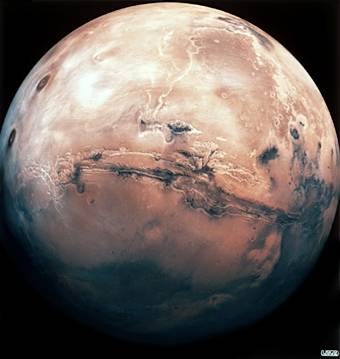
Mars is planet named after the Roman god of war, the fourth from the Sun
and the third in order of increasing mass. Mars has two small, heavily cratered satellites, or moons, Phobos and Deimos, which some astronomers consider to be asteroid-like objects captured by the planet very early in its history. Phobos is about 21 km across; Deimos, only about 12 km.
Unpiloted spacecraft have allowed scientists to determine that Mars's atmosphere is mostly made up of carbon dioxide (CO2), with small amounts of nitrogen, oxygen, and water vapour.
Owing to the thinness of the atmosphere, daily temperatures often vary by as much as 100° C. Surface temperatures are too cold and surface pressures too low for water to exist in a liquid state on Mars, so
the planet resembles a cold, high-altitude desert. This view is centred on the Valles Marineris, a great chasm some 4,000 km long. |