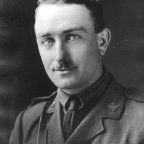
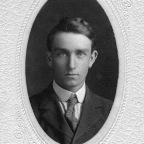
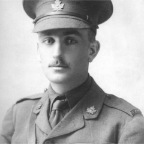
Dalhousie's Rhodes Scholar is Harry Austin McCleave
He is a Stewiacke Boy and Received His Early Education at Fort Ellis and Colchester Academy.
HALIFAX, January 13. - At its regular monthly meeting
yesterday afternoon the senate of Dalhousie University
elected Harry Austin McCleave Rhodes Scholar for Nova
Scotia. He is the son of J. H. McCleave, of Stewiacke, and
was born there in 1892. He received his early education at
Fort Ellis school and Colchester Academy. Mr. McCleave has
an excellent record as a student, among other honors,
standing first in the provincial examinations for Grade XII
in 1910, his total mark, 1,063 constituting a record. He
began attendance at Dalhousie in 1913, where, in spite of
the great disadvantage of having to travel daily between
Stewiacke and Halifax in order to attend lectures, he soon
made a mark for himself in all his classes. Mr. McCleave is
a typical Nova Scotia college man, hard - working, self -
respecting, self - helpful. He obtained his "athletic"
training in useful work on a Nova Scotian farm, and his
intellectual attainment promises to meet the demands of the
Oxford dons, whose dissatisfaction with the academic
performances of the usual Rhodes scholars is only too well
known.
He Was A Brilliant Student and Had Received the Degree of
B.A. When He Responded to the Call
Captain Gerald Dwyer is Wounded and Word Also Comes of the
Wounding of Ralph James
HALIFAX, October 14. - Word came yesterday to Robert
McCleave, who is attending Dalhousie University, that his
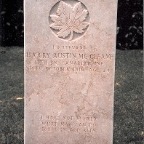
brother, Lieutenant Harry Austin McCleave had been killed
in action. This news will be heard with deep regret by a
large circle of friends in and out of college, for he was a
noted Dalhousian. Lieutenant McCleave was a Stewiacke boy,
received his B.A. degree at the closing convocation of 1916
and was Dalhousie's Rhodes scholar, having been elected in
1915 to take the honor this year, it being Dalhousie's turn
for the scholarship.
Like so many other Dalhousie men he gave up his studies and
offered himself for overseas service, crossing to England
as a lieutenant in the 64th battalion, afterwards being
transferred to another battalion at the front.
Harry McCleave, who was 23 or 24 years old, was a splendid
student, an all round man, liked by his fellow collegians
and all who knew him - the type who can be depended on to
carry a thing thru. He has given his life for flag and
country and the sacrifice will not have been in vain.
Telegram of Sympathy From Sir Robert Borden Read At Meeting
In Stewiacke
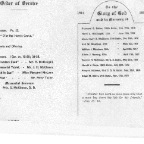
Stewiacke, October 16 - A memorial service for the late
Lieutenant Harry A. McCleave was held last night in St.
Andrews Presbyterian church, the largest church in the
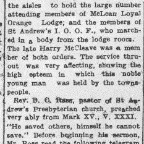
town, chairs having to be brought in the aisles to hold the
large number attending members of McLean Loyal Orange
Lodge; and the members of St. Andrews I.O.O.F., who marched
in a body from the lodge room. The late Harry McCleave was
a member of both orders. The service throughout was very
affecting, showing the high esteem in which this noble
young man was held by the townspeople.
Rev. D. O. Ross, pastor of St. Andrews Presbyterian Church,
preached very ably from Mark XV., V.and XXXI. "He saved
others, himself he cannot save." Before beginning his
sermon, Mr. Ross read the following telegram:
Ottawa, October 14 - J. H. McCleave, Stewiacke: "My
colleagues and I extend to you sincere sympathy in the
great loss you have sustained in the death of your son,
Lieutenant Harry Austin McCleave."
R. L. BORDEN
The choir rendered special music. One number a quartet by
four ladies: Mrs. Rutherford, Mrs. S. H. Taylor, Mrs. G. W.
Marshall and Miss Alma Fulton entitled "Fallen Heros" was
sympathetically rendered.
Fought in the Big Drive East of Thiepval, Storming the
Village of Courcellette.
The Most Dramatic and Picturesque Battle in Which the
British Army Has Engaged in France.
(Canadian Press Dispatch.)
British Front in France, Sept 18 - (Via London, Sept 19).-
The most dramatic and picturesque battle of the British
army in all its two years in France was fought here on
September 15. Here is the story of how all kinds of men
from the ends of the earth took part in this mighty
conflict.
In the same pressing station this week the correspondent
has seen Canadians, New Zealanders, English, Scotch, Irish
Newfoundlanders and Americans. These were some of the men
of many countries who took part in the now historic battle
and with them there went into action those armoured cars,
called "tanks," which are to the credit of a quiet officer
of Engineers. When the correspondent met this officer in
London six months ago and asked him what job he was now on,
he replied:-"Sh Sh don't tell."
It was the "tanks" that completed the wonderful business of
this battle.
To-day when the correspondent was calling on a Canadian
brigadier it was a "tank" called "The Cordon Rouge" looking
like a prehistoric monster in a skin of modern armor and
with engines inside, which took him across the field of
shell craters, weaving its way with pythonic adaptibility
by all irregularities to the door of the Brigadiers dugout.
The skipper of "The Cordon Rouge" alighted and with
phlegmatic drawl announced that he reported for further
orders. The Brigadier laughingly bade him not to start the
brute down the stairs of the dugout but move it to one side
and wait. So the "tank" ambled with the bulky leisure of a
hippopotamus over some more shell craters to a place where
it would be out of the way, until it was needed.
Then the correspondent went over the ground where the
Canadians had taken upto the edge of the Village of
Courcellette. Later they stormed the village. He met
Canadians who came from Montreal, Toronto, Winnepeg, and
Vancouver. There were also men with the accents of Missouri
and New England and others who, on the soil of France,
hailed one another in the French tongue of Quebec.
It was the Canadians' first offensive on any big scale.
They had stood the shock of the attack at the second battle
of Ypres, at St. Eloi, Orrell Hill and Sanctuary Wood, and
it had been their fortune up to the present to stand under
blows rather than give them. They wanted their chance on
the Somme to make good, as they said, and they had it.
This rainy day saw one battalions of them marching out from
the trenches they had won, and other battalions marching
in.
Those fresh from the fight were plastered with mud, but
triumphant. They had a hundred stories to tell, while the
rain dripped from their tarpaulins. The "Byng Boys" had
made good. The wounded, also drenched by the rain, eagerly
joined in these stories. The Canadians are known as the
"Byng Boys" after the name of their corps commander,
General Sir Julian Byng, and also by virtue of a popular
song in London entitled:-"The Byng Boys Are Here."
General Byng grasped the idea that the Canadians have
initiative. Just there as far as the correspondent could
learn is the essential of the universally admitted
brilliant stroke which the Canadians dealt when it came
their turn to play their part in the colossal plan of the
Somme offensive. In other words, General Byng understood
that, given a goal, the men of North America would go to it
wwith all there was in them, ready to take a pinch - hit
chance.
The correspondent went over the ground to-day where they
went to it, and saw where they stuck in trenches under
shell fire which they had gained after their second charge,
and which were not in the original battle plan. The night
before the battle the staff officers in charge of that
branch of the front, showed the correspondent the Canadian
objective. No home run was expected of them, but only a
sacrifice fly, to use baseball language, but they made home
run and brought in all the men on the bases. They gained
their first objective in an uninterrupted dash, absolutely
on time.
When the word was given they started for Courcellette,
which they were ordered to take. Now this village has been
"less crumped"than any yet captured. There were some
battered rafters of rooms still in position, that is,
Courcellette had less hammering by preparatory shell fire
so as to clean out its strong points, nests of machine guns
and so forth.
Through these streets to their new objective, marked on
their map, went these fighters of the new world, including
men from Nova Scotia to Vancouver. They were determined to
get there and make good, and they got there.
When no word came back for some time, the staff, sitting in
the centre of the web of telephone and telegraph wires,
over which were flashing the news of the progress of the
great battle, began to wonder if the Canadians were in
trouble. But presently they got word that the charge had
swept beyond the village, and that the Canadians were so
busy digging in they had not had time to send news. It was
explained that they thought it would be taken for granted
that they had got through.
Among those who "made good" say those who are supposed to
know the facts, was a battalion of French- Canadians, the
kind of men you see in times of peace working their farms
in Quebec or bending over the benches of a factory in New
England.
"We had luck with us and we forced it,"one of the Canadians
said.