|
|
| This site is listed in these disability/health related search engines. |
A Little Bit About
Spina Bifida and Hydrocephalus
|
|
| This site is listed in these disability/health related search engines. |
Hi, and welcome to my web page, where I will discuss a little bit about a birth defect called Spina Bifida. I know, you're probably wondering....Why? Well, because I was born with Spina Bifida and I have lived 30+ years with it, so I know a little about what it is and what it can do to your life and the life of your entire family. It is by no means anymore a critical defect than others you may have heard of like Cerebral Palsy, or Down's Syndrome, but I cannot discuss those, because I don't know much about them and I haven't lived with them. So, this page is my way of sharing with you my experiences and some excellent sources of information I have located on the web concerning this defect. I hope you find it informative, and take the information with a grain of salt and some common sense. It is only what I have accumulated over time and wish to share with those of you that may be interested in knowing about it. I encourage those of you with children and family members with Spina Bifida to contact your doctor, hospital, The United Way, or any other possible source for information on Spina Bifida. DO NOT BE AFRAID TO ASK! THAT IS WHAT THESE FOLKS ARE PAID TO DO!
There are a number of psychological
factors which must be taken into account when handling a person
with this disability. Because the child will likely be spending a
great deal of time in the hospital for surgeries and treatments
of associated disorders, it is important to build a strong,
loving, close relationship with the child. It is important to
avoid making the child feel as if they are being abandoned while
they are in the hospital. You must take time to spend with your
child and reassure them that they are not going to be left in the
hospital all alone. Also, a genuine fear of surgery and
anesthesia exists for the child. You must also take time to
reassure them that the doctors are not trying to hurt your child,
that they are there to help. Sometimes, the assistance of a
psychiatrist is needed. (I know, a shrink! ugh!) But, sometimes
it is for the best. Most of all, let your child know that you
love them! They need every bit of support you can give, and more!
I know, you don't have time; well, make some time! Children with
Spina Bifida often become disassociated from their schoolmates.
This can become a very serious problem, leading to poor
performance in school and basic withdrawal from the child's
school "community." You must encourage your child's
teachers and school counselors to be on the look-out for this
kind of situation and to intervene on the child's behalf, when
appropriate. Finally, you must learn not to treat your child any
differently than you would a child who is "normal."
Discipline and punishment when the child does something wrong are
key to their development into a "normal" person. (hehehe,
you should have guessed I would eventually come out with that one!)
Well, enough preaching, here is the basic information on Spina
Bifida.
Spina Bifida is a physical birth defect. "A
congenital defect in which part of one
or more spinal vertebrae fails to develop completely, leaving a
portion of the spinal chord exposed.*"
While the exact cause of Spina Bifida continues to mystify researchers, there are several factors thought to be involved. The most current theory, and the most viable so far, is that during pregnancy, the mother's body lacks sufficient levels of the B-Vitamin complex. Although, this does not explain the exact mechanism which leads to the cause of Spina Bifida. Much more research continues in some of the nation's most prestigious medical centers, regarding this defect.
"The incidence of Spina Bifida in the United States is about one case per one thousand (1:1,000) children born during any given time period. (This translates to a rough estimate of between 2,000 and 4,500 children born with Spina Bifida in a given year in the United States.) The incidence increases with either very young or very old maternal age. A woman who has had one affected child is ten times more likely than average of having another affected child.*"
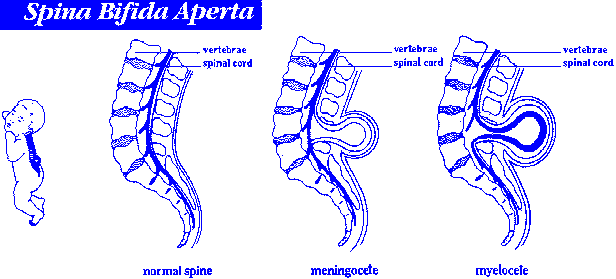
There are four known types of Spina Bifida, (some of them are illustrated in the graphic above)*:. They are listed and described below, in order of severity. Sometimes you may hear or read of these called Type 1, 2, 3, 4. In that case, Type 1 is least severe while Type 4 is most severe.
Spina Bifida Occulta*:
This the most common and the least
serious form. There is little external evidence of the defect
apart from a dimple or a tuft of hair over the underlying
abnormality. Spina Bifida Occulta often goes unnoticed in
otherwise healthy children, although occasionally there are
accompanying abnormalities of the lower part of the spinal chord.
Symptoms, which include leg weakness, cold and blue feet, and
urinary incontinence, may be present at birth or may develop
later in life.*
Meningocele*: This form of Spina Bifida, while it may visually resemble Myelocele, is not nearly as severe. Although a sack appears over the affected area of the spine, no severe side-effects usually occur with this form, however, repairs must be done surgically to remove as much of the scar tissue as possible, and close the opened area early in life.
Myelocele*: Also known as Meningomyelocele, the type that I have, is the most severe of the common forms of Spina Bifida. A well-defined, purplish-colored, fleshy sack appears on the back over the affected area of the spine. A child is usually severely handicapped. The legs are partially or completely paralyzed, with loss of sensation in all areas below the area of the spine where the defect occurs. Hip dislocation, and other leg abnormalities are very common. Hydrocephalus (excess cerebro-spinal fluid trapped within the skull) is common and may result in brain damage. Associated abnormalities can include Cerebral Palsy, Epilepsy, mental retardation and visual problems (Fortunately, I have avoided all except the Hydrocephalus, leg paralysis and eyesight problem). Paralysis of the bladder leads to urinary incontinence (leakage of urine, often occurs with me), urinary retention (when the bladder ceases up and does not let the urine pass), repeated urinary tract infections (a constant thing with me), and eventual kidney damage. The lower bowel may also be paralyzed, leading to leakage of fecal matter or the opposite, chronic constipation (aw jeez! I'm not gonna go into that one!).*
Encephalocele*: This form, although rare, is the most severe form of Spina Bifida, overall. The protrusion of the fleshy sack occurs through the skull (I know, a very graphic description!) There is usually severe brain damage, if the child survives, but most children with this rare form are "still-born."*
Diagnosis*: Closure of the vertebral canal usually occurs within four weeks of conception, meaning that Spina Bifida can often be diagnosed at an early stage of pregnancy, using ultrasound scanning. High levels of a chemical called alpha-fetoprotein in the amniotic fluid or the mother's blood may also indicate Spina Bifida. After birth, Spina Bifida is easily diagnosed if the protruding sack is present, otherwise an X-ray of the spine will also reveal any abnormalities.*
Treatment*: In cases that are not severe, surgery may be performed to close the defect and thus prevent further damage to the spinal chord. Ideally, the operation should be performed in the first few days of life. If the abnormality is serious, surgery may allow the child to survive with a possibility of severe mental or physical handicap. In the years 1998 and 1999, a series of experimental surgeries performed at Vanderbilt University Medical Center, on yet unborn babies with Spina Bifida, where the unborn child is temporarily removed from the mother's uterus and the spinal lesion closed prior to normal delivery, has yielded mixed results. If hydrocephalus, a buildup of cerebro-spinal fluid in the cranial cavity develops, a shunt (tube) is inserted into the skull (I have had my current shunt since 1974 with no problems) to relieve the condition. Retention or incontinence of urine is often treated by the use of an indwelling catheter, changed every 4 to 6 weeks. In older children, doctors and nurses can teach them to insert and remove a catheter into/from the bladder at set intervals throughout the day to remove urine from the bladder and thus, control leakage. (I learned as a teenager how to do this and thanks to my lack of sensation in that area, it doesn't hurt at all.) Laxatives, enemas or special diets may be used to control problems with bowel control. Physical and occupational therapy may be needed to develop and hone certain skills for daily/independent living which the child may be lacking. (After 10 years of therapy, I have nearly matched that same amount of time living in my own apartment, taking care of all my necessities by myself. Although I use a wheelchair, most times I don't feel troubled by it.) Depending on the degree of disability, special schooling and training for employment may be needed.* (Although, many children, like myself, are capable of entering a mainstream school and do as well in class as any other child.)
Prevention*: Parents considering another pregnancy, who have had one child with Spina Bifida should undergo genetic counseling to determine if there are any unknown risk factors of having another child with Spina Bifida. Otherwise, expecting mothers should maintain a healthy diet with a multi-vitamin supplement during pregnancy. Expecting mothers should consume an average of 0.4 milligrams of folic acid on a daily basis during pregnancy. It is advised that expecting mothers should not use illicit drugs, alcohol or tobacco products during pregnancy. Use of these "products" has recently been shown to raise the incidence of Spina Bifida. Also, more recently, within the last couple of years, it has also been shown that use of certain cold medicines, particularly cough syrup may increase the incidence of Spina Bifida.
Hydrocephalus A disorder often occurring with Spina Bifida, is the excess build-up of cerebro-spinal fluid (CSF) within the skull, causing increased Intra-Cranial Pressure, between the brain and skull. While there are several types of "hydro", mine is known as Acute Hydrocephalus. It was treated shortly after I was born, with a tube called a shunt, placed through a small hole drilled into the skull, to relieve the CSF pressure, thus minimizing brain damage. The shunt often requires a minimum of two follow-up surgeries to fine-tune its proper operation, often with the addition of lengths of tubing or relocation of the shunt, should it begin to work improperly. There are two common sites in the body used for draining the excess CSF. One is the heart, through a Ventriculo-Atrial shunt (the type I have), invented in 1952(?) This type was largely abandoned due to complications with the shunt and the heart. This was the original type of shunt chosen because of ease of accessibility to the jugular vein in the neck, a direct route to the heart, where a surprising amount of fluid can be absorbed. Later, an alternate technique was formulated to direct the CSF to the peritoneum (chest cavity) through a Ventriculo-Peritoneal shunt. This is a much safer procedure because of the peritoneum's ability to reabsorb even larger quantities of CSF, as opposed to the heart, obviously a much smaller "cavity." To learn more about Hydrocephalus and shunts, visit the link below to the Association for Spina Bifida and Hydrocephalus. Other nicely detailed information on Hydrocephalus and shunts can be found here, including QuickTime movie clips that show some of the procedures used to relieve the symptoms of Hydrocephalus. Another great site with detailed information and graphics regarding shunts and hydrocephalus can be found here.
Latex allergy Sensitivity to latex (natural rubber) can be a problem for people with spina bifida because of the frequency with which they come into contact with it. Many healthcare products contain latex so people with spina bifida (and medical professionals) are exposed to it on a regular basis - either during surgery (through the use of latex gloves and anesthetic equipment) or during bladder and bowel management (through the use of latex tubing, gloves and catheters). Latex allergy occurs when the body's natural defenses against an allergen come into force. It involves the production of antibodies when there is contact with a specific antigen (in this case latex). Antibodies are produced by the initial reaction to latex which sensitize the cells in all tissues. The severity of subsequent reactions depends on the means of entry of the antigen. Exposure to latex occurs when products containing rubber come in contact with a person's skin or mucous membranes such as the mouth, eyes, genitals, bladder or rectum. Serious reactions can also occur when latex enters the bloodstream. In addition, the powder from balloons or gloves can absorb particles and become airborne causing reactions when breathed by a latex sensitive person. The most potent and life-threatening reaction is entry into the vascular system, which can lead to changes in blood pressure and circulation (anaphylactic shock). Skin contact produces a less severe reaction this is usually raised, pinkish, itchy weals, which develop suddenly and last a few days, but leave no visible trace. Research has shown in the United States that between 18% and 73% of children and adolescents with spina bifida are sensitive to latex as measured by history or blood test. The Spina Bifida Association of America recommends that all individuals with spina bifida should be considered high risk for having an allergic reaction to rubber and should avoid contact with rubber products, particularly during medical or surgical procedures. In addition, it says people who have experienced allergic reactions during surgical or medical procedures should consider wearing a medic-alert bracelet or necklace. The Spina Bifida Association of California issues medical alert cards stating that spina bifida patients often have a severe allergic reaction to latex. For more information on latex allergy, visit the ASBAH site or the SBAA site, the links are below.
As I said above, this page is meant to inform you of the birth defect called Spina Bifida and is meant to provide some of my own commentary on living with it. Children with Spina Bifida should not be expected to be less than a child who is "normal." We can often surprise those of you who would not expect us to be disabled. Did you think before you began reading this page that I would say I had this defect? Would you have guessed? Surprised? KEWL!
Spina Bifida and Hydrocephalus in the news
Sometimes in my web searches, I come across news articles that I think visitors may be interested in. You can read them here. The latest articles published by the Associated Press deal with in-utero repair of Spina Bifida lesions and the controversy surrounding these latest techniques.
Spina Bifida and Hydrocephalus interactive online resources
There are some other great sources of information relating to Spina Bifida and Hydrocephalus on the internet.
One such example is called a listserv. This is an email-based interactive discussion group composed of up to several hundred people, some of whom live with these conditions and others who have family members or loved ones with these conditions.
A great listserv for people with Hydrocephalus is the Hyceph-L Listserv.
A great general listserv for information Spina Bifida is the Bifida-L Listserv. To subscribe to this listserv, send a blank email to Subscribe-SB-General mailing list, to unsubscribe send an email to Unsubscribe-SB-General mailing list.
Usenet also has a newsgroup dedicated to Spina Bifida: alt.support.Spina-bifida.
Yahoo also has an online club dedicated to Spina Bifida, where you can chat in real time and post messages and share information: Yahoo Clubs: Spina Bifida Central.
There are a number of other services available online for people with Spina Bifida and Hydrocephalus, but these, listed above, are a good start.
Click here to visit the site of the Spina Bifida Association of America (SBAA). This is the premiere site for Spina Bifida resources in the USA. It contains a wide variety of information that is useful to anyone interested in Spina Bifida or who lives with it.

Click the little "Pooh" icon above to visit the page of
a very special little boy with a mysterious illness. If any
medical professionals happen across this page, please try to find
someone who can help this little tyke. Otherwise, please take the
time to sign his guestbook.
I hope this page has helped to inform you and aid you in understanding Spina Bifida and Hydrocephalus, even if you never heard of these conditions before you came here. Feel free to email me with questions or comments about this page.
 people have visited this page since October 15, 2000, the day this page was moved to this server.
Click here to go back to my home page and thanx for coming to visit a private realm of my life.
*Source of information provided in this document: The American Medical Association Home Medical Encyclopedia, Charles B. Clayman, MD, Medical Editor, published by The Reader's Digest Association, Inc., with permission of Random House, Inc. Copyright 1989, by Dorling Kindersley Limited and the American Medical Association. ISBN 0-394-58248-9 (set of 2 volumes.)
NOTE: I make no attempt to substantiate claims or information on this page, which are not from my own experience. It is here for reference purposes only. Your doctor(s) should always be your "number one" source of information on the above-mentioned conditions.
people have viewed this page since October 15, 2000.

