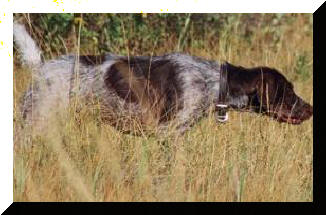


General Appearance
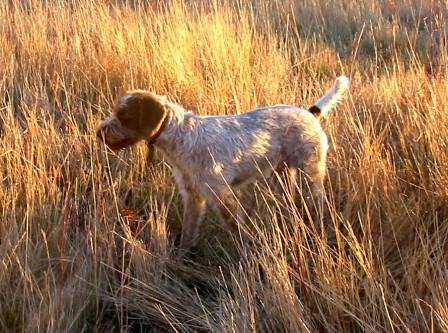
The German Wirehaired Pointer is a well muscled, medium sized dog of distinctive
appearance. Balanced in size and sturdily built, the breed's most distinguishing
characteristics are its weather resistant, wire-like coat and its facial
furnishings. Typically Pointer in character and style, the German Wirehaired
Pointer is an intelligent, energetic and determined hunter.
Size, Proportion, Substance
The height of males should be from 24 to 26 inches at the withers. Bitches are
smaller but not under 22 inches. To insure the working quality of the breed is
maintained, dogs that are either over or under the specified height must be
severely penalized. The body is a little longer than it is high, as ten is to
nine. The German Wirehaired Pointer is a versatile hunter built for agility and
endurance in the field. Correct size and balance are essential to high
performance.
Head
The head is moderately long. Eyes are brown, medium in size, oval in contour,
bright and clear and overhung with medium length eyebrows. Yellow eyes are not
desirable. The ears are rounded but not too broad and hang close to the head.
The skull broad and the occipital bone not too prominent. The stop is medium.
The muzzle is fairly long with nasal bone straight, broad and parallel to the
top of the skull. The nose is dark brown with nostrils wide open. A spotted or
flesh colored nose is to be penalized. The lips are a trifle pendulous but close
to the jaw and bearded. The jaws are strong with a full complement of evenly set
and properly intermeshing teeth. The incisors meet in a true scissors bite.
Neck, Topline, Body
The neck is of medium length, slightly arched and devoid of dewlap. The entire
back line showing a perceptible slope down from withers to croup. The skin
throughout is notably tight to the body. The chest is deep and capacious with
ribs well sprung. The tuck-up apparent. The back is short, straight and strong.
Loins are taut and slender. Hips are broad with the croup nicely rounded. The
tail is set high, carried at or above the horizontal when the dog is alert. The
tail is docked to approximately two-fifths of its original length.
Forequarters
The shoulders are well laid back. The forelegs are straight with elbows close.
Leg bones are flat rather than round, and strong, but not so heavy or coarse as
to militate against the dog's natural agility. Dewclaws are generally removed.
Round in outline the feet are webbed, high arched with toes close, pads thick
and hard, and nails strong and quite heavy.
Hindquarters
The angles of the hindquarters balances that of the forequarters. A straight
line drawn vertically from the buttock (ischium) to the ground should land just
in front of the rear foot. The thighs are strong and muscular. The hind legs are
parallel when viewed from the rear. The hocks (metatarsus) are short, straight
and parallel turning neither in nor out. Dewclaws are generally removed. Feet as
in forequarters.
Coat
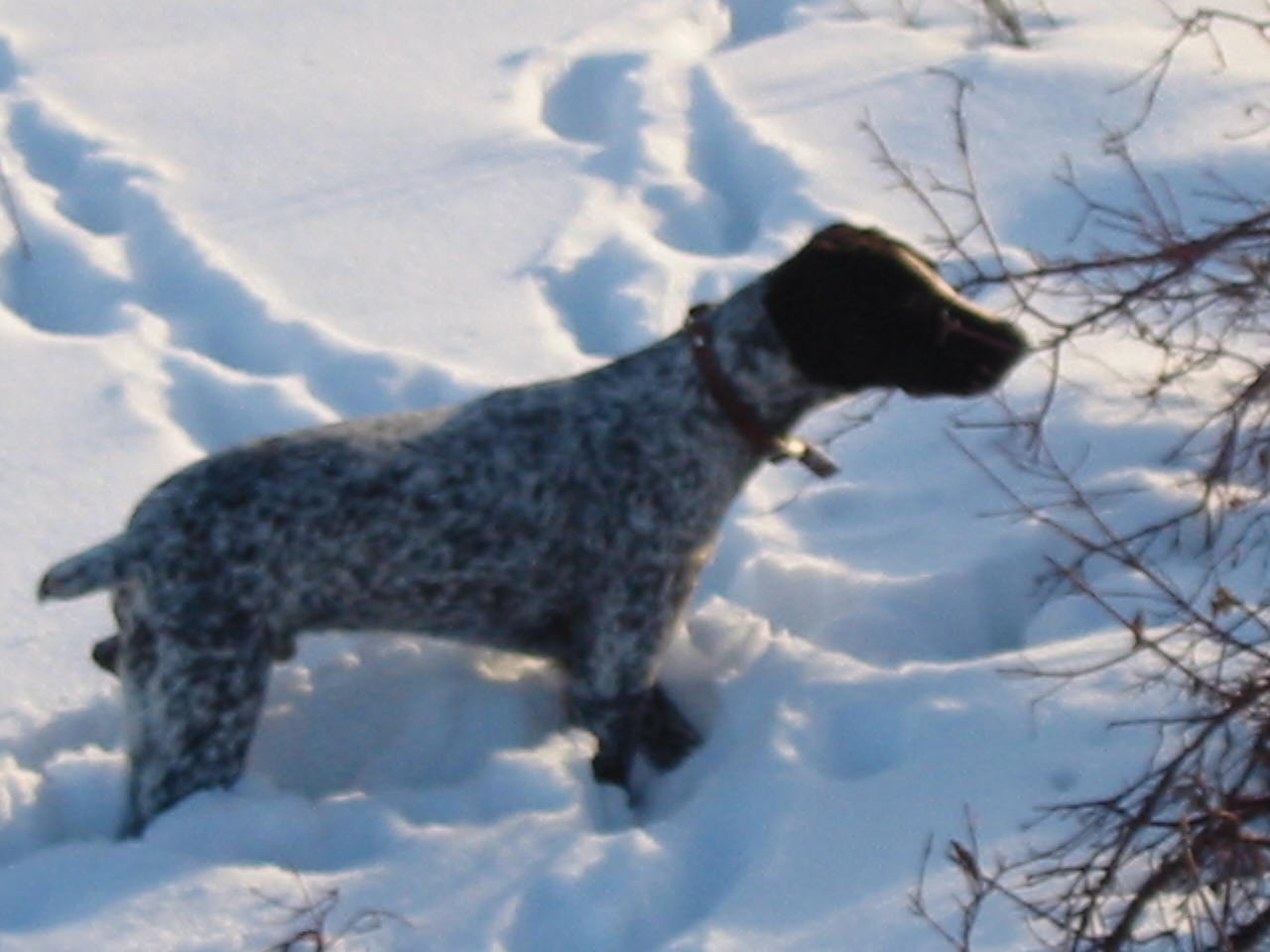
The functional wiry coat is the breed's most distinctive feature. A dog must
have a correct coat to be of correct type. The coat is weather resistant and, to
some extent, water-repellent. The undercoat is dense enough in winter to
insulate against the cold but is so thin in summer as to be almost invisible.
The distinctive outer coat is straight, harsh, wiry and flat lying, and is from
one to two inches in length. The outer coat is long enough to protect against
the punishment of rough cover, but not so long as to hide the outline of the
dog. On the lower legs the coat is shorter and between the toes it is of softer
texture. On the skull the coat is naturally short and close fitting. Over the
shoulders and around the tail it is very dense and heavy. The tail is nicely
coated, particularly on the underside, but devoid of feather. Eyebrows are of
strong, straight hair. Beard and whiskers are medium length. The hairs in the
liver patches of a liver and white dog may be shorter than the white hairs. A
short smooth coat, a soft woolly coat, or an excessively long coat is to be
severely penalized. While maintaining a harsh, wiry texture, the puppy coat may
be shorter than that of an adult coat. Coats may be neatly groomed to present a
dog natural in appearance. Extreme and excessive grooming to present a dog
artificial in appearance should be severely penalized.
Color
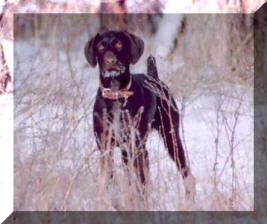
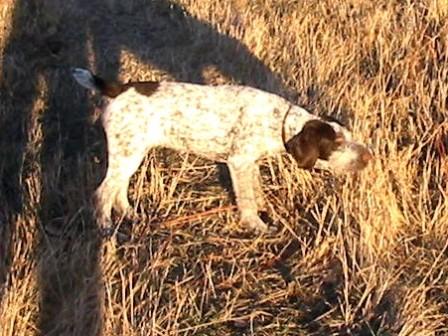
The coat is liver and white, usually either liver and white spotted, liver roan,
liver and white spotted with ticking and roaning or solid liver. The head is
liver, sometimes with a white blaze. The ears are liver. Any black in the coat
is to be severely penalized.
Gait
The dog should be evaluated at a moderate gait. Seen from the side, the movement
is free and smooth with good reach in the forequarters and good driving power in
the hindquarters. The dog carries a firm back and exhibits a long,
ground-covering stride. When moving in a straight line the legs swing forward in
a free and easy manner and show no tendency to cross or interfere. There should
be no signs of elbowing out. The rear legs follow on a line with the forelegs.
As speed increases, the legs will converge toward a center line of travel.
Temperament
Of sound, reliable temperament, the German Wirehaired Pointer is at times aloof
but not unfriendly toward strangers; a loyal and affectionate companion who is
eager to please and enthusiastic to learn.
Approved October 10, 2006
Effective January 1, 2007
Source: http://www.akc.org/breeds/german_wirehaired_pointer/index.cfm