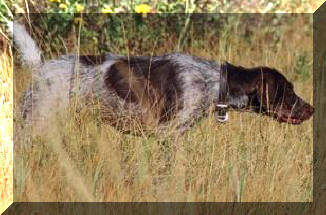
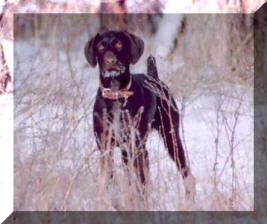
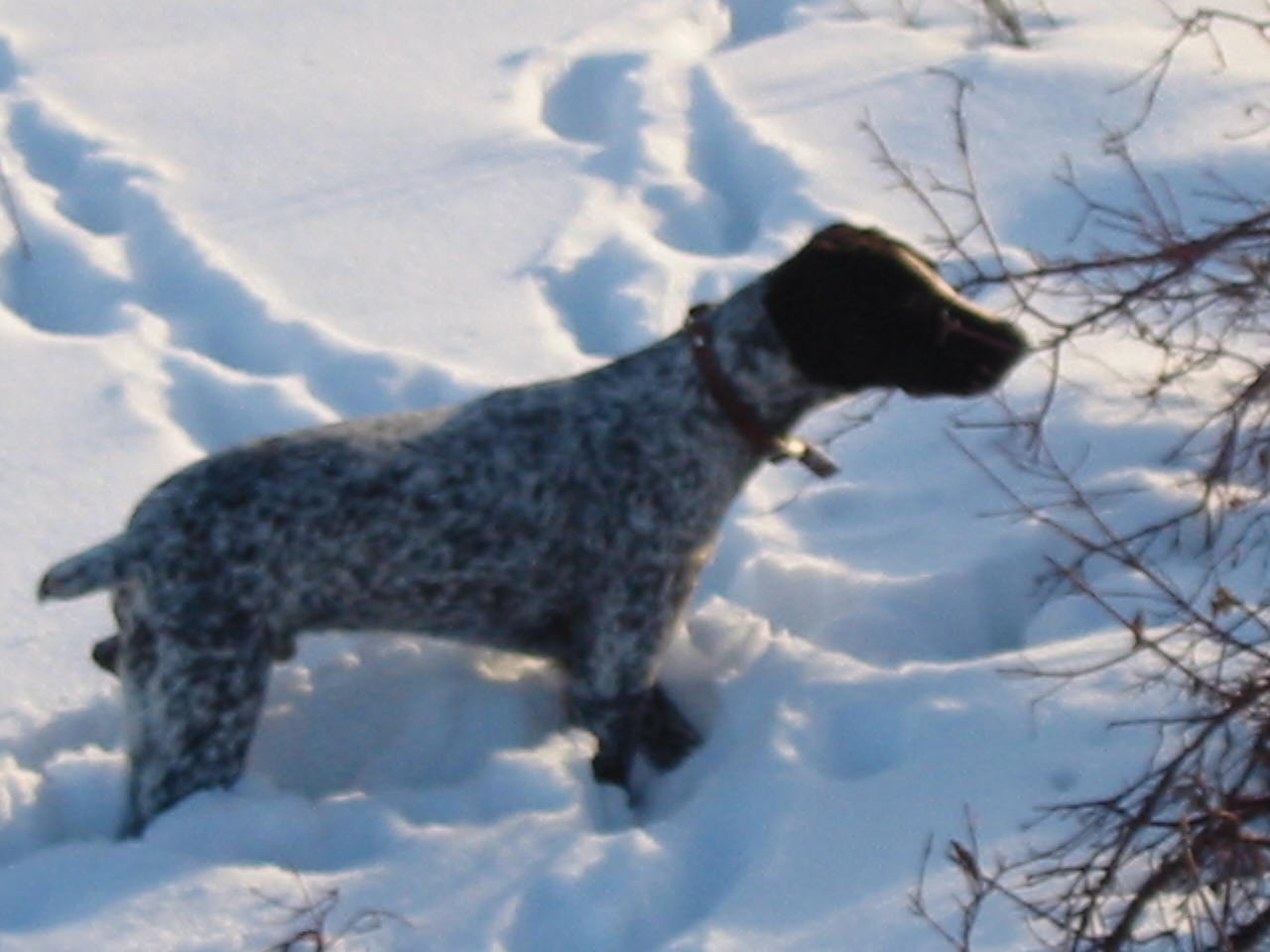
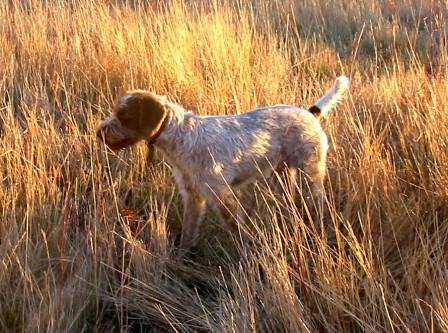
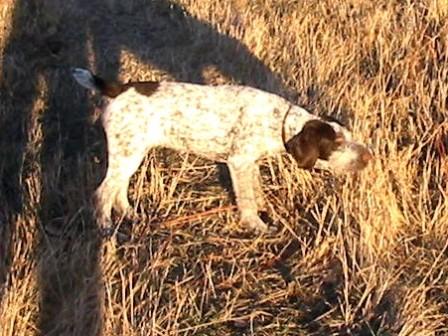


As much as we love our wires and we think they are the best dogs in the world, the truth is, they are not a breed for everyone. German Wirehaired Pointers are very demanding dogs. They need lots of exercise. And no, a walk on a leash is not enough for them. As members of the sporting group, they were bred to hunt for hours at a time.
We are not suggesting that only hunters should have German Wirehaired Pointers. GWPs make wonderful pets and house dogs. They just HAVE TO BE EXERCISED REGULARLY. Unless of course, you would like to have your shoes, TV remotes, books, and magazines chewed up, your carpet torn up, shredded paper towels all over your living room, etc. Yes, it all happened to us when we did not give our dogs enough exercise.
Many people ask if GWPs make good kennels dogs. The answers is no. They are very people oriented and like every dog they could get used to being full time kennel dogs but they thrive on human interaction. We do kennel our dogs outside when we are at work but they spend evenings, nights and weekends in the house with us.
The following is an excerpt from the German Wirehaired Pointer Club of America website:
WHAT ARE THEY MIXED WITH, AIREDALES?
AREN'T THEY THE SAME AS GERMAN SHORTHAIRS, ONLY WITH LONGER HAIR?
I'VE HEARD OF A BREED CALLED DEUTSCH DRAHTHAAR. IS THIS THE SAME BREED?
DO THEY SHED MUCH? ARE THEIR COATS EASY TO CARE FOR?
ARE THEIR HEADS NATURAL, OR GROOMED LIKE THAT?
ARE THEY GOOD WITH KIDS? DO THEY MAKE GOOD PETS?
WHAT ARE THEIR TEMPERAMENTS LIKE?
WHAT ARE SOME OF THE THINGS I CAN DO WITH A DOG LIKE THAT?
WHAT ARE THEIR ORIGINS?
GWP's trace their origins back about 120 years. They originated in Germany,
where breeders wanted to develop a rugged, versatile hunting dog that would work
closely with either one person or a small party of persons hunting on foot in
varied terrain; from the mountainous regions of the Alps, to dense forests, to
more open areas with farms and small towns. The breed the Germans desired had to
have a coat that would protect the dogs when working in heavy cover or in cold
water, yet be easy to maintain. The goal was to develop a wire-coated, medium
sized dog that could:
Search for, locate and point upland game;
Work both feather and fur with equal skill & Retrieve water fowl
Be a close-working, easily trained gun dog
Be able to track and locate wounded game
Be fearless when hunting 'sharp' game such as fox
Be a devoted companion and pet; and
Be a watchdog for its owners family and property.
WHAT ARE THEY
MIXED WITH, AIREDALES?
No. GWP's have no Terrier ancestors, despite their appearance. GWP's trace their
origins back about 120 years to Germany, where breeders wanted to develop a
rugged, versatile hunting dog that would work closely with one or more hunters
on foot in varied terrain. The Germans desired a dog with a coat that would
protect it when working in heavy cover or cold water, yet be easy to groom.
The primary ancestor of the GWP was a breed called the Pudelpointer. The Pudelpointer, itself, was developed by crossing the German Pudel and the English Pointer.
By selectively crossing the Pudelpointer to a variety of continental hunting including the Griffon, Stichelhaar, Polish water dogs, early German Shorthairs, etc. the breed we know today as the German Wirehaired Pointer evolved.
Today, the German Wirehaired is the most popular dog in its homeland. Because of its ruggedness and unique, close-fitting, harsh, protective coat, the breed is well able to withstand hunting in cold climates, and is, therefore, also popular in the Scandanavian countries. In fact, the majority of GWP's in the US come from primarily Danish foundation stock.
AREN'T
THEY THE SAME AS GERMAN SHORTHAIRS, ONLY WITH LONGER HAIR?
No. While both breeds originated at about the same time and there has been some
cross breeding between the two, each developed from distinctly different root
stock. The GSP is actually a slightly older breed. It was derived in part from
crossing English Foxhounds and old German hunting hounds with English and
Continental pointers.
On the other hand, the GWP has no direct hound ancestors. Its ancestors include Pudels and Pudelpointers, neither of which were used in development of the German Shorthaired.
These distinctly different roots make todays GSP and GWP different not only in temperament, personality, but if you look past the coat, you can see the difference in the head and body type as well.
I'VE HEARD OF A BREED CALLED DEUTSCH DRAHTHAAR. IS THIS THE SAME BREED?
Yes. In German the word "Deutsch" translates to mean "German", the word "Draht"
translates to mean "Wire" and the word "Haar" translates to mean "hair". German
Wirehaired is a literal translation of Deutsch Drahthaar into English.
In Europe the Deutsch Drathaar is not considered a "pointer". Rather it is one
of several breeds of Continental versatile gun dogs. This reflects the variety
of tasks the GWP may be asked to perform such as blood track, retrieve out of
water and hunt varmint. Other Continental Versatile Gun Dogs that are recognized
by the AKC include the German Shorthaired, Brittany, Vizsla, and Weimaraner.
When the Deutsch Drahthaar was officially recognized by the American Kennel Club
in 1959, its name was changed to the English translation and the word 'pointer'
was added for purposes of classification within the US Sporting Group. However,
today the GWPCA continues to stress the importance of the "versatile" aspect of
the breed.
DO THEY SHED MUCH? ARE THEIR COATS EASY TO CARE FOR?
The GWP retains several characteristics of its Pudel ancestors: high degree of
intelligence, trainability, biddability, and excellent water retrieving ability.
And, delightfully, a coat that sheds only lightly year-round. GWP's do not shed
drastically or "blow" their coat twice a year like many breeds. All dogs do
shed, however, GWP's shed at a rate that is not normally very noticeable.
A GWP with a correct coat requires only a minimum of grooming to remain neat and
presentable. A correct coat is harsh; lies flat, tight and close to the skin;
and is about 1 to 2 inches long on the body. A correct coat is also water
repellent, permitting the dog to dry quickly after a bath or a swim. Most
conscientious breeders will not sell as 'show quality' any dog that has a long,
soft, silky or wooly coat. Most such dogs go to hunting homes or pet homes.
However, this type of incorrect coat requires considerably more care to keep
neat.
ARE
THEIR HEADS NATURAL, OR GROOMED LIKE THAT?
A GWP with a correct coat has a naturally short coat on the skull. The ears and
cheeks often have some whispy fringe that is typically removed for the show
ring. The eyebrows, whiskers and beards are naturally longer.
So, yes, the head on a dog with a correct coat IS natural. It is not groomed
like that. And a GWP that has too short a coat possessing no facial furnishings
so that it resembles a GSP, is just as incorrect as one with too long a coat.
ARE
THEY GOOD WITH KIDS? DO THEY MAKE GOOD PETS?
GWP's are extremely devoted dogs. When raised in a home with one owner, they
become very definite one-person dogs. When raised in a home with several people,
including children, they become devoted to the whole family, although some dogs
may attach more strongly to one member of the household.
Young GWP's are typically fun loving and playful and with proper supervision for both children and animal, GWP's and kids do very well together. On the other hand, an adult GWP that has not been raised with children may need strict supervision if sold into a home with young children.
And, as with any dog, very young children should be taught to
properly handle a puppy, as well as to understand the difference between playing
with a dog and hurting it.
GWP's make superb companion dogs and pets. In fact, they crave human
companionship, doing best in a home where they are permitted a very warm, close
relationship with 'their people'. They are one Sporting Breed that does not make
a good kennel dog, nor a dog that lives all its life in a backyard with little
contact with humans.
DO THEY MAKE GOOD
WATCHDOGS?
As stated above, the typical GWP craves human companionship. The breed is also
primarily a hunting dog. For these reasons, they are not recommended as
candidates for formal guard dog training and work.
However, in the process of selectively breeding for the types of characteristics
desired in the Drahthaar, the Germans also selected for 'sharpness'. The GWP is
what is known as a 'sharp' breed. While there is no easy definition for that
definition, in practice, it means a dog that is fearless when hunting quick,
'sharp' animals such as fox and weasel. GWP's were expected to locate and kill
such game. In fact, until as late as the end of the 1940's, GWP's could not be
bred in Germany unless they passed a 'sharpness' test.
It is important to note that "Sharpness" does not mean "vicious." An adult GWP
may become aggressive toward other dogs and reserved or "aloof" with strangers,
but they should not be aggressive toward people.
Perhaps the closed comparison to the GWP temperament is the typical Terrier
terperament. These dogs are highly possessive. They are smart, proud, 'stand-up'
dogs. If challenged by another dog, or seriously mistreated by humans, or when
their home and family are in danger, a typical GWP is quite capable of fighting
or biting.
WHAT ARE THEIR
TEMPERAMENTS LIKE?
The GWP is a complex breed. Intelligence, strong desire to please, sharpness are
all qualities that make up the typical GWP. Many, GWP's have have a clown-like
side to their personalities. They can be active, busy dogs that amuse themselves
with various games. However, they are not 'hyper' dogs. In general, there are
few more loving or interesting breeds.
It is their intelligence, however, that can become the GWP's downfall. Without
interaction with their family, GWP's can become easily bored. Without mental
stimulis, they can become destructive and noisy in their attempt to "find
something to do."
Because of their desire to please, the GWP does not require nor respond well to
harsh or heavy-handed training. Most truly do not like to be 'on the outs' with
their people, and can be corrected with a sharp 'NO!' A GWP that is treated
harshly or roughly may completely turn off, becoming fearful, sulky and/or
remote, or may become a biter.
On the other hand, when permitted to develop a close relationship with one or
more people, and when trained with respect for his intelligence and desire to
please the GWP is a willing and able partner who will continue to amaze you with
his quickness to learn and his desire to perform.
DO THEY MAKE GOOD
HOUSE DOGS?
Yes. As mentioned, GWP's thrive on human companionship. However, they grow up to
be large active dogs that, without manners and basic obedience, can become
unwelcome in a household situation. It is important to take the time to train
them properly so they can become the loving companion they want so badly to be.
The typical GWP is not destructive, even as a young puppy. But, as mentioned,
they are active and easily bored. So it is not recommended that young, untrained
GWP's be given the run of the house when no one but the dog is home.
ARE THEY FENCE JUMPERS?
No. The typical GWP may be a fence-jumper, and do not commonly dig under fences
(although a bored dog may dig holes in your yard). However, most will find and
exploit holes in walls or fences, particularly if there is an offending squirrel
on the other side! Once a GWP learns it can escape from its yard, it may
continue to do so until all escape routes have been corrected. As with many
breeds, the safest place to keep a GWP when unattended is a covered, locked dog
run.
WHAT ARE
SOME OF THE THINGS I CAN DO WITH A DOG LIKE THAT?
First, and most important, enjoy one of the closest and most interesting
relationships with a dog that you are ever likely to experience. Then ask
yourself what you enjoy doing. It's pretty likely your GWP can participate.
Aside from its unique coat, one of the most distinguishing geatures of the GWP
is its versatility and its adaptability. Waterfowl retriever...Pointer of upland
game birds...Blood tracker of wounded deer...Hunter and Retriever of fox, hare,
rabbit and similar small furred game; this breed is all of this and more.
GWP's have competed successfully in Schutzhund trials in Germany. In Scandanavia,
in addition to hunting, the breed competes in a form a ski racing in which the
dog pulls its human partner, the skier, by means of a special harness.
In North America, the breed is a popular personal gun dog in addition to having
achieved success in AKC Field Trials. The GWPCA has long stressed the dual
purpose dog throughout its history. Unlike other members of the Sporting Group,
with few exceptions, there is still no split between 'field type' and 'show
type.'
In the US, the breed has had many Best in Show winners, and a large number who
have won or placed in group. It also has many dogs with obedience and tracking
titles. A sizeable percentage of titled GWP's have achieved titles in more than
one activity, and many show and obedience dogs are also used as hunting dogs.
With the new sport of agility gaining popularity, the GWP has found another
arena in which its natural athletic talent makes it a top contender
In fact, attaining excellence in more than one field of endeavor is not uncommon
to the breed. Several hundred GWP's have run in North American Versatile Hunting
Dog Association (NAVHDA) tests since that organization's founding in 1969, and a
high percentage qualified in those tests. Many of those dogs were also show
champions, field champions, hunting title holders and obedience title holders.
Many have done well in National Shoot to Retrieve trials.
GWP's have performed with the Ringling Bros. circus (one was a show champion),
and have acted in movies. The star of Walt Disney's movies The Biscuit Eater and
Bristleface were both GWP's. As with most 'stars', there were even several
fellow GWP's who acted as stand-ins!
This is a breed that enjoys plenty of exercise. Even GWP owners who prefer not
to participate in any particular organized dog activity find that their dog
makes an excellent companion on camping and fishing trips (your dog will want to
retrieve your bait and your fish!). They even make fine jogging companions.
In short, the activities in which you can participate with your GWP are limited
only by your interests, financial resources, the location in which you live, and
the time you have available to devote to your dog's training.
http://www.gwpca.com/index.php?option=content&task=view&id=17
To learn more about German Wirehaired Pointers please visit:
German Wirehaired Pointer Club of America's website