|
 |
Tibet
was terra incognita, i.e., The Unknown Land, to the western world
for a very long time. References to this country by the westerners
have been meagre.
Herodotus mentions 'gold digging ants in the north' but does not
know of the country.Strangely,
Ptolemy, who knew the sources of the rivers of the Punjab, never
had an inking of Tibet or its rivers.
|
|
It's the Arabs, from the middle 9th century, viz. Suleiman, Ibn Khordahbeh,
Al Ya Kubai, who became aware of this country, because by that time
they had come to India and Central Asia.The Immediate neighbours,
the Indians and the Chinese knew about this country for ages. The
population of Tibet is generally Mongoloid. It consists of a people
tall, long limbed and aquiline features andlong head in the Dotod
(Kham) and Domed (Amdo) regions. The other, short people, with high
cheek bones, flat nose and round headed population, are in the U-Tsang
region. Tibetan language is classified as belonging to the Tibeto-
Burman group by Western linguists. It may be noted that the Tietan
language has absolutely no resemblance to Chinese. As is usual, there
are many dialects in Tibet but the one prevalent in U-Tsang seems
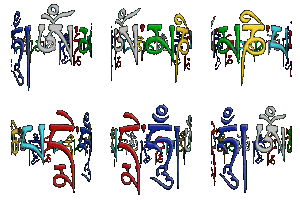
to be widely understood. The current forms of the Tibetan Written
characters have been developed in the 7th century on the basis of
Gupta Brahmi script prevalent in India. The Tibetan calendar follows
a lunar year of twelve months, each month comprising thirty days.
To adjust thi swith the solar year of 365, 1/4 days, an intercalary
or extra month is observed once in three years. The Tibetan New Year
begins with the first day of th month Magha in winter. In Sanskrit
Tibet is referred to as 'Bhota' and the Tibetan Language as Bhotia.
The modern name of Tibet, however, seems to be derived from the Mongolian-Thubet,
Chinese-Tufan, Thai-Thibet and Arabic-Thubbat. |
|
|
|