 |
|
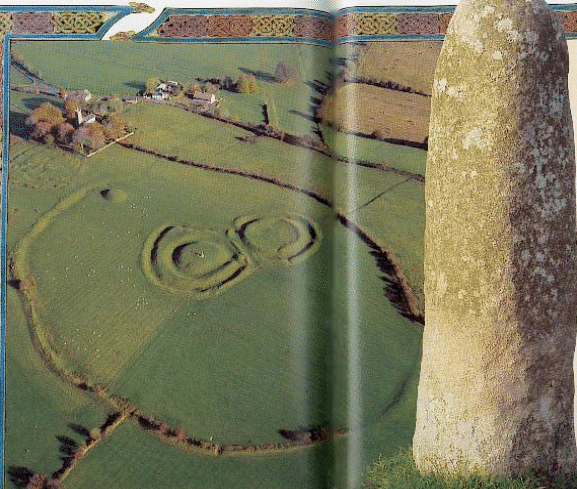
| "Lia Fail" The Stone of Destiny in Tara |
| Maiden Mother Crone |
 |
| Goddess of the land |
| The goddess has several distinguishing features: She personifies beauty and she gives her name as a cosmological centre-usualy a hill or mound. She bears a cauldron or chalise which is a neverending source of abundance and inspiration, the same inspiration imbued in the land that the Druids meditated upon to gain knowledge and truth. The internal sovereignty of the Self connected with the Goddess of the Land, the external spirit of sovereignty, through the tribe and the ancestors. The ancestors form part of the 'tuath' or tribeand their presence dwells within the land itself. The megalithic structures of the late Neolithic age, the chambered mounds, dolems, & portal tombs were ancient already when the Celts arrived. The resourceful Celts made these stone-age structures into abodes for their devine ancestors, the 'Sidhe'. They were the dwelling places of the Mother of the Gods, the sovereign spirit of the ancestors made mythic in the form of the devine feminine. This Goddess of Sovereignty is the embodiment of the 'other' in the I-Thou relationship between the self and the community of tribe, ancestors, and the earth. The mounds may well have held that meaning and purpose for the origional builders also, who were distant in time.... |
| Anu, Aine, Dana, Danu |
| In the Celtic worldview, like when the eternal Self as true ruler of the human being centres a person, when the true ruler is sovereign of the land, order and abundance prevails. The Celtic tradition represents sovereignty of the land as a female figure, a goddess, whom the ruler must marry so that order and abundance will prevail in the world. |
| The hidden House of Lugh |
| The High king of Ireland, Conn of a Hundred Battles, touched the stone upon the Hill of Tara and it cried out. Conn asked his Druids what this meant and they said to him: "The name of the stone is the Lia Fail, the Stone of Destiny. It was brought here by the Tuatha De Danann. It was placed here and it is here in Tara that it will stay forever. Whenever there is a gathering at Tara, the stone will cry out when touched by the rightful king, and when there is no king for the stone to exult in, there will be a hardness upon the land." Later, Conn comes to a finely built house near Tara that he has never seen before. In the house was a young woman. She had such fine looks and so steady and graceful a bearing he thought she must be a queen. She had on a green cloak that waved around her as she walked. It was fringed with silver and pinned by a marvelously wrought clasp of gold that reached across her breasts from shoulder to shoulder. Her brow was smooth and high, her eyes wide and bright, her cheeks flushed and playful, and her lips were as full and as red as the berries on the rowan tree. She had a |
| band of gold on her head to stop her shinning long hair from falling loose. From out of the sleeve holes of her dress her long straight arms, white and soft as the foam of a wave, held a silver vessel with rings of gold about it. It was full of fine red ale. She had a gold ladle and a gold cup to serve with. She said to the man on the seat of the host of the house: "Who am I to serve?" "Serve Conn of the Hundred Battles," the man said," for he will gain a hundred battles before he dies." That is how Conn got his name and knew of his destiny "This woman," the man of the house said, "is the Sovereignty of Ireland. She will be in this place forever...." |
|
| Mythology |
| Castle |
|
| Photos |

|
| You are visitor Number |
|
| Theban |
|
| Deities |
|
| Map of Ancient Ireland |
 |
 |