aka "Mentals"

Naruto City
Tokushima
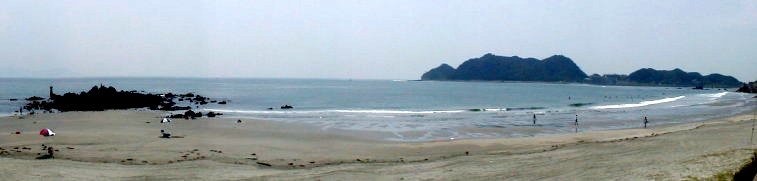
The setting is quite spectacular as the beach is located at the mouth of the great inlet of the Kii Strait as it empties into the Seto Inland Sea. The current and tides here are quite strong and caution is advised for weak swimmers. From the beach one can gaze unto the Naruto Oohashi Bridge, which crosses over the inlet onto Awajishima island. Beneath the bridge, the famous Naruto Whirlpools can be found. On clear days the view extends all the way to Wakayama Prefecture on the island of Honshu. The beach itself is fairly clean and is ringed with lovely flowering bushes. It is a nice spot for surfing or just swimming since there are often no waves.
Ryuuguu needs either a typhoon swell or the energy from a winter/spring low pressure system to produce any kind of rideable surf. Absent of this energy the water becomes a tranquil lake, perfect for swimming but not the best for surfing. The wave itself changes quite a bit as the strong currents in the channel tend to move the sand around a lot. It is best around waist to shoulder high. Head high gets tricky as the surfer must have the skill to pick and choose between the waves with a clean face and the board snapping dumpers. Ryuuguu will close out at double over head. Winds can be very strong here, too. A strong south swell and a stiff south east wind will turn this normally tranquil lake into rough and dangerous conditions very quickly.
Still, The Driving Range is a fun surf point. In summer the water is a warm as a bath and the vibe is mellow and mostly friendly. There is little or no localism to be found here. In summer it can get crowded but no where near as crowded as the nearby Komastu Kaigan beach. After school starts in September the beach returns to its semi-deserted state, yet good waves can still be found. As winter sets in the water gets progressively colder as the Kii Strait recieves very little influence from the warm Kuroshio Current. By Feburary and March the water drops from the warm bath like temps of near 30 degrees to a fridgid 8 or 9 degrees. Only the hardiest locals are to be found in the water in early spring, but if you show your face in the water in March you will be warmly welcomed by the locals in summer. Respect is, afterall, earned.
The main hazards here are the strong currents and jellyfish. The currents are very strong and during a typhoon swell unsuspecting surfers are sometimes swept out into the channel. Not a happy scenerio since the channel is one of the busiest sea lanes in the world and is puntuated by the odd whirlpool or too. While not overly dangerous by any means, caution is advised. The jellyfish arrive with the warm water. There are said to be over 400 types of jellyfish found in the seas around Japan and many have nasty, posionous stings. The purple, bubble headed ones seem to be the most feared, but they all have the potential to creep you out. I've seen some seriously allien looking jellyfish in the waters around here. Sharks are almost completely unheard off, although some of the old timers say that years back they used to be sighted now and again.
Veterans will tell you that the whole coast which stretches north for about 3 kilometers used to be surfable. If you go now you will find most of this coastline fortified with the loathed "tetorapoto", huge plus sign shaped concrete blocks that the Japanese Government loves to install along beaches everywhere. Still, during a typhoon swell a few small points in and around the tetra light up. There aren't any real facilites to be found, but there are some showers about halfway between Ryuuguu and the Bridge. A little further on there is a rest area and some bathrooms. A few noodle shops and small shops dot the highway along the coast. There are also a few "love hotels" should you happen to be with a partner and in the mood. And if you don't know what a "love hotel" is, then you haven't been in Japan very long.

Typhoon #5