|
Magnetic Discovery Club
Free Energy Magnetic Mini-Romag Support
Information Brought To You By The Magnetic Discovery Club
(Information originally posted at www.magneticenergy.com ) Mini-Romag Generator
We are providing this free
information out of love to help save our planet. Please help us in educating
people about magnetic energy. ABSTRACT This generator is a magnetic
device incorporating the use of permanent magnets turning with a rotor to
generate a magnetic energy which is then circuited to other mechanisms to do
useful work. This mini generator demonstrates that magnetic principles can be
utilized in units of various sizes. Magnetic units can be microscopic or a mile
wide, as long as the correct principles are maintained. When magnetic fields
are properly harnessed, when the magnets and housing are a certain composition,
when the magnets are rotating at the proper rpm, and when the energy is given a
redistribution path, a very powerful phenomenon occurs; the natural flow of
Universal magnetic energy begins to escalate. All magnets draw energy in to
maintain their power, but under the right conditions magnets can assist in
attracting large quantities of magnetic energy that can be used for numerous
purposes. It is critical to remember
that this magnetic generator does not create pollution while it is running. The
conventional processes used to obtain the materials obviously create pollution,
but as people progress beyond the current destructive technology, even the
processes of extracting natural resources and manufacturing materials will
become less polluting. It is also critical to note that this device is designed
to recycle the energy it uses from the Earth's energy system. Scientists will
soon come to a consensus that electricity does not properly harness the natural
flow of energy and that the electrical power system does not properly recycle
energy after it is used. The environment is suffering because of current
technology, especially electricity, and it is becoming critical that people
begin to switch to a new form of energy production. Many of the negative effects
of electricity production are apparent to most people, the stripping of natural
resources and the millions of tons of pollution that power plants pump into the
atmosphere. But the Earth's system is being severely affected by critical
energy interaction that is occurring between electrical fields and the magnetic
field around the planet. The focal point of electricity's negative effect on
the environment occurs in the ionosphere. The ionosphere is a sea of pulsing
neutrons that assists in sustaining life on this planet. The ionosphere
supplies the energy for any system in the environment that requires energy to
function. Power planets are constantly drawing energy from the ionosphere to
maintain functioning. The problem is the power plants do not use the energy
properly, nor do they recycle the energy back to the ionosphere. Running power
plants create an imbalance in the Earth's energy field that causes the
ionosphere to perform a rebalancing process. Powerful vortex fields form in the
ionosphere that draw energy up to restore the depleted field. These vortex
fields often result in dangerous storms that involve tornadoes and hurricanes.
The H.A.A.R.P. Project (High-frequency Active Auroral Research Project) in
Alaska is a multi-billion dollar governmental project that researches the
interaction between electricity, the ionosphere, and the weather. See Dr. Nick
Begich's book Angels Don't Play This HAARP to learn more about this
project. Nikola Tesla had a firm
understanding of the interaction the ionosphere had with energy systems. Tesla
designed many devices that form the foundation of today's technology. Tesla
also invented magnetically based devices that were never produced in large
quantities that were far superior than today's technology. Through his research
on magnetism and electricity, Telsa repeatedly demonstrated how intricately the
energy fields we generate are connected to the ionosphere. Telsa also proved
over and over that weather can be influenced by artificially generated energy
fields. For decades, the government has been using Tesla's concepts to test and
abuse the ionosphere without regard for the environment and the safety of
people. It is critical that people
stop damaging the ionosphere with electricity, not only because the weather
will become increasingly severe, but because ozone holes are continuing to form
and expand. Chemicals have never been the cause of the ozone holes. Electricity
production is the primary cause of the ozone holes, and many scientists have
known this for many years. It is an electrical interaction that is altering
magnetic molecular structures preventing a natural restoration to the planet's
energy field that is creating the ozone holes. The process forming the ozone
holes will be stopped because without the ozone layer, life will cease to exist
on this planet. The time will come in the near
future when the Earth will undertake a pole shift that will alter the magnetic
field around the planet. This pole shift will make electricity generation
impossible. The ionosphere will no longer supply the energy structures that
make it possible for power plants to generate electricity. This pole shift will
force people to use different technology, like magnetic energy, to power
devices. The revelation of a pole shift and the changing magnetic field is
being given to many people, and it is a necessary process for the Earth to
undergo to begin the process of healing, or rebuilding the energy field around
it to ensure a stable, long lasting system. Magnetic technology will assist in
rebuilding the system and ensuring our long term survival. PRINCIPLE BEHIND THIS ENERGY SOURCE This generator utilizes
neutral magnetic energy from the Earth's energy field by attracting the energy
through the proper magnetic harmonic. The unit captures the energy and changes
it into a polarity that magnetic devices can accept. This simple unit is like a
water wheel, it only functions if a flow is moving through it, and it will continue turning as long as it is being used to power something. An important object of the
present device is to provide a revolutionary new concept concerning the
utilization of power by directly capitalizing on the natural resource of
magnetism. Electrical power is the result of expending energy to drive a copper
wire through a magnetic field. But magnetic energy is a natural resource
needing a specific mechanism to draw on. There is no incorporation of a
secondary energy source except at start-up, to cause this magnetic generator to
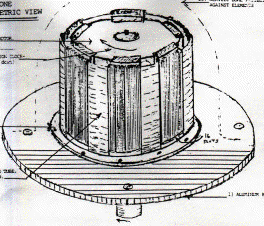
continuously function. HOW THE UNIT FUNCTIONS: The here disclosed 31/2 volt,
7 amperage magnet motor/generator must be charged up by driving the main shaft
at 2100 RPM for 42 seconds. This charging process manifests as magnetic energy
within the six coils of copper wire, the copper tube supporting these coils and
the copper coated steel wires wrapped around the magnets. This charging is
accomplished while the six coil connection wires, Part #22, are making
contact and setting up their alternating magnetic poles. After the 42 second
charging time one of these coil connection wires must be opened and this
circuit again completed through an energy draw at what could be called 7 amps.
See load Part #23. As current is drawn from the six coils, this draw sets up
magnetic poles which are a response between the rotor magnets and the coils.
This response then causes the main shaft to be rotated by the 12 permanent
magnets as they attract and build a release field. Then the driver unit (hand
crank) is disconnected allowing the unit to rotate with the load being the activating
driving force. The fields of the magnets must
be maintained during their spin movement. These magnetic fields which are
encapsulated are achieved by the wiring system. The attract/release of the
magnets is a function of several factors. First, the magnets attract field
between north and south is completed by taking a crossing path of attract (top
of one row to bottom of next, etc.). This action has the effect of fields
blending into fields, and a hold-back attract does not happen. Each time a
magnet set passes a coil an interchange of like energy between the coils around
the magnets and the generating coils sets-up neutral polarities which are
'release fields' and prevents a hold-back attract. One important magnetic
assembly is the circuitry which allows this interchange of energy. This is a
recycling of a stabilized magnetic energy not electro/magnetic because
the field of force is not a case of electrical input, an input that created the
magnetic energy, but rather a build-up of magnetic energy which caused an
energy thrust. In further defining the
workings of this unit it is important to understand that although electrical
and magnetic (energy) work with similar attitudes, the manner in
which they work sets-up a differing energy effect. One of these effects is that
magnetic structures want to share their f1ow, compatible to the
Universal Force, while electrical flow argues, (short circuits, sparks, etc.).
Because of this fact the working responses (within the unit) take place, how
they are needed, and when they are needed which results in a functioning unit.
There is a continuous transmutation process taking place whereby magnetic
energy continually generates an energy that manifests a measurable
current. In the past, inventors have
sent devices and drawings to Patent Offices claiming they had invented
perpetual motion. This motor, which is driven totally by permanent magnet
power, in no way can be compared with perpetual notion in that the principle is
not the same. When perpetual motion is discussed, it is mentioned in terms of
unknown factors, which produce an unknown force. Here, in this Mini Ro-Mag, the
force of attract-attract to attract-release within the magnetic structure can
be observed, thereby producing the generating force to turn the rotor, which in
turn produces the outflow of power. This power source is not predicated on a
continuous flow of energy but predicated on the consistency of the
transmutation process of the magnetic molecular structures within the Earth's
pressure flow. Some additional points may be
useful in understanding the functioning of this unit. The thin web of brass
between the magnets is important because it acts somewhat like a magnetic
insulator. Each section of brass, on the sides of the magnets becomes charged,
somewhat like a capacitor. This builds into a force which TAKES PART in causing
the rotations. The magnets have a
particularly low charge, but their charge is only a catalyst at the onset. It
is during the SPIN charging that this blend of alnico elements draws neutral magnetism from the atmosphere that then manifests with the proper magnet strength for continuous running. This 2.2 peak energy product is the power needed that becomes a point of
INCOMING and OUTGOING magnetic transference. Too much charge would solidify
polarities that would then negate the needed VARIETIES of DIFFERENT magnetic
fields. This Mini-Romag generator
cannot run horizontally. The magnetism of the earth system FEEDS this unit from
the top. Gravity is compressed magnetism. The spinning rotor CAPTURES this
compressed magnetism. Without the copper coated
steel wire around the magnets no activity would take place and here is why. As
the rotor is spun, an action that MUST happen is that the fields around the
magnets need to stay with the magnets. These fields do not manifest as
individual flux lines if the magnets are not wrapped as disclosed. The
copper-coated steel wire becomes a MAGNETIC CONTAINMENT FIELD as these wires
take on THEIR OWN charge. These SETUP fields then serve as ISOLATOR fields
which keep the magnets' flux lines in their place. The reason these copper-coated
steel wires need no insulation is because the COPPER COATING ITSELF builds into
a magnetic flow, which insulates the primary flow that travels inside the steel
portion. This action results in a magnetic flow circuit that is GUIDED by the
activity of the copper coating. This action should serve as a TEACHING to show
how magnetic current can be sent through conductors that are TOTALLY UNLIKE the
standard electrical insulators. The primary USE of this field (set up by these
wires) is that it serves as a RELEASE AGENT that breaks the elastic hold-back
during the generating cycle. The reason for the U-bent
wires is that they serve as a CONDUIT that causes the magnets flux lines to
take their travel path very close to the magnet. This circuit path is around
the back surface and both side edges. This action can be likened to compressing
a balloon. The result is that the field on the front or WORK SURFACE is greatly
extended OUTWARD. This outward extension impacts the copper stator core, which
then FEEDS captured magnetic current into the stator windings. SUBJECT: Answers to questions
about the Mini Romag unit To be successful, we
must all put our energy into making this work. We were given this information in
bits and pieces that we had to sort through to make sense of. There may still
be improvements to the design we have presented. For example, the romag may
contain information useful on the miniromag - we have not done enough
experimenting to see if this is true. Q1) What type of brass is used
for the rotor? A1) brass rotor made of 83%
copper, 3% Zinc, 7% Tin and 7% Lead. This info is taken from the romag. Q2) About the 12 permanent
magnets on the Mini-Romag, is the Alnico 4 material and its charge to only 2.2
peak energy product important? A2)The 2.2 peak energy product
is critical even though it produces magnets that are VERY WEAK. The magnet
company we used said their most difficult part of making these magnets was to
charge them FAR LESS than their energy potential. It seems these magnets and
their charge are at the very heart of this unit's design. We had a teaching
about the need for controlling the release timing in order to make a magnet
motor. This teaching states, "the release timing in magnets is dependent
on their strength. "A magnetic current needs to be free to flow TO the
rotor, then away from it, as the magnets charge and discharge their energy. The
release timing is the key to this activity. Q3) Is there insulation on the
outside surface of the copper coated steel wires? A3) We don't think so,
although we haven't tried the unit with insulation on the wires. Q4) Should the 11 (eleven)
turns of copper coated steel wire be connected to something? A4) Yes, the drawings show the
upper six magnets have these wires connected in series. The lower six magnets
are also connected in series, but there are no connections from the upper to
lower rotor magnets. The flow inside the wires is encouraged to flow around by
connecting the wire that exists at the SOUTH half of the magnet to the wire
located at the NORTH half of the wire next to it. Q5) What is the primary reason
for using these copper-coated steel wires around the magnets? A5) During the spin mode, the
method for containing the magnetic power of each magnet is to wrap them as
stated. When the rotor is spun and charged, these wires serve a critically
important function as CONNECTIVE DISTRIBUTORS. They distribute an energy flow
by properly containing the magnetic power of each magnet, and at the proper pulse
point release a harnessed energy into the stator winding. Q6) What keeps the magnets
from flying out? A6) The wrapped magnets fit
snugly into the bent wires. We are not sure of the best way to mount them, we
just applied a thin coat of clear 5-minute bonding agent on to the bent wires.
As we rotated the rotor at high speed, we never had any magnets come flying
out. There may be another method of mounting the magnets that produces greater
output, we just don't know yet. Q7) Did you bond the Mica into
the slots? A7) Yes. As you probably know,
Mica cracks if you bend it at room temperature. So we first cut the mica to
size then heated it with a standard iron. Next, the rotor was pre-heated to
about 200 degrees F. and the soft Mica was placed onto a heated tool the shape
of the slot. Next a bonding agent was placed in the slot area and the tool
forced the Mica in place, allowing it to stay until the bonding agent was set. Q8) Can some other insulation
be used instead of Mica? A8) The Mica is not just for
insulation, it serves an important magnetic function by setting up needed
fields of energy. Thus Mica is very important. Q9) How can the Mini-Romag
take a load with the use of only one bearing? A9) This Mini-Romag unit is
not intended to drive ANYTHING. Its value is that it produces useful magnetic
current. The shaft is used only to drive it at start-up with an IN-LINE
coupling. Q10) How many light boxes will it light up? A10) NONE. The drawings show that only the light box generator can light up light boxes. It seems the best application for
this unit is to feed magnetic current to a small Magnetic Heating Unit, a
Magnetic Water Pump, or some other small magnetic device that will attract
magnetic energy. Q11) What does it mean that
the rotor magnets have a changing magnetic spacing? A11) The face of the magnets,
which is directed toward the stator coils, is a flat surface. The coil has a
rounded surface. As the lead and trail edge of each magnet pass any coil, the center
part of the magnet maintains a distance from the coil which is farther away.
This action causes different surfaces of the magnet to REACH to the coil with
changing sizes of flux lines. This changing magnetic spacing contributes to the
generated flow that leaves the coils. How do we know? We asked if a thicker
magnet should be used then rounded to fit the radius of the winding, and the
answer was NO. Q12) Can the Mini-Romag run
horizontally? A12) No. The feeding of
magnetized molecular structures must enter from the top of the unit. Q13) Is it possible to use a
3-volt light bulb as a load for the Mini-Romag? A13) The first items we tried
were small light bulbs. Electrical devices do not DRAW magnetic current because
they do not have an attract structure. Neutral magnetic current must be offered
a place to go which offers it a chance to gain a particular polarity. There may
be a way to modify light bulbs to get them to work with this unit, we simply do
not know yet. The principles of the pump and the magnetic motor might reveal a
way to set up a magnetic circuit and device to draw magnetic current into
various devices. To learn more about this subject study the action of the 10 HP
Magnetic Motor and the Water Pump. Q14) Is the Mini-Romag going
to run by itself if one does not open the starter switch to draw off magnetic
current? A14) No. The six coils need to
setup attract poles to the spinning rotor. It is only when magnetic current is
removed from the coils that they establish their needed poles. Q15) Would a copper-coated
steel wire having a coating of solder do for wrapping the wires? A15) We don't think so,
solder, for some reason, was not even to be used on the connections. Q16) The coils wound with the
stated turns on the Mini-Romag stator do not add up to the sizes given. Why
not? A16) We probably should not
have given coil sizes, just the number of turns. However, we found these coil
sizes by actually measuring our coils after winding. All our work was HAND
WOUND and it is the human element that adjusts what is possible to what theory
says should be the finished sizes. It was a tight fit, but it did fit
nevertheless. Maybe reducing the number of turns until the coil fits is the
easiest solution. Q17) Was the acrylic dome just
for protection against the weather? A17) Probably not. Other
magnetic units needed to have the air space around them CONTAINED so that the
air could be magnetically charged. As we spun our unit, waves of magnetic
energy could be felt several inches away from the stator. Q18) Are the mounting points
for the copper stator actually rivets that fit into the acrylic ring? A18) No. The six copper
downward extensions should go 1/4 inch deep into the aluminum base plate. The
purpose of the aluminum base is to feed a magnetic charge into the copper
stator. We had difficulty mounting this stator as directed and mistakenly added
the acrylic ring, one of the errors we later found by looking at old notes. Q19) Would you be interested
in building another Mini-Romag or finishing the 50 HP Romag if help were
forthcoming? A19) Our experience with this
free energy subject has been nothing but massive suppression. When we have the
freedom to actually make these units without threatening the present fossil
fuel based economy, we will proceed with construction. At this time, we are to
teach about magnetic energy. We have asked, "So when can we have the
freedom to build and use some of these great devices?" The answer we
received was, "Don't get ahead of me, just don't get ahead of me, the
timing must be perfect." That answer seems to guide our next step. We will
know when to GET TO WORK. PARTS
LIST AND CONSTRUCTION DETAILS When
building your first unit we suggest using the stated materials. 1)
Aluminum Base Plate 2)
Sleeve Bearing, 1" long, 1/2" inside diameter, oil impregnated brass. 3)
4" long by 1/2" diameter Brass Shaft 4)
Brass 2" diameter Rotor, 1-3/4" long 5)
Six rotor slots, each 1-3/4" long by .260 deep by 23/32" wide. These
slots are spaced exactly 60 degrees apart. 6)
One slot cut in center of Brass Rotor, 360 degrees around, 1/4" wide by 5/16"
deep. 7)
12 slots (formed from the six slots as the 360 degree cut is made). Each slot
is lined with .010 thick mica insulation. 8)
A total of 228 pieces of U-shaped .040 thick copper coated steel wires. Each
slot (Part #7) has 19 pieces of these wires fitted into the Mica, thus these
wires do not contact the Brass rotor. The lead edge of these wires (See Figure
7) is flush with the Rotor's outer surface and the trail edge protrudes
1/8" above the Rotor's outer diameter. 9)
Eleven complete turns of .032 thick copper coated steel wire. These 11 turns or
'wraps' accumulate to 3/8" wide and the same pattern is placed around all
12 magnets. When placed into the bent wires #8, they are a snug fit making firm
contact. 10)
Are 12 pieces of .005" thick mylar insulation inserted into the cores of
the wires #9. 11)
12 permanent magnets, insulated with the mylar, to not contact wires # 9. These
magnets measure 3/4" long, 5/8" wide, 3/8" thick
and are made of a special composition and strength. Alnico 4, M-60; 12 AL, 28
Ni, 5 Co, bal Fe, Isotropic permanent magnet material cooled in magnetic field,
Cast 9100 TS. 450 Brin, 2.2 Peak energy product. When inserted in the rotor the
outer faces of these 12 magnets are not to be machined to a radius. The center
of these magnets pass the center of the coils with 3/32" clearance. The
edges, where the wires are wrapped, pass 1/32" away from the coils. This
'changing magnet spacing' aids in not only the release cycle but also contributes
to rotational movement. (Sharp magnet edges which are facing the coils are to
be sanded to a small smooth radius.) 12)
Magnet polarity placement into Rotor. (See Figure 5.) 13)
Connection pattern for wires wrapped around magnets. (See Figure 6.) The 12
wire wraps are divided into two sections, upper and lower of six each. There
are no connections between these sections. The magnetic flow direction between
the upper 6 wraps and the lower 6 wraps is attained by the 'flow direction' as
shown in Figure 5. Viewing Figure 6 shows the wires wrapped around the magnet
starting at the top 'north' half and then after 11 complete turns the wire
exits at the lower 'south' half. As this wire then goes to the next magnet it
arrives at an attract wire which is its 'north' side. Thus all wires get
interconnected from south to north magnet half or north to south magnet half.
The actual connections should be crimped copper clips not solder with
insulation tubing to prevent contact to the Rotor body. 14)
A .030 thick copper tube (stiff material) 2" long by 21/2" inside
diameter. 15)
Are six slots cut at the top of tube #14. These slots are 5/8" wide by 1/32"
deep spaced at 60 degrees apart. 16)
Are six slots cut at the bottom of tube #14. These slots are 5/8" wide by
5/16" deep and in line with the upper slots #15. 17)
Six copper tube mounting points. 18)
Acrylic ring to hold Part #14, measuring 3-3/4" O.D., 21/4" I.D.,
3/8" thick bolted directly to Part #1. This ring has a .030 wide groove
cut 1/4"deep to allow the six copper tube mounting points, Part #17, to be
inserted. 19)
A .002" thick plastic insulation paper to be placed around the inside and
outside of Part #14. 20)
Are six coils of insulated copper wire, each coil having 72 turns of .014 thick
wire. Each coil is wound with two layers, the bottom layer to completely fill
the 5/8" wide slot with 45 turns and the top layer to span 5/16" wide
with 27 turns. To be sure each coil has the exact wire length or 72 turns, a
sample length wire is wrapped then unwound to serve as a template for six
lengths. A suggested coil winding method is to fill a small spool with one
length then by holding the copper tube at the lower extension, then start at
the plus wire in Figure 2 and temporarily secure this wire to the outer surface
of the tube. Next, place the pre-measured spool of wire inside the tube,
wrapping down and around the outside advancing clockwise until the 5/8"
slot is filled with 45 turns. Then, return this wire back across the top of the
coil for 15/32" and winding in the same direction again advance clock-wise
placing the second layer spanned for 5/16" with 27 turns. This method
should have the second layer perfectly centered above the first layer. After
winding this coil, repeat the process by again filling the small spool with
another length of pre-measured wire. A very important magnetic response happens
as all six coils have their second layers spaced as disclosed. 21)
This number identifies the top view of the second layer. 22)
Connection pattern for six coils shown in Figure 2. When the unit is driven at
start-up (hand crank) for 42 seconds at 2100 RPM, all six jumper wires must be
together which means the plus wire goes to the minus wire connected by the
start switch. After 42 seconds the load is added to the circuit and the start
switch is opened. To double check your connections between the coils, note that
the finish wire of coil #1 goes to the finish wire of coil #2, which is top
layer to top layer. This pattern then has start of coil 2 (bottom layer) going
to start of coil 3 (also bottom layer). When the copper tube with the coils is
placed around the rotor, the distance from any magnet to any coil must be
identical. If it measures different, acrylic holding shapes can be bolted to
the aluminum base, protruding upward, and thus push the copper tube in the
direction needed to maintain the spacing as stated. 23)
Wires to load. 24)
Wires to start switch. 25)
Rotational direction which is clock-wise when viewing from top down. 26)
Acrylic dome for protection against elements. 27)
Coating of clear acrylic to solidify rotor. Do not use standard motor
varnish. Pre-heat the rotor and then dip it into heated liquid acrylic.
After removal from dip tank, hand rotate until the acrylic hardens, then
balance rotor. For balancing procedure, either add brass weights or
remove brass as needed by drilling small holes into rotor on its heavy side. 28)
Insulation tubing on all connections. 29)
Shaft for start purposes and speed testing (if desired). This
concludes the parts list for the Mini-Romag. Please share this information with
others.
(The above information was part of the original posting at
|
||||
|
Minature |