
Rights of British Colonies, Asserted and Proved: Throughout this document James Otis proves that the purpose of government was to provide for a secure, quiet and happy enjoyment of life liberty and property. He goes on to say that God gives man the natural right to be free.
The Boston Port Act: This document shows the other side of the issue. Written by the British government, this document tries to destroy the natural rights of man and prove that the colonists were in Britain's debt for trying to disobey the absolute law.
The Rights of the Colonists: This document makes a tie between man's natural rights and how they survive under British law. Samuel Adamsstates that man has rights such as the right to worship God, but he also believes that the colonists owe the British Government and should bend to their law before our own.
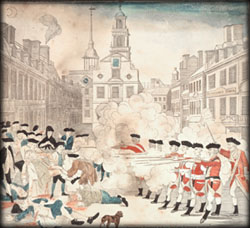
The Boston Massacre as Reported in the Boston Gazette: Man's rights and how we should stand up for them are highlighted in this document. It gives a detailed analysis of how the rights and lives of the men were violated and how the colonists were in the right.
Circular Letter of the Boston Committee on Correspondence: This document automatically assumes that the rights of the British colonists are being infringed upon and that the colonists need to unite and defy Britsh laws. The circular letter derives it's purpose from the fact that the basic human rights of the colonists were being infringed upon.
The Rights of the British Colonies Asserted and Proved: This document, really focused on the responsibilities of the government, the uniting of people for the betterment of it, and the equality of the people. James Otis bases lots of his arguments on beliefs, rather than on facts. He specifically highlights that:
+The Government controls the land and property of the country and all property is power.
Power is also used however the possessor chooses.
+People are "weak, imperfect beings", but they have to rely on each other to imporve their own
faults. Only by working together can people reach successful outcomes.
+The colonists should be happy to be British subjects. They should want some rights instead of
some kings though. He points out that their slavery is not by Britain, but by the British government
The Boston Port Act: This document is an act from the British Parliament focusing on British trade in the Boston Harbour. It outlines the action that now needs to be taken to punish the Boston people for the Boston Tea Party. The majority of this document, unlike the last one, is based on fact, and not belief. The specific points are:
+The violent acts of the Boston people should be returned with the departure of Great Britain from
Boston's shores.
+If a British ship is in the Boston harbour, all of the supplies on board will be forfeit if it doesn't
move in six hours.
+If laws are broken by the British or American's a court trial will take place.
The Rights of the Colonists: Samual Adams outlines the colonists basic rights in this document. He focuses on the colonists right to life, liberty and property. He also shows how to maximize the amount of liberty and freedom that should be granted to each citizen. Some of the specific rights he points out are:
+The natural Liberty of Man should be abridged only so far as is necessary for the great end of
society and for the good of the whole.
+Every man should have the right to woship God according to the dictates of his own conscience.
+Man is to be free from Superior power on Earth, and the legislative should not have absolute rule.
Boston Massacre as Reported in the Boston Gazette: This account of the Boston Massacre was written from a distinct Bostononian point of view. It portrayed the colonists as domonstrating inevitable behavior, and the British as tyrants and raging "bullies" who took murder as "necessary punishment". Many of the things stated in the document are said for shock value. Some of the main points were:
+"[The British] attacked single and unarmed persons until they raised much clamor...continuing to
drive the popel off by pricking them in several places" upon which the colonists grew very angry.
+'The British were so cruel and unaffectd by their ats that they even attempted to forcefull prevent
those trying to help the wounded and remove the slain'.
+The aggravated Bostonians threw harmless snowballs at the British soldiers but were returned with
deadly bullets.
Circular Letter of the Boston Committee of Correspondence: This document's main focus is on how the colonists in Boston are being treated unfairly. It's also a call for the colonies to unite as long as the injustices are present. The letter specifically highlights how:
+Britian wishes to close the harbors of Boston by war if necessary until restitution is made to the
East India Trading company for the loss of tea.
+Britians main goal is to get the colonies to seperate and take each other down.
+All of the colonies should unite to help Boston and themselves. If the colonies do not help Boston,
they are neglecting their American duties.