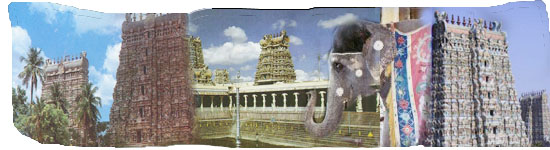
Madurai is one of the
oldest cities of India, with a history dating all the way back to the
Sangam period of the pre Christian era. The glory of Madurai returned
in a diminished form in the earlier part of this millennium; it later
on came under the rule of the Vijayanagar kingdom after its ransack
by the ravaging armies of Delhi (Malik Kafur). During the 16th and
18th centuries, Madurai was ruled by the Nayak Emperors, the foremost
of whom was Tirumalai Nayakar. The Sangam period poet Nakkeerar is
associated with some of the Tiruvilayaadal episodes
of Sundareswarar - that are enacted as a part of temple festival traditions
even today.
The Sangam age or the Golden age of Tamil literature – produced masterpieces
way back in the Pre christian era and in early 1st millennium . Madurai was
the seat of the Tamil Sangam or Academy of learning.
The entire city of Madurai, is built around the Meenakshi Sundareswarar Temple – the temple par excellence. Concentric rectangular streets surround the temple, symbolizing the structure of the cosmos.
As early as the 3rd century BC, Megasthanes visited Madurai. Later many people from Rome and Greece visited Madurai and established trade with the Pandya kings. Madurai flourished till 10th century AD when it was captured by Cholas the arch rivals of the Pandyas.
The Cholas
ruled Madurai from 920 AD till the beginning of the 13th century. In
1223 AD Pandyas regained their kingdom and once again become prosperous.
Pandian Kings patronised Tamil language in a great way. During their
period, many master-pieces were created. "Silapathikaram",
the great epic in Tamil was written based on the story of Kannagi who
burnt Madurai as a result of the injustice caused to her husband Kovalan.
In April 1311, Malik Kafur, the general of Alauddin Khilji who was
then the ruler of Delhi, reached Madurai and raided and robbed the
city for precious stones, jewels, and other rare treasures. This led
to the subsequent raids by other Muslim Sultans. In 1323, the Pandya
kingdom including Madurai became a province of the Delhi empire, under
the Tughlaks.
The 1371,
the Vijayanagar dynasty of Hampi captured Madurai and it became part
of the Vijayanagar empire. Kings of this dynasty were in habit of leaving
the captured land to governors called Nayaks. This was done for the
efficient management of their empire. The Nayaks paid fixed amount
annually to the Vijayanagar empire. After the death of Krishna Deva
Raya (King of Vijayanagar empire) in 1530 AD, the Nayaks became independent
and ruled the territories under their control. Among Nayaks, Thirumalai
Nayak (1623-1659) was very popular, even now he is popular among people,
since, it was he who contributed to the creation of many magnificent
structures in and around Madurai. The Raja Gopuram of the Meenakshi
Amman Temple, The Pudu Mandapam and The Thirumalai Nayakar's Palace
are living monuments to his artistic fervor.
Madurai started slipping into the hands of the British's East India Company.
In 1781, British appointed their representatives to look after Madurai. George
Procter was the first collector of Madurai.
Now after India's independence, Madurai is one of the major districts of Tamilnadu
State. Later on Madurai district was bifurcated into two districts namely Madurai
and Dindugul Districts. In Madurai District, there are 15 State Assembly constituencies
and two parliament constituencies.
The history of Madurai will not be complete without mentioning the name of RaniMangammal, the woman of great skill and sagacity. History does not provide many instances of ruling queens in Tamil Nadu. Though it was considered that women were not suited to succeed the throne of a kingdom, Rani Mangammmal, however shines in almost solitary eminence as an able and powerful ruler in Tamil Nadu.
Madurai is famous for its temples.The Aappudaiyaar Koyil Tevara Stalam and the Koodalazhagar Divya Desam are the most important temples one should rarely miss to go. In the vicinity of Madurai is Tirupparamkunram, one of the 6 padai veedu shrines of Murugan (glorified in Madurai Sangam Nakeerar’s Tirumurugaatruppadai). Also in the vicinity of Madurai is Alagar Koyil, one of the prominent Divya Desam shrines of the Sri Vaishnavite faith.