Here, perfect for any chicken/chikken website:
� A newborn calf weighs anywhere from 60 - 90 lbs. Holsteins can weigh 100 lbs. at birth.
� Along with grass, hay, and grain (corn, wheat, barley, oats, & soybeans), cows also like fruit and vegetables. Cows will eat cabbage, taters (including sweet potatoes), apples, rutabagas, beets, turnips, carrots, broccoli, pumpkins, and squash. Bypassing table manners, these ruminant herbivores can eat their veggies whole or slightly chewed, then chew the undigested portion (cud) later, at a more convenient time.
� Cows poop a lot - up to 15 times a day. They drain their radiators with equal vigor, excreting around 3� gallons of urine daily.
� Cows can jump. If given a running start, they can jump over a fence�most never try because there's really no point.
� Cows like to swim and frolic in the moonlight. Studies show their nocturnal activity increases when it's a full moon.
� Cows have 300� (near panoramic) vision and can see in color, except red.
� Cows have a great sense of smell and can detect scents over five miles away.
� Cows have no top front teeth, just a tough pad of skin. Instead of biting at prairie grass and hay, cows use their long and flexible tongues that are course at the surface to wrap and pull the foliage in. They have nice bottom front teeth (eight) that secures the grass against the top pad, then will swing their heads up to break off the grass. They have six powerful molars (top and bottom of jaw) used for slight chewing the first time down, and for chewing the regurgitated cud on the rebound.
� A cow has one stomach with four "compartments."
� The normal cow's body temperature is 101.5�.
� A heifer is a female bovine that has not yet had a calf or developed mature characteristics of a cow.
� A steer is a male bovine that's been fixed (castrated).
� A bull is a male bovine that's good to go.
� Though used as a catch word for all cattle, cows are by definition mature female bovines that have given birth to a calf.
� The scientific name for the cow group (all cattle) is bos taurus, a subfamily of the bovidae family.
� Creep feeding refers to giving nutrition-supplemental grains to nursing calves.
� Polled cattle refers to bovines that are naturally without horns-hornless.
� Veal is a sad example of human arrogance. It involves the practice of separating a young calf (commonly a male dairy calf) from its mother shortly after birth, confining it to a very small indoor pen without exercise or sunlight and feeding it an artificially formulated diet�all to keep the calf muscle pale and "tender." Calves are then slaughtered and this cholesterol-rich meat is served to sad sacs who consider it a delicacy. Public awareness has created a significant reduction in veal consumption over recent decades.
� Angus - From Celtic origin comes the hornless, black as coal bovines called Angus. Farmers from Angus and Aberdeen counties in northeast Scotland are credited with the formation of the breed. The first Angus bulls in America were transported from Scotland to a ranch near Victoria, Kansas in 1873. Angus cows are noted for their durability, calving ease, and maternal traits. Among beef cattle, they are the largest registered breed in North America.
� Herefords - Herefords, characterized by their red hair and white faces, began in the mid 1700s by farmers near the town of Hereford, England. These farmers needed a breed of cattle that could efficiently convert their native grass to beef. Though they have seen many changes over time, Herefords are still a major industrial breed as they mature early and have favorable longevity.
� Simmental - The name is traced to their original location, the Simme Valley of Switzerland. Simmentals are one of the world's oldest and most widely distributed breeds with an estimated 40 - 60 million Simmentals worldwide. While still more common in Europe, they have become a major breed of beef cattle in North America. These varied color bovines of impressive stature are known for their rapid growth development and great milk production.
� Charolais - Charolais are one of the oldest breeds in France, from the old French provinces of Charolles and neighboring Nievre. They are distinct with their white or cream colored hair and large size. Charolais are known to feed aggressively in both warm and cold weather that lends to rapid growth.
� Holsteins - Holsteins are traced to the northern regions of the Netherlands, and Holland was the early exporter of these black & white beauties to America. Aside from outstanding milk production, Holsteins are social and stylish, and downright good folk. But their innocuous look doesn't negate their physical stature as Holsteins are notably larger than most of their beef cattle counterparts. Holstein cows weigh about 1,500 lbs and stand an average of 58" high at the shoulder. Holstein bulls can weigh 2,600 lbs or more. Holsteins aren't the only breed of dairy cows, but they're the most common. Their spots are like snowflakes�no two are identical.
� At two years of age, a cow will give birth to her first calf.
� A cow will typically spend 6 hours a day grazing and 8 hours chewing cud (regurgitated food i.e. grass that is harder to digest).
� Though it varies by breed, a mature cow weighs between 1,000 - 1,500 lbs. Bulls commonly average between 1,600 - 2,200 lbs. though some can get considerably heavier.
� And from firsthand experience: �Holstein cows like having their picture taken. During mating season, Angus bulls do not.
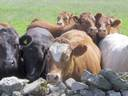
Stole this from Hannah...
Ned Nott was shot and Sam Shott was not. So it is better to be Shott than Nott. Some say Nott was not shot. But Shott says he shot Nott. Either the shot Shott shot at Nott was not shot, Or Nott was shot. If the shot Shott shot shot Nott, Nott was shot. But if the shot Shott shot shot Shott, Then Shott was shot, not Nott. However, the shot Shott shot shot not Shott, but Nott
who was shot Shott or Nott?
Here's a quiz i took... i think Mary told me to.

ok, you scare us. You're evil to the bone. Just,
get yourself a monkey and go away *hides*
Are you a rabid Pirates of the Caribbean fangirl?
brought to you by Quizilla
A chickens' body temperature normally runs at 102-103 degrees F.
A chickens' heart beats 280-315 times a minute.
A rooster takes 18-20 breaths a minute, a hen 30-35.
There are over 150 varieties of domestic chickens.
A chicken is a bird. (Oooooh!)
Chickens are not capable of sustained flight.
It takes a hen 24-26 hours to lay an egg.
The latin name for chicken is Gallus Domesticus.
Chickens come in an infinite variety of colors and patterns.
Chickens lay different colored eggs, from white, to brown, to green, to pink, to blue.
A chicken can have 4 or 5 toes on each foot.
Grocery store chickens are 5-8 weeks old.
A chicken takes 21 days to hatch.
Chickens were domesticated about 8000 years ago.
Americans consume 8 billion chickens a year.
All domestic chickens can be genetically traced to Gallus Gallus, The Red Jungle Fowl.
It takes 4 lbs.+ of feed to make 1 dozen eggs.
The chicken was once considered a sacred animal symbolizing the sun.
Breeds were developed to provide plumage for ceremonial costumes.
The first Poultry Exhibition was held in the United States on November 14, 1849. There were 219 exhibitors, 1023 birds, and over 10,000 visitors.
One trait, called Melanosis, causes chickens' bones, ligaments, skin and tendons to be colored black.
In 1925, hens laid an average of 100 eggs a year. In 1979, he World Record was set by a White Leghorn who laid 371 eggs in 364 days!!!
A hen lives an average of 5-7 years, but can live up to 20 years. She'll lay eggs her entire life, with production decreasing every year from year one.
An egg starts growing into a chick when it reaches a temperature of 86 degrees F.
Alektorophobia is the name given to "The Fear of Chickens".
A chicken will lay bigger and stronger eggs if you change the lighting in such a way as to make them think a day is 28 hours long!
The chicken can travel up to 9 miles per hour.
There seven distinctive types of combs on chickens: rose, strawberry, single, cushion, buttercup, pea, and V-shaped.
Unrelated to the chick, the male cock-of-the-rock bird earned the name "cock" because of its rooster-like appearance and combative behavior. The female of the species influenced the word "rock" being added to the name because of her habit of nesting and rearing the young in sheltered rock niches.
The largest chicken egg on record was nearly 12 oz., measuring 12 1/4" around.
The greatest number of yolks in one chicken egg is nine.
The record for laying the most eggs: seven in one day.
There are more chickens in the world than any other domesticated bird. More than one chicken for every human on the face of this earth.
The longest distance flown by any chicken is 301 1/2 feet. (as the crow flies)
Every bird and mammal except the spiny anteater experiences REM (rapid eye movement) sleep.
Did you know that some breeds of chickens can lay colored eggs? Sure enough, the Ameraucana and Araucana can lay eggs colored in shades of green or blue, depending on the breed and it's ancestry.
In 1994, 73,866 million eggs were produced in the U.S. proving once again the U.S. has the best darn chickens in the world.
China not only has the most people in the world, but also has the most Horses with 10,000,000 and chickens with over 3,000,000,000 of them.
Chickens and turkeys are known to cross-breed, these breeds are known as "Turkins".
The term 'Chicken Pox' didn't come from people believing that they came from chickens, it came from the Old English term 'gican pox' - which means the itching pox.
Laid head to claw, KFC chickens consumed worldwide would stretch some 275,094 miles. They would circle the Earth at the equator 11 times or stretch from the Earth approximately 50,094 miles past the moon.
There are approximately 450 million chickens in the United States.
There are more chickens than people in the world.
Chickens make sounds with actual meaning. They give different alarm calls when threatened by different predators.
A rooster will attack anything that he thinks will harm the hens ( that includes humans ). Their spurs (located at the back of their leg ) can cause a very painful puncture wound.
If a rooster is not present in a flock of hens, a hen will often take the role, stop laying, and begin to crow.
In Gainesville, Georgia - the chicken capital of the world - it is illegal to eat chicken with a fork. [Source: local ordinance]
McDonald's in india doesn't serve beef -- only chicken, mutton and fish. [Source: notice displayed in McDonalds bombay outlet]
The closest living relative of the t-rex is the chicken.
The waste produced by one chicken in its lifetime can supply enough electricity to run a 100 watt bulb for five hours.
The longest recorded flight of a chicken is thirteen seconds.
There are more chickens than people in the world.
Deep Thoughts by Jack Handey #290: Before a mad scientist goes mad, there's probably a time when he's only partially mad. And this is the time when he's going to throw his best parties. #77: We tend to scoff at the beliefs of the ancients. But we can't scoff at them personally, to their faces, and this is what annoys me. #38: If you saw two guys named Hambone and Flippy, which one would you think liked dolphins the most? I'd say Flippy, wouldn't you? You'd be wrong though. It's Hambone. #362: A lot of times when you first start out on a project you think, This is never going to be finished. But then it is, and you think, Wow, it wasn't even worth it. #308: If a kid ever asks you how Santa Claus can live forever, I think a good answer is that he drinks blood. #86: I can see why it would be prohibited to throw most things off the top of the Empire State Building, but what's wrong with little bits of cheese? They probably break down into their various gases before they even hit. #282: If you lose your job, your marriage and your mind all in one week, try to lose your mind first, because then the other stuff won't matter that much. #89: If you ever go temporarily insane, don't shoot somebody, like a lot of people do. Instead, try to get some weeding done, because you'd really be surprised. #414: If I could go back and change one thing in my life, I think it would be that time I found that one-dollar bill on the sidewalk. I would change it to a million-dollar bill. #205: Broken promises don't upset me. I just think, why did they believe me? #359: You might think that the favorite plant of the porcupine is the cactus, but it's thinking like that that has almost ruined this country. #427: I used to think Mom's biscuits were special, because she said she put a secret ingredient in them. Years later I asked her what the secret ingredient was, and she said it was "love." Right then I felt like the biggest sucker in the world. #230: Instead of burning a guy at the stake, what about burning him at the stilts? It probably lasts longer, plus it moves around. #433: I remember the first time I ever saw a shooting star I said, "What the hell is that?" But nowadays when I see one I just say, "What is that?" I leave off the "hell" part. Maybe when I'm old I'll just say, "Whazzit?" #334: The next time you go to the doctor, go ahead and bring in a stool sample. They might need it. Better go ahead and bring some for the dentist too. #153: As the light changed from red to green to yellow and back again, I sat there thinking about life. Was it nothing more than a bunch of honking and yelling? Sometimes it seemed that way. #198: When I found the skull in the woods, the first thing I did was call the police. But then I got curious about it. I picked it up, and started wondering who this person was, and why he had deer horns. #454: One afternoon, when I was about ten, I decided to walk over to the "wrong side of the tracks." At first I was a little scared. But then I noticed that the yards were nice, and so were the houses. In fact, most of the houses were better than those on our side of the tracks. A lot better. #16: Anytime I see something screech across a room and latch onto someone's neck, and the guy screams and tries to get it off, I have to laugh, because what is that thing?! |
| I hope you enjoyed my completely pointless website. Come Again! |