 |
 |
 |
| 201-301 19th C."Hot-dipped Technology" |
 |
| Website Links: |
| P.M. Cunningham |
| Email: |
|
|
|
|
|
| The following is the text of articles written on and for the Authentic-Campaigner Website, August 2004, this is the part of a series of articles, previous link included below: |
|
 |
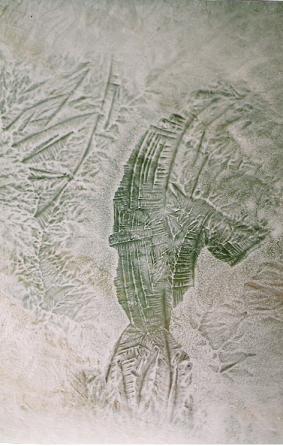
| The photo to the right shows unusual crystallization on a sheet of tinplate. |
|
|
 |
 |
 |
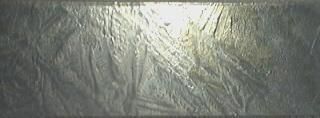
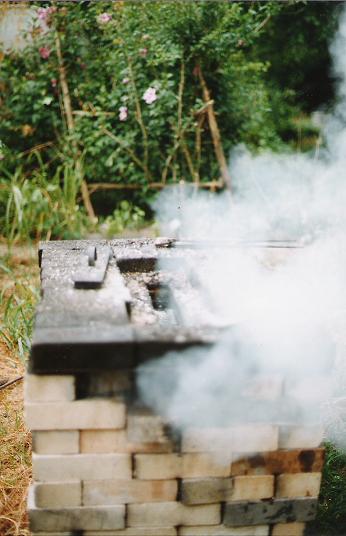
| Previous Page Tinplate 101 ... The process of producing tinplate requires a great number of steps which can be divided into two categories: Iron preparation and tinning operation. The manufacture of sheet iron prior to the 18th century was by hand hammering. This process was labor intensive and kept the manufacture of tinplate to relatively small levels. In 1728 the introduction of rolling mills allowed the iron sheets to be formed by the hot pack method. This process involved passing hot iron between rollers to make it thinner, folding the metal over on itself, and repeating the process until the desired thickness was achieved. This process was used until the 1920's, when cold reduction process of forming sheet steel began to be used. After the sheets had been formed the next step was to descale them, which was sometimes referred to as "black pickling". They are immersed in a leaden vat filled with muriatic acid and allowed to steep four or five minutes. From here they are taken into a reverberatory furnace where they are left until the heavy scale falls off and they become annealed. They are then run through cold rolling mills to polish the surface of the sheet. The material may at this stage go through a second annealing at a lower temperature to remove the hardness put in by the rolling mills. The next step is "white pickling" which removes the final film of oxidation, which developed during the cold rolling and annealing. The sheets are put in vats of lye for ten to twelve hours, then transferred to vats of sulfuric acid for about an hour, from which they emerge clean and ready to plate. The sheets are then placed in vats of fresh water to prevent surface oxidation until they are plated. These processes can be seen in the illustration from Diderot on the first tinplating plate. The actual tinning process took place in multiple vats, and although not every manufacturer used the same procedures, the steps involved remained basically the same from the 18th century through the 19th century. The cleaned sheets were removed from the fresh water vat and immersed in a vat full of burnt grease, which served as a flux to prepare the iron for bonding with the tin. Once coated they would then be immersed in up to three successive vats of tin to build up a layer of tin on the steel, each vat containing more pure tin than the last. These vats contain a mixture of block tin and grain tin, grain tin having fewer contaminants of iron, sulfur, and other foreign substances. Each of these vats would have from two to six inches of grease floating on the top of the tin to prevent oxidation of the tin. The grease would be a mixture of linseed oil and suet, tallow, or palm oil depending on the time period. The vat temperature would be kept just below the flash point of the grease being used, about 500-600 degrees Fahrenheit, with each vat being slightly cooler than the last one. Once the tin was on the sheet any excess tin was removed, leaving a smooth surface. This was done by a process called washing. This process involved five stages; a tin-pot, a wash-pot with a partition, a grease pot, a draining pan, and a listing pot. The wash ?pot contained pure grain tin and had a partition it to keep the dross from the previous tin vats from contaminating the entire surface of the vat. This partition was an early 19th century improvement. Because sheets placed in the tin pots would be dipped in the wash-pot, the wash-pot would slowly pick up impurities and be transferred to the less pure tin pots from time to time. Directly after being removed from the tin pots the sheets would be dipped in the wash pot on one side of the partition. Upon being removed the sheet would be wiped on both sides with a hemp brush to remove the excess tin. The sheet would then immediately be dipped into the other side of the wash pot and quickly removed to erase the brush marks. From here the sheet would be dipped into the grease pot to smooth out the last irregularities of the coating thickness. Once removed the sheet would be placed on the pan to drain and cool. When cool, the sheet edge would be dipped in the listing pot, a shallow pot of tin about �" deep, designed to melt only the drip edge that had built up through the previous steps. When removed from the listing pot the sheet would be hit sharply on the edge with a piece of wood to shake off the excess tin. This would leave the sheet with a faint stripe at the bottom edge which could be seen on every sheet of tinplate sold.? 202, "20th-21st Century Hot-Rolled Tinplate Technology" Someday, I will be able to completely research and document the history of 19th Century hot-rolled tinplate technology. From the bits and pieces of information that I do have to date, the process has not changed drastically in the last hundred plus years, minus the exception of general refinements. I feel it is important that this information be posted since this is a common practice for producing (hot-dipped) tinplate today. The following is a description of how hot-rolled tinplate process is employed in the modern industry. The link primarily is based on producing galvanized material but there are only minor differences in the production of tinplate versus galvanized sheet. http://www.galvinfo.com/ginotes/GalvInfoNote_2_1.pdf A related page on that particular website deals with the crystal theory (spangle). Since I was only a history major in college and not a molecular chemist. The aforementioned site deals only with zinc but the basics of the chemistry/physics are the same with tin. Regardless of the plating process used, a crystalline structure will be developed in the tin coating because of the different molecular structure of tin vs. zinc. The look is different, yet the theory remains the same. http://www.galvinfo.com/ginotes/GalvInfoNote_2_6.pdf 301, "Personal Experience" As stated by Mrs. Lawson -Weaver (SPINSTER): "A similar problem relating to tin wear vexes me" This was my issue for 20 years, �tinware vexes me, too. I spent years manufacturing goods made of tin thinking I like coffee and I like coffee pots. I had a really hard time making a coffee pot and watching it rust out in less than a year. So, aside from personal usage, there was also the problem with selling a product that had such a short shelf life. John Sarver (AGATE) stated: "As the term was first introduced on a wide scale to the hobby by the WVM reproductions of several years back, would be most interested on your take, please do enlighten us." I'M GUILTY! I have the feeling that hot-dipped, as John stated, came through as a common term/standard by which the products were defined. So let's indulge for a moment, my history. Twelve years ago, upon being frustrated with the reactions of usage (that electroplate has) we sent out on a mission to find something better. We spent four months going through potential companies that were still doing "hot-dipped" tin, not necessarily for sheet products, but for restaurant equipment instead. One company in Chicago was actually still using tallow and tallow pots as was historic (the only one), but each company employed a slightly different technique. All samples, therefore, produced a different look. Between getting samples from companies interested in the work and attempting to find a suitable product, we settled with an Ohio company. This is where the first of the Vet's product line material came from and thereby the introduction of hot-dipped to the civil war re-enactment community. This company slowly put me out of business by returning plate with a longer lag time, so after a year and a half we went to search elsewhere. Another 4 months of phone calls, getting samples, talking with company representatives, and a little head scratching, we ended up with the same variety of sample finishes that we had gone through earlier. At that point in time, we attempted to deal with a company selling hot-rolled tinplate, and had them run 500 pounds of metal for us. The problem with hot-rolled is they are plating off of base steel. I have 500 pounds of scrap metal still, there is no way to distinguish, prior to plating, the quality of the steel and the potential for underlying scale in the steel. The roll of steel we got had a scale line directly down the middle. Now for those of you whom are unfamiliar with scale lines, imagine our surprise when that is what we found! I had to go back to a 1920's text on plating to discover this material interaction. Simply put, a scale line is a line where there is no tin on the plated surface. There are no means by which to pickle this out, or remedy the problem; it is in the base metal. So, at this point we have gone through a dozen companies, either dipping or rolling companies, an outlay of cash for absolutely wasted materials, and have no potential for anything other than electroplate on the horizon. What do we do? Answer? Revert back to a philosophy that if this was done in the 19th century that it could be done again. Six months of research, driving around the country, and talking on the phone provided only brief glimpses of 19th century technology. The only real descriptions of early 19th century tinplating by dipping tend to be rather general, with little to nothing that amounts to a "hands-on" operating manual. Upon the completion of that research project the decision had to be made as to what to try. We went with trying to copy out what the dipping companies were doing for us, but doing so, employing early to mid-19th century techniques. Since sheet wrought iron is still not commercially available, to my knowledge, and because of the problem of purchasing raw steel stock for plating, what we set out to do was re-create the final processes of 19th century technology by doing reflow on electroplated tin. This saves the nasty pickling operations of muriatic acid and sulphuric acid, which are necessary to clean the steel in order to bond a tin coat to them. By reflowing over electroplate there is already a "primed surface" to which the tin may adhere. Another six months in passing time, we began to build vats and piece together 19th century technology to a 20th century system, finding raw material sources of tin and tallow, etc. A system was finally established and used. What we tried to set up was something based on the "washing system" previously described in the 201 course which entailed a tin pot with tallow floating in the top, a second vat of pure tallow, and a listing pot. The pure tin pot was the only one set up at that point since frankly, we had NO idea what we were doing then, and had already invested countless dollars in our mission. Who could back out now, but where doth one draweth a line? We needed to find a way to make tin "stick". We were successful. Interesting detail, six tinners who do repro work came and ran my vat; each pulled plate out of the same vat with the same prep work involved and each sheet pulled out differently according to the person using it. One can question if there can be a standard for 19th C. tinplate. I had always thought that all the variations I had previously seen in company samples were due to process variations but "hands-on" technique definitely changed the look of the plate. Unfortunately, chronologically speaking, life interruptus; a move was necessary and final setup of the system was not installed. At the new place, we have a working vat, but unfortunately we have no gas line and our vat is set up for natural gas. This is where I get stupid and all plate production stops for two years. (Is anyone paying attention here?) In early March one year, gathering wood to heat the house, it occurs to me that wood makes fire. So that natural gas line didn't seem to matter anymore, because in the early 19th century, I doubt they had one either. Wood makes fire, fire burns and makes vat hot. (Duh? Must've been something that occurred in the move. Somehow I lost the concept of 19th century technology. I was too close to the highway and the fumes from the exhaust� uh, someone please tell me, how could this have escaped me?) New learning curve needs to be established: learning to control heat with wood is not as simple as it sounds. Fire can be too hot and too cool. This is an ever-changing process and I am still learning. Still vexed, only differently. At some point, the tallow pot will be installed and the listing pot, but for now, it is hands-on vat, dipping one sheet at a time. Our process in basic form: take electroplated tinplate, clean of residues, either through soap and water, acetone (thanks Robert, it helps), pickling as necessary in a fluoroboric acid solution, and dunking into a vat of liquefied tin, with roughly 1-2 inches of tallow on top...�keep the bedroom windows and doors closed! I got curious one day, and attempted to find out what the tallow pot would do once it is employed (never dip tin in the kitchen!!!) It worked perfectly, doing all we expected. The tallow pot diminishes the flow lines and provides an even surface by removing excess tin and, by running cooler, it also tends to mask the crystalline structure of the plate. The problem is, FLASH FIRE! Tin melts at 460 degrees, and what we use is an acidless tallow (all fatty acids removed) that has a flash point of 600 degrees. As the tallow is subjected to heat, fatty acids re-develop and the flash point lowers. At max, we have 150 degree play-range that we work within that is constantly being reduced under heat source, that temperature range being very difficult to play with using a wood fire, which is why to this date, we still have no tallow pot running. The listing pot is there to provide only a � inch cleanup on the sheet. That pot is there also, but not presently hooked up. We will use this once we get the gas hookup. Right now, the listing edge is simply sheared off. We work around the listing edge, not using it. This is probably where all the earlier debate on what hot-dipped material should look like started. Since our tallow pot has never been hooked up, the "finished look" has never been achieved. The goal of creating a heavier coating, that wears like original material, however, has been achieved. Currently we pull a coating thickness of about 15 lbs., which is slightly heavier than 19th C. tinplate. The use of the tallow pot takes that coating thickness down to the period weight of 10 to twelve lbs. For this reason, we have never claimed our material is "perfect", we only claimed that it would hold up like original wares. Problems with dipping tinplate in this fashion are probably nothing more than the historical aspects that were encountered. (NOTE: Considering the methods by which I make tin, I am not DEAD, nor was I ever ill, though I know rumor has run amok for years. The point is, we did not deal which such heavy acids, and nothing has killed me. ;)) Beyond the mess and noxious fumes, there are two main issues that show up with the plate, one is de-wetting and the other is tin-ferric oxide. De-wetting is where the tin fails to adhere to the plate. Think of a rock in a river current and how water flows around it; there is more water to either side with a gully behind the rock, like ebbing. This is how de-wetting appears. Tin-ferric oxide is a simple chemical reaction that occurs naturally between the reaction of the iron with which the vat is created and the tin that is inside of it. As the vat is used, this material slowly develops. Generally, it stays at the bottom of the vat but through insertion of the plate into the vat, it is slowly drawn up to the surface. This makes the appearance of grit or sand on the plate. Simple problems, but annoying and ever changing in this process. Sheets of plate will come in from the manufacturer with different oil loads, providing different de-wetting issues; oxides build up and the vat needs to be cleaned. In some cases solutions work and in others it is a constant struggle. Trial by fire (literally at some points). Since no one is attempting to copy a 19th century technology for plating, the sources for advice and assistance are quite limited. For the consumer What does all this mean? Is there a 19th century hot-dipped tinplate on the market? Personal opinion, no. It ain't there yet. There is nothing "right" out there. There is the technical aspect of hot-dipped that makes it a preferable product, that being the thickness of the coating and the reduction of microscopic pinholes over electroplate. There is the aesthetic of seeing perfectly flat, painted, or "dipped in candle wax" look from which to choose. The key to all of this, in my opinion, is the amount of tin on the sheet. The more tin on the sheet, the longer the life of the product, and referring back to prior posts will help in this understanding. Remember, period tinware had a 10 to 12 pound coating; that is where it got its life. It helps if it is "hot-dipped" but that should not be the only rule by which one judges a purchase. A few weeks ago, I met up with someone that was advertising "hot-dipped tinware", and though I thoroughly respect the workmanship, in talking with the individual I determined he did not provide a product with any more tin on the surface than what he produces out of electroplated. The step is being made here, but it is up to the consumer to question the vendor to better define the product. Not only should one consider the means by which the material is processed, of equal importance, is getting the specifications for that material from which the product is made. Anyone wishing to go to 400 level courses or grad level, feel free to send me the Cliff notes. I may or may not know the answer, but I have plenty of questions myself and a little assist would be great. Answers are not necessary; I have found that questions posed can be just as beneficial (refer back to the fire stuff!). If anyone is interested in attempting to further this experiment at historical archeology, I would love to further the discussion. CLICK ON the smoky VAT photo below for PICTURES OF and AT THE VAT |
 |
 |
 |
| Tin Tinkers is a historical tinner-coppersmith-sheetmetal discussion forum...You too, can come join the fun! Please register as a member to enjoy full access to our site! |
|