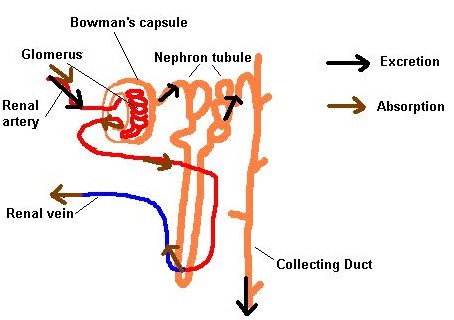
Excretion by the kidneys is obvious, but osmoregulation is less obvious. Osmoregulation is the control of internal water balance of an organism in an environment which is of different solute concentration than the inside of the organism. When the solute concentration of an organism's blood is too high, it must retain more water in order to maintain the balance of water and solutes in the blood, and vice versa for a solute concentration which is too low. In order to do this, the hypothalamus causes the pituitary gland to release a hormone called the Anti-diuretic Hormone (ADH). ADH is a "water saver" in that it increases the permeability of the collecting duct, which allows more water molecules to flow back from the filtrate (which is excreted) to the blood. Increasing the amount of water in the blood then decreases the concentration of solutes.
Alcohol inhibits the release of ADH; therefore, less water is recovered from the filtrate and more is excreted. This is the reason that alcohol consumption is linked to frequent urination, not the mere consumption of large amounts of liquid.