
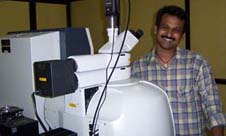

My thesis work involves using Raman spectroscopy to study biological systems. My interest is to study the structural features, physical properties and interactions in these systems. Raman spectroscopy, along with IR spectroscopy, is a type of vibrational spectroscopy based on the inelastic scattering of light. The Raman spectrum of a molecule has a wealth of information about the molecule and acts as its structural finger print.
Though Raman spectroscopy is an excellent tool to probe structural aspects of the molecules, it is inherently a weak process. On an average, the Raman scattering cross sections are in the range of 10^(-32) which is atleast 10^(16) times lower compared to fluorescence. This can prove to be a severe draw back when studying biological samples which are usually in low concentrations inside a cell. Its been observed that adsorption of the sample to the surface of a noble metal (like gold or silver) brings about tremendous enhacement in the Raman cross section of the sample under study, there by accommodating the detection of samples at very low concentrations. This technique is called the Surface Enhanced Raman Spectroscopy (SERS). For my PhD thesis I am working on different protocols to establish the application of Raman and Surface Enahanced Raman spectroscopy as an analytical tool to study and solve problems in biological systems ranging from DNA to reconstituted proteins to liposomal structures resembling cells.
People have been working on the tiny laboratory of the nature, which is the cell, since years and might have to work for many more to come to unearth the treasure of knowledge hidden in it. I am trying to make a small contribution towards taking that effort a step closer. I am interested to know what happens at the surface of the cell, on the envelope surrounding it, the Plasma Membrane. There is a wealth of knowledge to be unearthed right at the surface of the cell. There are many substances that go across this envelope carrying information which helps in coordinating the activities of different cells so that they can carry out a common task. The proteins embedded in the plasma membrane, mainly the receptors for the messenger molecules, have a very important role to play in this process. How this is accomplished and the information at the surface of the cell is passed on to the interior of the cell and to other cells of the tissue forms the core of a very interesting problem in biology. Apart from acting as a boundary cutting out the inside of the cell from its outside, the plasma membrane has a very important role in maintaining the integrity of cell and in protecting the contents of the cell which form the essence of life from external environment.
If you are doing research you are worth what your publications are. So here is a list of my publications to date.
Papers
1.Syamantak Majumder, K.P.Tamilarasan, Gopi Krishna Kolluru, Ajit Muley, C.Madhavan Nair, Athira Omanakuttan, K.V.G.K.Murty and Suvro Chatterjee. Activated pericyte attenuates endothelial functions: Nitric oxide/cGMP rescues activated pericyte associated endothelial dysfunctions. Biochem. Cell Biol. (in press)
2.M.Sankar, C.Madhavan Nair, K.V.G.K.Murty and P.Manikandan. Transesterification of cyclic carbonates with methanol at ambient conditions over tungstate-based solid catalysts. Appl. Catal. A, 2006, 312: 108-114.
3.C.Madhavan Nair, C.Sabna, K.V.G.K.Murty and S.V.Ramanan. Permeability of R6G across Cx43 hemichannels through a novel combination of patch clamp and surface enhanced Raman spectroscopy. Pramana, 2005, 65(4): 653-661.
Conferences and Posters
1. A novel Surface Enhanced Raman Spectroscopic investigation of the gene BRCA1 exon 2 implicated in breast cancer.
C.Madhavan Nair, P.Gajalakshmi, K.V.G.K.Murty
Poster presented at the second convention of BRSI (24-26 November 2005, Chennai)
