First we'll need a piece of tubing. For this blowgun, I have selected a 10 foot long piece of 1/2" EMT conduit from my local hardware store. It cost $1.19. EMT sizes are misleading as this tube has an inside diameter if 5/8", or .625 cal. EMT is very inexpensive, and is adequate for most applications, but it does have a seam down the length, and the inside of the tube is fairly rough. I use a tubing cutter to trim the length to 6 feet.
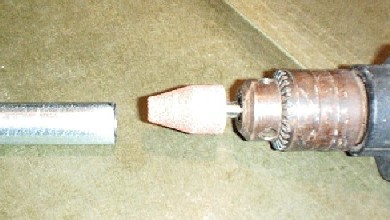
After trimming, the end that was cut will have a slight lip on the inside of the tube. In the photo I am removing the lip with a grinding wheel in my electric drill.
Lately, I have been leaving this minor lip intact. I use the end with the lip as the inlet. The lip still allows a dart to be loaded, but prevents the dart from coming back through the tube if you inhale too close to the inlet.
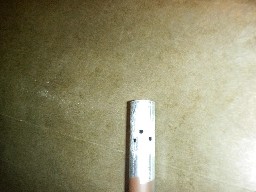
Next, I'll port the discharge end. Porting is done to improve the flight characteristics of the dart by reducing turbulence as the dart exits the tube. Here I have drilled 8 holes, 1/8" diameter, about an inch from the exit end of the tube. After drilling the holes, remember to remove any jagged edges from inside the tube. I use sandpaper glued to a 1/2" dowel for this.
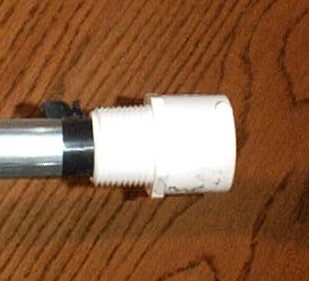
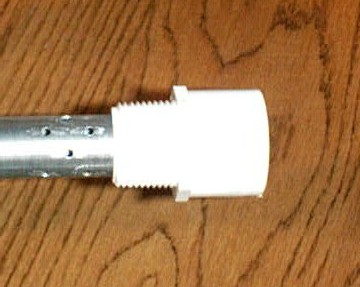
Next, I'll wrap the inlet and discharge ends with electrical tape to allow me to fit a couple of Schedule 40 PVC male adapters. On the discharge side I put a 3/4" fitting to prevent the end of the tube from being damaged if it strikes something. On the inlet side, I use a 3/4" to 1" adapter as a mouthpiece. Here are photos showing the inlet and outlet of an .81 cal. blowgun so you can get the idea.
Once all that is done, you may want to use paint, tape, or some other method to camouflage your blowgun, especially if you want to use it for hunting.
Back to Main Page Go to Dart making page
 page hits.