The sage Sabari
She
was the daughter of Shyamana Maharishi and was driven away
by her mercurial, sage-husband for accidentally and innocently looking up at
another man (which in those days was strictly forbidden). She sought asylum at
the Matanga ashram. She learns from her guru,the sage Matanga that Lord Rama and
Letchumanan would pass the ashram in search of Sita who was kidnapped by Ravana.
She awaits Lord Rama and Letchumanan gathering the choicest fruits for them and
eventually gets to meet them here. In remembrance of her steadfastness, resoluteness
and faith Lord Ayappan ordained that the entire place be named Sabarimala.
Hence, today this place still retains this name.
Upon
the completion of the Appachimedu, a devotee shall not miss the Sabari peedam
constructed to commemorate this divine personality. As a mark of respect,
devotees do pay homage here before continuing with the pilgrimage. Contemplate
upon the resoluteness and faith of this great sage, spending all the long nights
amidst wild animals and cold weather simply seeking nourishment from the thought
of sighting Sri Raman. Can you exercise this kind of faith today ?
To realize the Truth, Sabari's fortitude and faith are essential, not just
the mouthing of mere mantras and prayers.
Sadhana, sadhaka and siddhi
Swami Ayappan
worship, just like any other worship is geared towards the realization of the
Truth - that everything around us and we ourselves are governed by some unseen
principle of power. A power - infinitely greater than anything that we
have seen or heard and can ever conceive. All the elements of nature are the creation
of this Supreme power. The whereabouts of this power if we seek externally
cannot ever be conceived and construed. In Hinduism, we seek this power by
delving within us-for it is our contention and time-tested truth that we have
that touch of power within us , just like any other living thing around us.
Simply put, it is that power that physically makes our hearts tick. Can any
man-create a battery that can replicate the immensity and power of this
God-made battery? Where did the consciousness in us come from? While, we are
asleep we loose touch with the external world, yet that consciousness is there
isn't it? When a child is born that consciousness is already there. We don't
inject that through the needles and syringes, as we do we in immunizations
? That is what the Vedas call Prajunyanam Brahma (our very Consciousness
is God). Other revelations in the Vedas are Aham Brahmasmi (This is not
You), Tat Tvam Asi (Thou Art that) and Ayamatma Brahma (Our Atma
is the ParaBrahman). These are repeated over and over again in books and great
sages who have realized these great truths through self-experimentation have
also imparted the same to the masses. A few have benefited but many are still
struggling in the ocean of samsara.
An
Ayappan devotee is a sadhaka(seeker of truth), the fasts etc are sadhanas(means
of seeking the truth) and the Gurusami a siddhi (a person who has realized
the Truth).Sabarimala yatra is the test-bed to realize this immutable and
fundamental truth. Otherwise, one's life remains as nothing but "a
big bag filled with much sorrow, a little laughter and bottomless
hollowness." There is much more to living then just acquisition of wealth
and sense-enjoyment. See the soul within you and make every Sabarimala yatra
with that in mind. Cultivate sama-darsana (equal vision) and sama-sveekarana
(uniform acceptance) - that is why every other Ayappan during the fast is
addressed as Ayappan. Everything about you is an Ayappan. Aspire towards
attaining this state of mind. Control the mind that is constantly
conniving to outplay the true you .
The Great Narayana Guru's teachings
are the same too :
"One race, one religion, one God."
When this great soul established the first Sivan temple in Aruvippuram in Kerala,
breaking down the citadels of orthodoxy and caste, he inscribed on the temple
wall the following message :
"This is the model abode
Where all men live in brotherhood
Without any caste distinction
Or religious animosities."
The Sabarimala Ayappan worship also hovers around the same very
truth that Narayana Guru expounded. The funeral fire and the fauna beneath the
soil are not going to give you privileged treatment because of your status and
standing in earthly life. Eventually you are reduced to a handful of ash and a
photograph of you may hang for some time in a remote corner of your home, signifying you once
existed. The real "you" marches on for several, infinite lives.
Thiruavarnam and the Garuda pachi (bird)
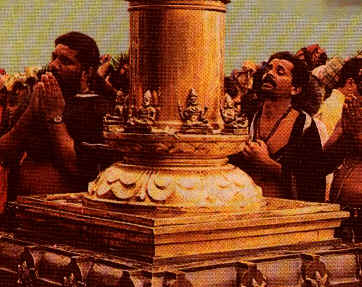
The royal regalia and the clothes (thiruavarnam) are from the Pantala Maharaja's palace where Manikandan once lived. These are very expensive items and are heavily guarded and revered. The huge eagle (it escorts the regalia and entourage bearing the same, unfailingly each year ), symbolically the vahana (chariot) of Lord Vishnu, is actually a sage who unfailingly takes the form a bird and hails from Kassi up north to pay homage and respect to Swami Ayappan annually. This fact is seldom found in the books. The thiruavarnam (collection of Ayappan's regalia and clothes) by itself is the significant testimony of His presence at Pantalam several years ago. The present residents and lineage of the Pantalam palace still hold on to the belief that He visits them in the form of Ayappan devotees each year.
Bhakti (or
Love)
The word Bhakti (or love) is
derived from the word Bhaj, meaning "to adore, to love and to
keep companionship with". There are different levels of love, denoting
the varied degrees of affinity to the Supreme Consciousness( or God). These are
as follows:
a). Conventional religion (sadharana
bhakti) - here there is mere conformity with
the accepted beliefs and observances of a religious community , without any
inner spiritual urge or dynamism..
b). Sraddha (faith) -
when truths of religions like God, soul and the hereafter are taken seriously
and the need for some set of practices to intensify one's spiritual perception
is felt. Usually a personal calamity or the stumbling upon a holy man brings
about this conversion and upliftment. Only through devotional disciplines can
the love for God be sustained. Without the same the mind relapses to one's
worldly preoccupations.
c). Rati - here the mind develops a natural
proneness to God because of the inward joy this contemplation gives. There is a
natural joyfulness and continuous attraction for Him.
The Rati stage is further subdivided into:
i). Jnana Bhakti
There is an intellectual kind of love for God i.e mergence with the
Absolute as the goal. Here bhakti is the means and the end is
Moksha (liberation from embodiment).
ii). Priti Bhakti
Intense personal love of the all-perfect Divine person eg God is looked upon in
any of the forms of living personal relationship as mother, master, child,
friend, husband or lover ( eg the gopikas at Vrindavan for Krishna). It is said
that only at this stage that Krishna (or God) reveals His Ananda (blissful)
nature to His followers. He even subordinates to His devotees:
"......Being fond of my devotees, my heart is under their sway. I do not
value myself or even Sri
who is ever associated with me, as I do these holy men who have accepted
Me as their Supreme
goal............" (Bhagavatam.pp.4.63-68)
At the Sradhha stage (which is considered the first
stage), the devotion has to be roused up and sustained by deliberately
cultivated disciplines or sadhanas. These are collectively called Bhagavata
Dharma and are as below:
a). Sravanam (hearing narrations of His glorious deeds).
b). Kirtanam (chanting and reciting His name).
c). Smaranam (remembering Him continuously).
d). Padasevanam (serving Him).
e). Archanam (worshipping Him).
f). Vandanam (paying obeisance to Him).
g). Dasyam (practising the role of a servant to Him).
h). Sakhyam (looking upon Him as an intimate friend).
i). Atmanivedanam (surrendering oneself totally to Him).
During the Ayappan swami fast and the yatra the above
sadhanas , either jointly or severally, are practised to realise Him in oneself
and in all other beings.
Bhakti - a
gradual metamorphosis from the concrete to the abstract realms
In the Bhagavata (Bh.11,2,45-47), the various realms of Bhakti
have been clearly delineated as thus:
" The
perfect Bhagavata or devotee of the Lord (Bhagavatottam) is
one who sees glory of the Bhagavan, the inmost Self, reflected in all
beings and all beings as dwelling in Him, their inmost Self. A mediocre Bhagavata
is one who entertains an attitude of adoring love towards God, of friendliness
to His devotees, of kindliness and sympathy to common people and of indifference
to one's enemies and bad people. And he is of the inferior type of Bhagavata
who performs worship of God in images with faith and devotion, but is totally
indifferent to devotees of God and other beings ( on account of his incapacity
to see the Divinity dwelling in all beings)."
| Swamiji's
comments: " Idol worship is the first step in spiritualism. It is also the simplest way to teach children about divinity. Children whose ever-wandering minds are incapable of appreciating abstract concepts ought to be initiated from images and idols to the infinite realms of divinity. Idols are in the beginning mere stones. They acquire their grace or chaitanya after the pradistha (or installation). The life-force from the priest is transmitted from the presiding priest to the idol via mantras and prayers. There is a colossal body of rules encompassed in the science of installation. A temple needs to be rejuvenated once in 12 years through the kumbabhisegam too. So in a way, we are greater than the idols ; it is just that we don't realize this truth. " |
In teaching theory, one advances from the concrete to abstract ideas to facilitate comprehension. Is it the norm to teach a child about the attributes of a potato without ever showing the child a potato or at least an image of it ? What is the point of talking about the theory of time - dilation in Physics to students if they do not know how to read time and recognize its relative nature ? The idols and images are condensed essence of the Divine. It is not just praying to the idol per se but while praying to it outwardly, inwardly we reflect upon the infinite quality of God Himself and the teachings of the respective avatars ( incarnates). Remember, God pre-existed all things and lives we see before us today. The earliest of men have described God in the only way they knew best and in ways which are unacceptable and inferior to our present means of communication and knowledge. Let the ways and means differ but the only immutable constant is that Infinite power controlling the entire universe and its momentum. Swamiye Saranam..

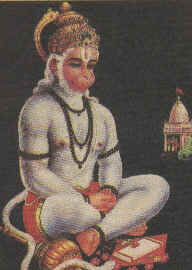
SRI HANUMAN
Rama! Rama ! Rama !
The benchmark of a true devotee.
Each Ayappan devotee should strive to remain subdued and focused as Him.

*****************
--Swamiye Saranam Ayappa Swamiye Saranam Ayappa--