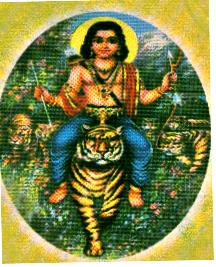

Swami Ayappan's history in brief
The prime causal factor for
Swami Ayappan's avatar was Mahishi, the asura demon. In the past Mahishi was in truth, Leelavathy the wife of sage Dattatreya, who cursed her for forbidding him from
his progression into the sanyassin vanashrama. Leelawathy was too bound to
matrimonial bliss and her desire for it remained unabated. She was cursed by her
sage-husband to be born as a Mahishi (she-buffalo). She in return cursed
Dattatreya to be born as a Mahishan (buffalo).Their curses manifested in the
next life. In her new birth and upon
learning of the death of Mahishasuran ,her cousin at the hands of Mothess
Durga(Chandi) she through tapas obtained the boon of invincibility from Lord
Brahma. With this newly obtained boon, she wreaked havoc on the devas and sages
for a lengthy period of time. Upon the incessant, unbearable onslaught of her
fury and upon the prayers of the sages and innocent ones, the two powers of Siva
and Vishnu united to create a mighty force called Manikandan (the earthly name
for Ayappan). Only a child born out of two males could annihilate Mahishi-that
was a precondition for her demise entrenched in the boon granted by Lord Brahma.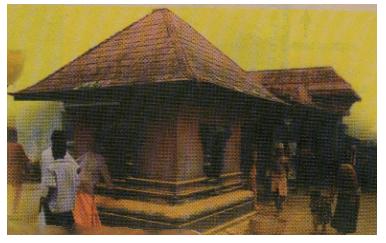 Today, the
repentive Mahishi is revered as the Mallikapurathu Amman atop Sabarimala.(see picture beside).
Today, the
repentive Mahishi is revered as the Mallikapurathu Amman atop Sabarimala.(see picture beside).
There
wasn't anything physical as
commonly depicted between Siva and Vishnu. It was merely a unification of two powers,
which in truth is inseparable and one*. Siva is Vishnu and Vishnu is Siva. They
are mere avatars of that single,all-pervading Supreme Consciousness.
| Swamiji surmises: " In all probability, Swami Ayappan could be the reincarnation of Lord Rama Himself. While in the vicinity of the Pampa river, Rama learned of the death of His earthly father King Dasaratha, who pined for Him even in his death-bed. The king had grieved for not having enjoyed His childhood pranks as sage Visvamitra took Him away in His youth and later it was marriage with Sita. To replace the lost period Lord Rama had promised Dasaratha to be born again and make up for the lost childhood pranks he had missed with Him.Lord Rama also performed the rites for His father in the Pampa river." --------------------- "Pantalam, was actually Patmastalam (place of lotus), which over time came to be known as Pantalam through repetitive usage and tongue-twisting." |
Ayappan
worship was not confined in the early days to Kerala alone. In other parts of India,
particularly 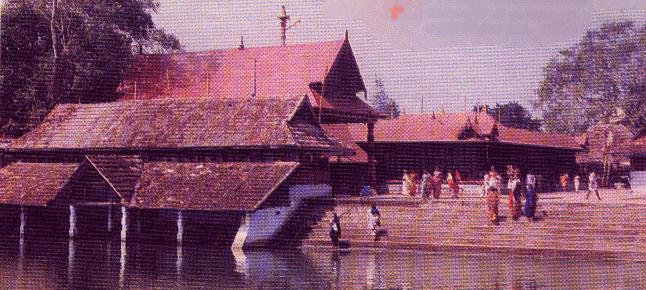 in Tamil Nadu this worship was
prevalent too. Ayappan was known as Kaval
Theivam (Guardian God) or Aiyanar and is installed away from the main precincts of a
temple. This is how it should be. The installation of Swami Ayappan (or Sastha)
idol in any other temple ought to be outside the main temple precincts. You can
witness this in Chottanikara (Picture below), Guruvayoor, Ambalapuzha Krishnan (picture beside) and most other temples in
Kerala.
in Tamil Nadu this worship was
prevalent too. Ayappan was known as Kaval
Theivam (Guardian God) or Aiyanar and is installed away from the main precincts of a
temple. This is how it should be. The installation of Swami Ayappan (or Sastha)
idol in any other temple ought to be outside the main temple precincts. You can
witness this in Chottanikara (Picture below), Guruvayoor, Ambalapuzha Krishnan (picture beside) and most other temples in
Kerala.
Swami
Ayappan is called the Kali-yuga varathan, because the only recourse to
world-peace and continued progress lies in identifying the unity in the
diversity of religions. There is a common thread that links us all, no matter of
what race, creed or birth one hails from.
"It is to invoke this realisation that the Ayappan avatar manifested itself. Saivism is no different from Vaishanavism in truth - everything goes to the same Infinite Supreme Consciousness, just like all the rivers, streams that eventually meet the sea and become engulfed by its immenseness. If every single person, or at least most of the earth's population realize this truth you shall see the heaven open right before your very eyes. Learn to kill the animal within you and then the Truth shall be vividly conspicuous to you," explains Swamiji.
"CHILDREN. SEEK HIM EARNESTLY, UNCONDITIONALLY
WITH LOVE AND CONFIDENCE YOU SHALL FIND HIM. THIS IS MY DISCOVERY AND EXPERIENCE IN ALL MY LIFE AS A SANYASSI AND YOGI. DON'T FAKE YOUR FAITH
BEFORE HIM FOR HE KNOWS EVERYTHING !"
-Swamiji Krishnan Sreedharan.
*********************************
* Sivaya Vishnurupaya Sivarupaya Vishnave
Sivasya hridayam Vishnuh Vishnostu hridayam Sivah
Yatah Sivamayo Vishnuh evam Vishnumayah Sivah
Yathantaram na pasyami tathama swastirayushi
- Skandopanishad
( Siva in the form of Vishnu and Vishnu in the form of Siva- I bow down.
Vishnu is the heart of Siva and Siva is the heart of Vishnu as both are
essentially
one. As I do not perceive any difference between the two, may my life be blessed
and prolonged.)
Vishnu
Dyaana Sloka
Saanthakaaram Bujaka Sayanam
Patmanaabam Suresam
Visvaathaaram Kakanasathrusam
Mekavarnam Subaangam
Lakshmikaantham Kamalanayanam
Yogikihruth Thyaanakamyam
Vanteh Vishnum Bhavabayaharam
Sarvalokaika Naatham
***************************************
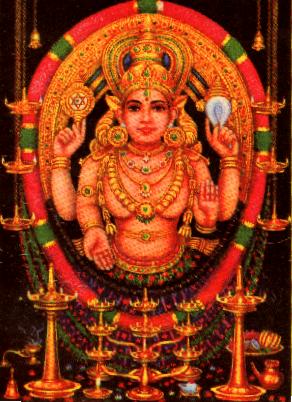
Chottanikara Bhagavathi Amma
AMMEI NARAYANA SARANAM