

Before you can study types of Proteins, you have to know about their basic structures. One identifying characteristic of proteins is their presence of Nitrogen. The MONOMERS of these important organic molecules are called Amino Acids. These bases are formed when a Carboxyl group and an Amino group are bonded together on a carbon atom, with another hydrogen atom, to form the basic unit of all proteins. It is because of the huge flexibility of these two functional groups that proteins are so diverse and complex.
Complex froming of Complex Molecules
When Proteins form, the carboxyl group of one amino acid bond with the amino group on the other. This is called a Peptide bond. However, since the Oxygen is more electronegative than the Nitrogen, the electrons of this bond are more attracted to the Oxygen, causeing an uneven electrical charge. This uneven charge is another way that amino acids can bond when they form large chains.
Shapes and Levels of Structure
The shape of a protein detirmines its function. Proteins, when they are formed by Ribosomes in the cells along with genetic information passed along by RNA, are twisted and turned about in the endoplasmic reticulum of cells (cell structure that shapes proteins) so that they may form the shape that will allow the protein to do the job it is needed for.
Proteins also have what we call levels of structure, which are described below the picture.
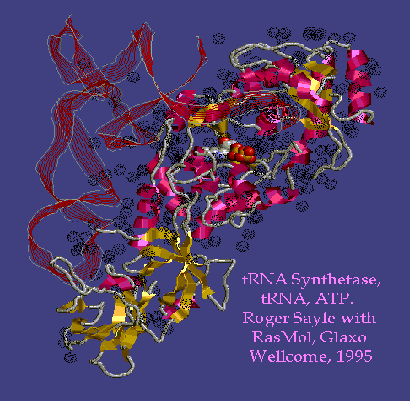
Secondary Level - This is where we observe the twisting and turning of sections of the amino acid chains, caused by Hydrogen bonding (the bonds caused by uneven electrical charges). Here, proteins take one of two shapes: the Alpha Helix (spiral string ) or Beta Sheet (Pleated sheet).
Tertiary Level - This is the actual twisting and turing of the molecule itself, as a whole. Many types of bonds cause these convultions. Hydrogen, Ionic, Covalent, Disulfide and something called Hydrophobic Reactions (formations caused by things that do or do not disolve in water) cause these different shapes in proteins.
Quaernary Level - This level is only present if there is more than one chian of amino acids forming the protein. This is the final twisting and turning, between the entire molecule to form the fininshed protein. Hemoglobin is a good example of Quaternary structure, where 4 chains bond, and then twist and turn together to form the final protein.
2) CHEMystery page: Well organized info in Proteins
3) Encarta Encyclopedia: Proteins