

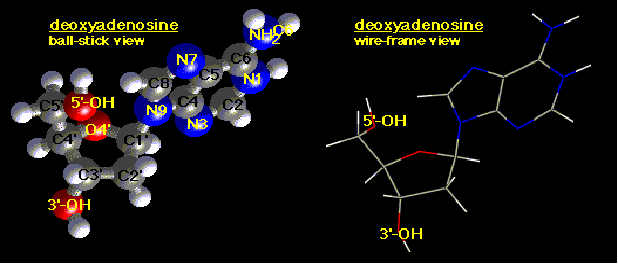
Before you can study types of Nucleic Acids, you have to know about their basic structures. the MONOMERS of these organic molecules are called Nucleotides. Nucleotides are composed of three things:
1) Phosphate
2) A Hexose Sugar
3) A Nitrogen-containing base
A long chain with a long story
Nucleic acids are formed when long chains of nucleotides form by condensation bonding. Here are several common bases:
Purines:
Guanine
Adenine
Pyrimidines:
Cytosine
Thymine
Uracil
Famous NA's
Uunder the picture are the three most commonly studied Nucleic Acids and their functions:
- Cells are obtained from the crime scene
- The cells are then broken open and the DNA, which dissolves in water, seperates from the other cell parts.
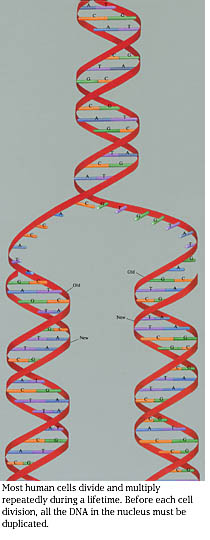
- The "DNA water" is then heated so that the DNA will "unzip."
- The weak hydrogen bonds that hold the bases of DNA together are very weak, and are easily broken by high heat.
- Some free floating bases are added to the solution and, becuase certain base pairs only pair with others, the DNA rebuilds itself and is replicated.
- This process is repeated several times untill there are many many coppies of the DNA.
- The DNA is then stained and placed in a special agarose gell.
- The gell is placed in a magnetic field so that the staine DNA moves down the gell.
- Now, the gell has been marked by several lines and spaces cause by the building-up of DNA at that place (caused by density of the DNA which is different for different people) - This gell is used to detirmine the traits of the suspect.
For more in-depth info on DNA fingerprinting, check out the links section at the bottom.
RNA - Ribose Nucleic Acid is much like DNA in appearence of a helix, however it is single stranded and instead of Thymine, Uracil is used in the base pairing. Both of these are formed by condensation, a method of bonding that allows molecules to come together at their functional groups (water is also released from this reaction). RNA is used to synthesize proteins in the cells of living things. First, genetic information that is stored on DNA is transfered to the "carrier" RNA. This RNA then comes together with a ribosome in the cell and the two move to a structure in the cell called the Endoplasmic Reticulum. The ribosome, along with the information the RNA provides, builds proteins piece by piece and then releases them in the Endoplasmic Reticulum.
ATP - Adenosine Triphosphate is what most scientists call the energy of cells. It is actualy not even a Nucleic acid, but rather a nucleotide. It is formed by three phosphate groups bonded to Ribose, the sugar. It is the weakness of these last two phosphate bonds that makes this molecule such high energy. Water (hydrolysis) is used to break down ATP into ADP (Adenosine Diphosphate) and large amounts of energy are released. Often, cells have cycles that break down and then rebuild ATP. This is where your cells get the energy to function as they do. Check out the likes below to learn more about ATP.
2) CHEMystery: Nucleic Acids (good information, well condensed and organized)
3) Encyclopedia Encarta: Nucleic Acids
4) Learn more about ATP!
5) Site with great videos on DNA fingerprinting and great links
6) Don't know your cell parts? You should to understand RNA. Click here!