

Before you can study types of carbohydrates, you have to know about their basic structures. Carbohydrates, like other organic molecules, have a backbone of fused carbon atom rings that the other atoms in the chain branch off of. The MONOMERS of carbohydrates are called Monosaccharides. Monosaccharides are the base of all carbohydrates and are formed by 3-7 fused carbon atoms.
Hexose Sugars
The Hexose Sugars are monosaccharides fromed by 6 carbon atoms. These include the three most well known sugars:
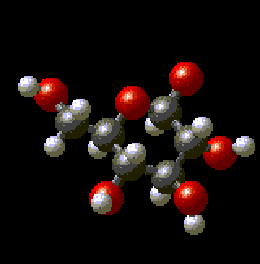
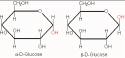
Glucose - (C6H12O6) blood sugar of animals
Fructose - sugar of plant fruits
Galactose - found in many other complex carbos
Other Sugars
There are other monosaccharides, like Ribose that is used in DNA, that are well-known and frequently used in organic molecules. Disaccharides are sugars formed by two monosaccharides and Polysaccharides are chains of three or more simple sugars.
Disaccharides
Lactose- Galactose and Glucose
Surcrose- Glucose and Fructose
Maltose - Glucose and Glucose
Starch - Plant energy storage (roots and fruits) found in pastas
Glycogen - Animal energy storage, produced in the body and stored in Liver
Cellulose - Structure of cell walls, Chitin and used as fiber for animals
Formation of Carbohydrates
Carbohydrates form by a process called condensation. In condensation, two Hydroxyl functional groups combine, releasing water and froming a bondwith the remaining oxygen atom, thus joining chains of carbohydrates.
Hydrolysis is the reverse of condensation, where water is added, the bonds are broken and a complex carbohydrate is broken down into smaller, useable ones.
2) More in-depth, but much more advanced information, only for advanced students
3) Also pretty advanced information, but awsome, comprehensive graphics
4) Good info, well organized and well presented.