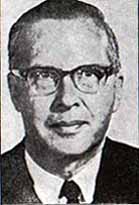
WHAT IS THE NATIONAL CHARACTER OF THE MACEDONIAN SLAVS
(Prof. Heinrich A.Stammler , IMRO - Union of The Macedonian
Brotherhoods in Bulgaria, Sofia, 1991)
This is the first issue in the series of "Macedonia: and the
Macedonian Question".
Throughout the series, we will be inviting emminent academics and
political figures from around the world to view, examine and
comment on this most difficult of socio-political problems.
The series will deal at length with all aspects of the question,
from the ancient movements and settlements of peoples to the most
up-to-date polls and censuses; from the manipulation of people by
the use of force and terror to the more insidious techniques of
modern propaganda; and from the development of early slavic
languages to the present, unprecedented accusations of the
creation of a new, "literary standard language", all of which have
been used to convince a people of who they are and what they are
not!
Ultimately, this publication hopes to help the efforts being made
to set straight the problems within the region known as Macedonia
and to disentangle the knot of misinformation, hidden facts and
lies, all of which has resulted in particular interpretations (or
misinterpretations) of history. This is the legacy of many periods
of instability, dating back to the 1877 - 78 Russo-Turkish War and
the Bulgarian liberation, the Berlin Treaty of 1879 and decades of
Serbianization and of the far more protracted and subtle
Hellenization of the Southsrn region of Macedonia. Of course, the
last 45 years of totalitarian rule has done more to bury the truth
than any other single force, but this series will endeavour to
confront the expantionist nationalism that presently seeks to
continue its history of falsification and oppression of the
Bulgarian character of Macedonia.
By presenting the views of outside observers and "innocent
bystanders", we feel sure that this series will help to give the
clearest and most objective view of the problems and their best
solutions and will serve as an essential companion to the other
publications, concerning this problem, which have more "involved"
contributors.
We are certain that, in the end, by careful work and study, the
truth will out and real and, above all, just solutions will be
found and adopted.
Andy Barrett
--------------------------------------------------------------------------------
Mr. President, Dear friends. Ladies and gentlemen,
First of all please allow me to express my sinccrcsl gratitude to
the President of this Organization and to the Committee for having
afforded me the precious opportunity of addressing this
Conference. Time is short and I do not want to claim your
attention longer than is absolutely necessary. I honestly feel
that perhaps my justification for speaking to you about the
problems of Macedonia is somewhat flimsy. What are my credentials?
It is true, I am a professor of Slavic and East European Studies,
but as far as my teaching and writing is concerned, Russia and,
more recently, Poland have come more closely under my observation.
I hope , nevertheless, that you might forgive me my boldness to
appear here before you when I refer to a point of saving grace in
my favour: I love the Southeast of Europe, and five wonderful
years of my life were spent in Bulgaria in the capacities of an
academic teacher and a public servant. There I had the opportunity
of meeting people from all walks of life, of making myself
familiar with the history, the culture and living conditions of
the country and last but not least, of striking up close and firm
friendships, some of which have survived the trials and
tribulations of the catastrophic events which living through has
been our common lot. I also availed myself of the possibility of
making a trip to Macedonia and, although the journey was short,
places like Kratovo, Skopic, Veles, Shtip and Goma Dzumaya are for
me not merely names, geographic nomenclature or statistical data,
but I can say: I was there; I saw, I listened and heard; I have
not forgotten!
I will not go into a presentation of the manifold facts of
history, ethnography, linguistics, folklore and statistics which
bear testimony - and I think this testimony is incontrovertible -
of the Bulgarian character of the Slavic-speaking population
settled in Macedonia. Whole libraries, have been written to
establish the Bulgarianism of the Macedonian Slavs and I believe
that many of you are much more intimately familiar with this vast
literature than I could ever be. And, Indeed, it would be absurd
if I, a mere outside observer, and only an occasional one at that,
would presume to teach you things which you not only know, but
live.
Let me, however, point out one circumstance which in my eyes, has
profoundly changed the whole situation. Up to the Second World War
the Bulgarian Macedonians, after the retreat of Turkey from
Europe, had to struggle incessantly for the preservation of their
heritage against the encroachment and machinations of the
Pan-Serbian circles, carried under the slogan that Macedonia is
nothing but Southern Serbia; and on the other hand they had to
fight the absurd notion propounded by Athens, that the
Bulgarian-speaking Macedonians are but "Slavophone Greeks". That
would be the same as if the English would assert that the
French-Canadians are but "Francophone" English people! Recent
events have taught us what reactions to expect from the
French-Canadians if such insinuations were to be made.
I believe, however, that it was easier to counter the Pan-Serbian
claims, even though they were dressed in the political scholarship
of men like A.Belie and Jovan Cvijic, because here was only the
matter of a spirited and well-reasoned defense against the
illegitimate ambitions of expansionists, which was, at bottom,
still old fashioned nationalism. And this is still the situation
in which the Macedo-Bulgarians find themselves under Greek rule.
I wish,however, to call your attention to a much more sinister
device concocted in Belgrade under the sign of the Red Star, the
Hammer and the Sickle. That the invention of a separate Macedonian
nation, a Macedonian literary language and even a Macedonian
history, is divorced from all the evidences of historical research
and scholarship. By sophistry and the distortion of the historical
facts it is said, for example, that St.Clement of Ochrid was a
member of some separate Macedonian people which has never exited,
and that the language used by the apostles and teachers of the
Slavs for the christianization and the enlightenment of the
Slavonic world was a separate Macedonian idiom, which has nothing
or only very little to do with the Bulgarian language as such. In
order to find some historical foundation for these unproven and
undemonslrable allegations, historians of this school have even
restyled the West-Bulgarian Kingdom of Tsar Samuel as a state run
for the benefit of the mythical separate Macedonian people. Let me
quote only one authority, the eminent Russian byzaniologist, A. A.
Vassilijev, whose monumcnted history of the Byzantine Empire is
generally considered a standard work in this field. What has he to
say about the national character of Samuels Kingdom?"Afler the
death of John Tzimisoes the Bulgarians took advantage of the
internal complications in the Empire and rebelled against
Byzantine domination. The outstanding leader of this period was
Samuel, the energetic ruler of Western independent Bulgaria, and
probably the founder of a new dynasty, one of the most prominent
rulers of the First Bulgarian Empire." In the entire passage
dealing with this heroic, as well as tragic episode in Bulgarian
history, Vassiljev consistently uses the term "Bulgaria". In a
footnote, it is true, he mentions the hypothesis put forward by
the Serbian historian D.Anastasijevich that Samuel's Kingdom was
not lawfully Bulgarian, but a "Sloveno-macedonian Empire". But
quite obviously he does not make this hypothesis his own. I think
that in the market of international historical scholarship the
authority of Professor Vassiljev rates considerably higher than
that of Mr.Anaslasijevich. Another noteworthy fact that is such
attempts to deprive the Bulgarians of their history and heritage
by declaring that they were not Bulgarians at all, had already
been made in the years soon after the First World War. This shows
that the recent creation of a separate non-Bulgarian Macedonian
nation, complete with history, literary language, folklore, etc.,
by fiat from above, does have its precedent.
It goes without saying that the endeavors to divest the Macedo-Bulgarians
of their national identity were accompanied in recent times by
violent measures designed to lend force to the arguments set forth
by Pan-Serbian propaganda, no matter whether this propaganda
appeared disguised as scholarship or downright indoctrination. Let
me quote from a symposium entitled," The case for an Autonomous
Macedonia" compiled and edited in 1945 by Mr.Christ Atanasoff. One
of the crown witnesses summoned to testify was the well-known
British Balkan expert. Miss Edith Durham. In 1931, she wrote the
following in the paper La Macedonian, published in Geneva: "During
the Balkan War there was a Serbian schoolmaster - an Austrian
subject - at Cetinje, who taught German in the boy's school. He
rejoiced greatly over the conquest the Serbian army was making in
Macedonia. It would add much valuable land to Serbia. An
Englishman said to him: "Oh, but Serbia cannot annex these places,
they are all Bulgar". The inhabitants put the article after the
noun. This is well known as a Bulgar peculiarity. The Serb
replied: "That does not matter. When our army has been there for
two years, you will find no articles after nouns there, I can
assure you". But, in spite of torture, murder, imprisonment, the
Bulgai article still lives on at the end of the noun."
Since it was not possible to do away with that stubborn post
posited article by administrative matters, comprising the whole
gamut from violent suppression to persistent persuasion and
bribery, a new tack had to be tried. The article was declared not
to be a peculiarity of the Bulgarian language, but also a
characteristic of a hitherto non-existent separate Macedonian
language.
In parenthesis let me say this: Since the disappearance of the
classical, semi-Hellenic Macedonian Kingdom of Philip, Alexander
and Perseus in Roman limes, the terms "Macedonian" and the
"Macedonia" have been used as geographic terms for that area in
Southeastern Europe, which is still known under this name. Since
the middle ages it has been inhabited predominantly by Slavo-Bulgarians
and by minorities of Albanians, Valachians, Turks, Greeks,
Gypsies, Jews and, as the statistics of the 19th and 20th
Centuries show, surprisingly few Serbians. For more than a
thousand years the Slavs living in this area have been considered
Bulgarians, or to be more precise. Western Bulgarians whose idiom
is distinguished by certain dialectical peculiarities, without
thereby losing its general Bulgarian character. This clearly
recognized fact, incidentally, caused the great 19th century
philologists, who laid the groundwork for a systematic study of
this language to call it, in the early stages of its development,
Old Bulgarian. The language employed by Sts.Cyril and Metodi,
St.Klement and St.Naum and a host of other medieval writers and
teachers is an old Bulgarian idiom. Please allow me to make a
personal remark in this context. When I, in the spring "of 1931,
began to study Slavic philology at the University of Munich, we
used the famous handbooks and grammar of this language written by
the celebrated German Slavist, August Leskich. These books
described and analyzed the phonology, morphology, vocabulary
syntax of a language which unequivocally was designated as Old
Bulgarian :Handbuch or Grammatik der Altbulgarichen Sprache. It is
also true that the term "Old Church Slavonic", most frequently
used nowadays,was sometimes applied to this language, but one
should keep in mind that this term is basically meaningless, at
least up to the times of Peter the Great. In the course of his
secularizing transformations and reforms, Peter favored the
introduction of the Russian vernacular into common usage,
relegating the then library language of the Muscovite Tsardom,
still based as it were on Old Bulgarian, to purely liturgical and
ecclesiastical purposes. This practice was later followed by other
awakening Slavic nations, especially those of the Orthodox
faith.profoundly. Nevertheless may it be said here, in parenthesis
only, that the Old Bulgarian imprint on the native language of the
Russians was so strong that even nowadays authoritative scholars
in the field of Slavic linguistics and philology, such as Boris
Unbegaun, speak with good reason about the partially Old Bulgarian
character of the Russian standard literary language.
Thus, the fiction of Macedonia as "Southern Serbia" could not be
maintained in the long run because it really held no water. Even
responsible Serbian leaders could not close their eyes to this
fact. Even the Yugoslav Ambassador in Sofia, Mr.Milanovich, in a
moment of deep crisis for the Yugoslav State, that is in the
summer of 1940, saw fit to forward to his master in Belgrade the
Prime Minister Slojadinovich, a statement from Macedonia received
in Bulgaria on the situation in this region. Here we read:
"Everybody has to know that today Macedonia is not lost for
Bulgaria, but on the contrary, there exists a healthy Bulgarian
spirit more than ever. Some call themselves Macedonians, but this
is due to the terrible reaction which the name Bulgarian provokes
in the Serbians. It is well known that all injustices, robbery and
violence create reaction and disgust. This is exactly what the
Serbians have achieved in Macedonia. When they came to Macedonia
they knew that Bulgarians lived in this country. That is why they
thought, by crude measures and lawlessness, to frighten the people
and to win them over for the Serbian cause. But all was in vain.
And now they are surprised at the anti-Serbian feelings in the
hearts of the majority of people. The common wish of the people is
: Let Gypsy come, only let this one, the Serbian, go away.
Anathema to any Bulgarian who will forget his own brothers.".
The war and its aftermath did away with the Pan-Serbian
military-bourgeois monarchy. Overboard went what Marxists call
Bourgeois nationalism and chauvinism. But let no man be deceived
that the substitution of the old order by the dictatorship of a
Communist party and its leader spelt the disappearance of an
expansionist Greater Serbian nationalism. Had the means employed
between 1912 and 1940 been crude and brutal, and therefore in the
end unsuccessful, new devices had to be invented, this time more
clever, more insidious, in order to attain the same goal. This
time under the banner of a Yugoslav Communist Revolution! If we
have failed so far wean away the Macedonians from their
Bulgarianism, because we tried so hard to make them into Serbians,
well, then let us now try to insinuate that they arc neither
Serbians nor Bulgarians, but a separate national entity, for
instance, Macedonians with their own history, language and
culture; but let us also make it perfectly clear to them that only
we here in Belgrade are willing and able to guarantee this
artificial nationality concocted in the test tubes of Serbian
Communists and their non-Communist predecessors. The whole
Macedonian nation and the so called language -this I wish to
affirm here before you- is not a philologicum, but a polilicum
designed according to the well tried maxim of old: divide et
impcra - divide and rule. History teaches that a ruler, a parly or
a leading group which enjoys unlimited power and has the will to
use this power ruthlessly for the attainment of its goal, has
always found partisans, advocates and adherents prepared to do the
bidding of those at the helm of the state, sometimes against their
own belter knowledge. Wasn't it one of the great cynics on the
throne. Henry the VIII of England, who said when planning
something particularly outrageous and arbitrary "let me first
carry out this measure, afterwards I shall always find professors
at Oxford to justify it". So it is no wonder that in Skopie and
elsewhere the Belgrade government should have found learned
collaborators who fell for their line. I think that under the
circumstances prevailing one should not judge them and their
zealous efforts too harshly. But it is deplorable that scholars
abroad with solid academic reputations and achievements, who are
not exposed to the pressures of the intellectual under
totalitarian regimes, should also swallow this latest Belgrade
bait hook, line and sinker. Can they really accept the thesis
that, contrary to their own testimony and conviction, people like
the Miladinoff brothers, Gregory Perlicerr, Alexander Todoroff,
Damjan Gruev, Gotse Delceff, Peju Javoroff, Anion Strashimirof,
Dimitr Taleff are Macedonians in the sense of the word bestowed
upon it with the blessings of the Belgrade party bosses? And what
about men who figure so prominently in the Pantheon of Bulgarian
letters like Ivan Vazoff and Teodor Trajanoff who lived and worked
in Bulgaria proper, but whose family background is Macedonian,
Bulgaro-Macedonian that is. What about such a significant figure
of the Bulgarian Renaissance like Raiko Zhinzifoff from Veles, who
declared in 1963 in his Novobulgarska sbirka - or did he, perhaps,
call it Novo-Makedonska sbirka? "As Bulgarian language we regard
that language which is spoken in all Macedonia, Thrace and
Bulgaria proper. The differences between the dialects are
negligible. Every Bulgarian who does not suffer from
nearsighteness cannot designate a certain expression as
"Macedonian" or "Thracian"., for there are no "Macedonians" or
"Thracians" as individual nations, but only Slavo-Bulgarians - in
short, one Bulgarian people and one Bulgarian language".
One could object here that this is a voice from the long forgotten
depth of the 19th century. One could also maintain that Zhinzifoff,
with all his linguistic and folklore erudition, was not up to par
with regard to the achievements of philological science, that is
that we in the 20th century know better now. Let us then examine a
few testimonies belonging to our century.
Let us first listen to the voice of practical common sense, the
voice of a man who would never lay claim to the reputation of a
learned academic linguist. The opinions of this man, however,
deserve to be listened to attentively and carefully because they
are based on the profound national experience of a statesman and a
leader of his people, Ivan Mihailoff.In his book, Makedonia: A
Switzerland of the Balkans, edited and translated by Christ
Anastasoff, he makes the following observations pertinent to the
linguistic problem: "Like the scholars of different countries who
were familiar with Macedonia, so also did the Turkish authorities
and all the rest of the objective observers consider the
Macedonian Slavs as Bulgarians. This was not only upon the basis
of the logically had introduced in their schools, but on the basis
of all other ethnic features by which a given nationality is
judged. The local dialects of the Macedonian Slavs arc basically
considered by all as Bulgarian language. Every nationality employs
its own common literary language, while in every nationality meets
different dialects. As far as the Bulgarian dialects in Macedonia
arc concirned they do not vary very much from the rest of the
Bulgarian dialects as, for instance, do dialects among the
Germans, Italians and other nationalities. The dialects of the
Germans in Switzerland is, perhaps, the most difficult for all the
rest of the Germans.
But that did not prevent the Swiss of German origin to consider as
their own the common German literary language. Precisely so,
before the appearance of the regimes of national oppression in
Macedonia after 1912, the native Bulgarians officially used that
literary language which is common for all the Bulgarians of the
world and to the formation of which the cultural workers of
Macedonia have contributed a great deal." This point of view
deserves to be firmly kept in mind, especially in view of the
artificial construction of a new "Macedonian" nation and language
as commanded from above. For this purpose the chief perpetrators
of this dubious enterprise now take great pains to smuggle into
this newfangled synthetic idiom all sorts of Serbanianist and
other foreign ingredients so as to alienate the Macedo-Bulgarians
from their historical, cultural and linguistic matrix.
But what has the linguistic science of the 20-th century to say
about these attempts to deny the Bulgarian character of the Slavic
idiom spoken in Macedonia? Here I cannot go into the details of
the lingiustic argument adduced by international scholars, to
refute the claims. To note that Professor A.M.Selishchev, the
eminent Russian philologist, in his article entitled "Macedonian
Dialectology and Serbian Linguistics" already in 1935 destroyed
the claims of Serbian scholars like Velich, Djordjevich, Pavlovich
and others that the idiom spoken in Macedonia is closer to Serbian
than to Bulgaria should be enough. This task he performed in a
thorough scholary way, basing himself upon the findings and
achievements of modern linguistic research in the field of Slavic
philology. Whoever is interested in the course of his irrefutable
reasonic can study this article in a volume recently published by
the Bulgarian Academy of Sciences under the title L'histoire
Bulgare dans les Ouvrages des Savants Europeens. Professor
Selishchev cannot be suspected of any sort of polilicing. He has
worked in Russia under the old as well as the new regime;
following nothing, to the best of his abilities, but the dictates
of his scientific conscience. It is remarkable to see how to this
pure scholar and cabinet savant, far as he was from the passionate
turmoil of the political motives behind the scientific smokescreen
spread by the named Serbian scholars. He said: "The aim of all
these books is the same: namely, to furnish an historical,
ethnographic and linguistic justification for Serbian domination
in Macedonia - to furnish this justification by means of true
scholarship. The arrogance in the style, the irony with which the
Bulgarian people are treated is another common feature of the
books of Belgrade professors. In the case of Professor Georgevich
this irony borders upon downright rudeness. On the other hand,
everything Serbian is idealized. The attempts of the authors of
such books to clothe their products in a science-like garb must be
unmasked. The true character of their content, harmful to all
science, must be demonstrated".
The results of the linguistic and ethnographic research in the
field of Macedo-Bulgarian studies undertaken by Professor
Selishchev not so long ago match the findings not only of the
Bulgaro-Macedonian philologist Krusle Misirkoff, which he
published in 1910-1911, but also of a number of 19th century
Serbian scholars like Stefan Verkovich, Tuminski, A.Hadzic, Vasa
Peladic and others. That authors like Selishchev, Misirkoff and
Verkovic working at different times and under completely different
circumstances should have arrived at the same results, with regard
to the Bulgarian character of the dialects spoken in Macedonia and
their geographic extensions points to two noteworthy qualities of
their research Its exactitude and its factual and logical
consistency, in view of which all the counter-arguments of Serbian
and Pseudo-Macedonian opponents take on the suspect colouring of
sophisty and political expediency. More proof was recently given
for the Bulgarianism of the Macedonian dialects by the Bulgarian
philologist Blagoi Shklifoff in a paper about the idiom spoken in
the area of Kostur. From the evidence he is able to muster, it
becomes perfectly clear that the Kostur dialect cannot be used to
buttress the hypothetical existence of a separate and individual
Slavic language called Macedonian, but that here, as elsewhere, we
deal with but another variant of the Bulgarian language as spoken
by the Western half of the nation.If indeed, this is the
conclusion at which Mr.Shklifoff arrives, the dialects in
Macedonia are by their character intrinsically different from
those spoken in Moesia and Thrace, then these differences would
have to show more than anywhere else in the dialect of Kostur, the
area of which borders on two non-Slavic linguistic regions,
located geographically distant from the other Bulgarian dialects.
A strictly scholary approach to this idiom, however, cannot but
establish its basically Bulgarian character. The paper by
Mr.Blagoi Shklifoff was published in 1968. Sclishches's analysis
and demolition of the claims raised in 1935. But the same position
and results are visible in the book about Macedonia by the Czech
Balkaniologic Vladimir Sis which was printed in Prague in 1914 and
came out in Zurich, Switzerland in 1981 in a German translation.
After Sis enumerates all the factors which effect the closest
mutual correspondence between Old Bulgarian and the Modem
Bulgarian language as spoken also in Macedonia, he points to
certain philological peculiarities by means of which the Bulgarian
language is distinguished from all other Slavic language, Serbian
included. After a painstaking comparison between the Bulgarian
standard literary language and various dialects spoken in
Macedonia, he arrives at the following conclusion which I shall
quote here verbatim "Whoever is familiar with the basic structural
principles of the two neighboring languages must, even though he
may not be a philologist, arrive, on the basis of the examples
cited here, at the same conclusion to which also the French
slavicist, Louis Leger, came, and I repeat his words: The
Macedonian Slavs are Bulgarians and speak a Bulgarian dialect.
Indeed, even the Serbian Vuk Karadzic, who was the first to
publish some Macedonian folksongs, selected them in order to
determine with their help the basic characteristics of the
Bulgarian language. That there occur Serbanianisms in some North
Macedonian dialects does not prove anything. It is inevitable that
in border areas between two linguistically kindred groups a
certain inlcrminigling of vocabulary lakes place. If the fin
Serbianisms in the regions of Tetovo or Kumanovo, we also find
Bulgarianisms in the Prizren dialect behind the Shar Planina, a
purely Serbian area. The Russian scholar Hilferding says in his
book An Excursion Into Hersegovina And Old Serbia:" In the
language of the Serbians around Prizren it is clearly noticeable
how much it tends to resemble the Bulgarian dialects. It would be
interesting to investigate how this blend of the Serbian language
with the Macedo-Bulgarian has come about. "That authorities
marshalled here in such an imposing array would be sufficient to
support and prove the point I wish make here, namely, that the
language spoken by the Slavs between Skopie and Salonica, Kostur
and Kustandil is neither Serbian nor "Macedonian", but Bulgarian.
Please allow me to invite one more witness to make his deposition.
The man and scholar I am refering to is a former countryman.
Professor Guslav Wcigand, the eminent German Balkanologist,
cthnographer, linguist and lexicographer. Wcigang ordinarily was
no Slavist. When he began his career, his research interests were
centered in Rumania and Albania. He is one of the very few Western
Scholars to give the world a grammar and reader of the Albanian
languagc. But in the course of his studies he became convinced
that he would have to embrace with his research also the Slavic
groups settling in this, as Christ Atanasoff has called it, tragic
peninsula. This extension of his studies had the effect that
Wcigang became also a linguistic expert in the Modern Bulgarian
language, a field in which again he proved himself as grammarian
and lexicographer. In 1924, he published in Leipzig his
fundamental work Ethnographic von Maccdonicn, a chapter of which
is devoted under the headline "The Bulgarian Language As Spoken In
Macedonia" (Das Makedonische Bulgarisch) to linguistic issues. The
result of Weigand's meticulous observations do not essentially
diverge from the findings of the other students of these affairs,
quoted in this context. But in one point, at least as far as I can
sec on the basis of the limited number of documents available to
me, Weigang had an intuition which had not occured, at least in so
many words, to other scholars. He was , of course, fully aware of
what was going on at that time in Macedonia, a period which Ivan
Michailov, as we have seen, so aptly called "The Regimes Of
National Oppression". He must have speculated which devices, apart
from brute force, the oppressors might yet use to achieve their
goal - the denationalization of the Macedo-Bulgarians. As a
well-trained experienced linguist and ethnographcr it was, in all
probability, clear to him that all the attempts at Serbanization
would end in futility and frustration. But then - what other means
could the enemy of the Bulgarian nationality propose to undermine
and destroy Macedonian Bugarianism? And here he hit intuilively
what was to happen 20 years later. The artificial, test tube
creation of a separate Macedonian History, literary language and
nation. Here are the conclusions at which Weigang arrived after a
conscientious examination of the linguistic and ethnographic
facts: "Whatever segment of this language we analyze, again and
again it becomes evident that we deal here not with the Serbian,
but the Bulgarian language. All attempts of Serbian chauvinists to
design the Bulgarian language as spoken in Macedonia as a Serbian
dialect or as a mixed language of indefinite character will
therefore end in failure. One could pose the question whether,
perhaps, the Macedonian Slavs haven't their own language,
something in between Serbian and Bulgarian. Such an assumption,
however, would be absolutely unjustified, for, as we have seen, in
phonology, morphology and syntax Macedonian Bulgarian and
Bulgarian proper harmonize in every respect. Certain exclusively
Macedonian peculiarities cannot essentially change this picture.
In the lexicon there occurs a number of words of Greek or Turkish
origin which do not exist in the Serbian or Bulgarian vocabulary.
In proportion to the overall lexicon, however, their number is
quite insignificant, as can be seen from the linguistic samples
adduced here, which clearly demonstrate that Macedonian can only
be considered a Bulgarian Dialect".
In the 1926, the Russian journalist L.Nemanov, a representative of
the respectable emigre newspaper Poslednie Novosti, edited in
Paris, travelled in what then was officially called "Southern
Serbia". He published a report about his impressions and
experiences under the title, "What I Saw in Macedonia". His
findings are those of a man who was probably a good practical
linguist, but certainly not a learned professor of linguistics.
They felicitously supplement the results of strict academic
research, in his own trend of observant impressionism, he relates:
"The Serbian authorities insist that the language spoken by the
population in Macedonia is not Bulgarian, but a Macedonian dialect
of the Serbian language. This reminds me of a case when a Serbian
man of science was trying to prove to me that in general there was
no Bulgarian language, but that it was a Shop dialect of the
Serbian, to which I seriously retorted that Russian as an
independent language was nonexistent to except as a Moscow dialect
of the Serbian language. That is why whatever the Serbian
politicians cail the language in Macedonia, it is a fact that this
local language is comprehensible to me, a man knowing a bit of
Bulgarian, while it is difficult for me to understand Serbian".
This statement, not devoid of humor as it is, may furnish some
comic relief after all the dry seriousness of philological
research and linguistic inquiry. But one should not forget that it
is the question of depriving a people of its national identity,
the first blows are invariably directed at its language, because a
common language, a common heritage and a common destiny are the
chief characteristics of historical nationality. And the pride in
just this heritage and the hopes and aspirations of a common
destiny, in rcturn,arc expressed in just this common language. So
the best way to emasculate a national group is to rob it of its
native tongue or to corrupt it. If it should turn oul impossible
to extirpate the language of a group one desires to oppress and
destroy - well, then let's try to persuade them and the world that
their language docs not exist at all, that in reality it is quite
another language they arc speaking, a language of whose existence
they had not even dreamed before, which, however, exists because
we tell them so. You do not speak Bulgarian, you have never spoken
Bulgarian, neither have St.Cyril, St.Methodius, St-Clemens, Tsar
Simeon or Tsar Samuel. They have all spoken Macedonian only,
ignorant and unenlightened as they were, they didn't notice. The
same is true of the Miladinoff, Gotse Delchev, Peju Javoroff or
Teodor Trajanoff. They did not know, but now they are better
informed because we tell them so.
A nation which will not surrender its own national identity and
national heritage, will not give up its native tongue, the
treasure house of all its achievements and aspirations. When the
Israelis and the Irish succeeded in re-establishing their own
state, it was the first legitimate, and natural endeavor of their
leading minds to recapture their lost or half-lost native idioms
and restore them to their rightful glory. When, before the First
World War, the Prussian government undertook to ban instruction in
Polish in the schools in the eastern provinces of Prussia these
decrees were bitterly and resolutely resisted by the Polish
minority. In the end, all these measures proved futile, but they
have contributed to poisoning the atmosphere between Germans and
Poles down to our own day. The press tells us what undesirable
things happened in the Southern Tyrol where the Italian government
shows but scant regard for the cultural rights of the
German-speaking minority. Alas, these examples, spread all over
the globe, could be multiplied ad infinitum. It also shows that
even at a lime when many of the more advanced nations are making
great moral efforts to overcome a narrow-minded, self-centered and
often aggressive nationalism there persists the feeling that
questions of language and national identity cannot and must not be
resolved by cither brute force or cunning persuasion, or by
distortion and falsification of the historical and statistical
facts. In his attempts to explain the origins of human language,
the great German humanist, statesman and linguist Wilhelm von
Humboldt once declared that all research in this problem leads to
a point where further explanation avails nothing, where even the
keenest, most critical intelligence will have lo admit that human
language in its deepest well-springs is a divine miracle. From the
limes of the ancient Helenes on, the nations have delighted in
their own languages, have recorded them not only with the
intelligent curiosity of science and scholarship, but also with a
sense of awe and wonder. At bottom, their languages have always
appeared to them as a precious vessel, a national possession
cherished above all other things, a sacred covenant with their
inscrutable destiny. As long as there is one living soul also
among the Macedo-Bulgarians who remembers this deep in his heart
and acts accordingly, the Macedo-Bulgarian cause is not lost. Keep
the banner of your language flying, then the hope for a free
Macedonia for the Macedo-Bulgarians will be resurrected again and
again, and in the end, if Heaven wills it so, Macedonia's goal
will be fulfilled.
By:
www.knigite.abv. bg/en/index.html
|