The History of Chaos
Centuries have passed since humans first realised small causes could have large effects and
that it was hard to make predictions with any certainty. In fact some systems allowed the end
result to reach a state of total unpredictability. Shortly before the start of the twentieth
century, a French mathematician, called Jacques Hadamard proved an example concerning the
reliance on the starting conditions to determine the patterns of motion at a point on a
frictionless surface. Snooker balls are a good example of this type of unpredictable motion.
When three balls are pushed together, the resultant direction of these balls is not easily
predictable. Another Frenchman, this time a physicist Pierre Duhem agreed with Hadamard's idea.
He published a paper claiming that prediction becomes unusable due to uncertain initial
conditions.
The man considered the founder of Chaos theory, Henri Poincar� produced "Science et Methode",
which suggested that there was a determining factor in dynamic systems that was at first unknown
which would cause large scale changes later on. The work of the three men mentioned above was
disrupted by the discovery of quantum mechanics. Other factors were the fact that both ergodic
theorems (Ergodic theory can be described as the statistical and qualitative behaviour of
measurable group actions on measure spaces) and computerised simulations were unavailable for
use which meant that there were neither the right amount or quality of tools available. As a
result of the lack of technology and tools to work with chaos, only in the twentieth century
(relatively late for most important mathematical discoveries) were people able to start
understanding chaos properly.
Henri Poincar� - "The Founder of Chaos"
Henri Poincar� often considered the "Last Universalist", was able to suceed in all branches
of mathematics.He was able to contribute to diverse fields such as analysis, algebra,
topology, astronomy, and theoretical physics. His mind was constantly full of creative ideas,
and he published extensively. Among his published works were several popular pieces that tried
to give the general public a basic understanding of the workings of science.
Henri Poincar� submitted a solution to the question "was the solar system stable" and was
thought to have won at first, but an error in the calculations was discovered. Poincar� was
unable to find a solution and as a result had shown that the widely accepted view that the
universe was purely deterministic was in fact wrong. He stated that Newton's laws did not
provide a solution to the "three-body problem" (which was mentioned above using snooker balls),
meaning that a problem involving the earth, moon and sun could not be tackled. This was again
due to the fact that initial conditions caused huge differences in the final result making the
final answer unpredictable. Poincar� showed that he was trying to find order where it did not
exist.
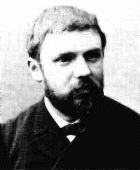 Henri Poincar� : April 29, 1854 - July 17, 1912
In a similar style to proof by contradiction, Poincar�'s answer contributed to the creation of
chaos theory.
Later in the twentieth century, with the advances in technology, people have written extensive
journals and articles into chaos and its behaviour. It is still a phenomenon that grabs the
interest of a huge number of people.
Next: Why is it so hard being a weather reporter?