
Home
Bleecker

DIED: 19 APRIL 2004
MARRIED: Selly Bleecker
BURIED: 26 APRIL 2004
PARENTS:
Father:
Mother:
Brother: Rudy Martin
CHILDREN:
Frank Bleecker
Ronald Bleecker
James Bleecker
Child: Feilicia and ?
Michele Bleecker
Wednesday, May 5, 2004
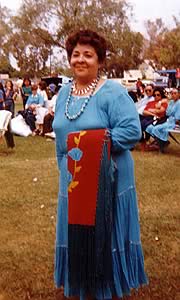
Shoshone heritage made Helen Bleecker proud
Santa Ana woman sought equal rights for American Indians.
Helen Bleecker
By ROBIN HINCH
The Orange County Register
Her casket was specially painted turquoise, her suit was turquoise and her daughter wore turquoise gloves to the funeral.
Helen Bleecker's favorite color was no secret.
The neighbors certainly knew it. Her Santa Ana house was painted turquoise - inside and out.
But to Helen, turquoise was more than just a shade that caught her fancy. It was a symbol of her Shoshone Indian heritage, of which she was immensely proud.
She served on the board of directors of the Capistrano Indian Council in San Juan Capistrano and as secretary of the League of California Indian Councils. She attended picnics and powwows and fund- raisers.
Helen spent a good part of her life learning about her culture and fighting for equal rights for American Indians and their descendants.
She was 80 when she died April 19.
HELEN BLEECKER
� Born: July 21, 1923, Santa Ana� Died: April 19, 2004, Anaheim� Survivors: Husband, Selly; sons, Ronald, James, Frank; daughter, Michele; brother, Rudy Martin; two grandchildren� Services: Have been held. Arrangements by Brown Colonial Mortuary, Santa Ana.
Born Helen Reyes in Santa Ana, she was three-quarters Shoshone Indian and one- quarter Paiute. In adulthood, this heritage was a source of pride, but as a child Helen was forced to attend segregated schools and received only minimal health care.
Her parents were among local American Indians who organized programs for their children's education and medical and dental treatment - work Helen carried on with zeal.
Before Helen could enter high school, her mother died and she had to raise her younger brothers. But over time, she earned more than the equivalent of a high school diploma through years of political and community work.
She met her husband of nearly 60 years, Selly Bleecker, an Alpha Beta slaughterhouse foreman, at the beach. They lived first on Oak Street in Santa Ana, then in their colorful, turquoise Flower Street home.
She was a strong, determined woman with an unshakable conviction of what was right for her people. She was organized, thorough and not to be trifled with. People who worked with her called her "the motivated one."
Helen had bearing. There was an elegance about her, in the way she dressed and walked and talked. She was both charismatic and convincing. If she believed in something, she was loyal to the cause to the bitter end.
"It's how you win and how you lose," she told her children. "That's the whole game."
Her tactic was never to lose her cool. "In the face of adversity," she said, "you can never let them see you sweat."
A born organizer, she pulled together events for her children's schools' PTAs and for John F. Kennedy's presidential campaign, and lobbied heavily for passage of legislation that guaranteed health benefits and public education for Indian children.
Helen made sure her own children received the formal education she was denied, but also taught them not to brag about it, even though they hold diplomas from such institutions as the Michigan Institute of Technology, the University of Southern California and the University of California, Los Angeles.
"Anyone can get book learning," she said, "but it takes a special person to help others with it. Use it and communicate what you've learned to others."
Helen spent her life helping others. The children in the neighborhood called her Grandma and loved to spend time at her house, which was filled with fascinating American Indian artifacts.
She made frequent trips to New Mexico with hand-me- down clothing that she handed out to barely clad street children.
Helen didn't just talk about American Indian lore and philosophy. She lived it.
She took her children to powwows throughout the Southwest and seemed to have friends wherever she went.
And she imbued them with the American Indian philosophy by which she lived: The honor is to give to others.
CONTACT US: (714) 796-6082 or [email protected]