Wind and It's Effects
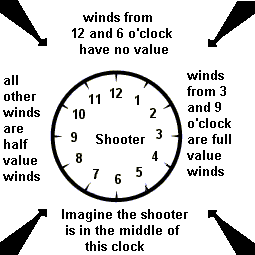
A common method of estimating the velocity of the wind.
During training is to watch the range flag.
The shooter determines the angle between the flag and pole.
In degrees, then divides by the constant number 4.
The result gives the approximate velocity in miles per hour.
If no flag is visible, the shooter holds a piece of paper.
Or grass, cotton, or some other light material at shoulder level
Then drops it.
He then points directly at the spot where it lands.
And divides the angle between his body and arm.
By the constant number 4.
This gives him the approximate wind velocity in miles per hour.
If these methods cannot be used
The following information is helpful.
In determining velocity.
Winds under 3 miles per hour can barely be felt.
Although smoke will drift.
A 3- to 5-mile-per-hour wind can barely be felt on the face.
With a 5- to 8-mile-per-hour wind.
The leaves in the trees are in constant motion.
And with a 12- to 15-mile-per-hour wind.
Small trees begin to sway.
The number that you get will be the number of clicks.
That you will need to add to your settings.
To compensate for the wind blowing.
USMC Wind Adjustment Method
The USMC has been using this windage adjustment method,
Since the days of the 1903-A3 Springfield.
After determining wind direction and speed,
use the following formula:
Range in 100 Yds. x Speed in MPH/15 (math constant)= MOA Windage
For instance, your target is 300 yards away,
and there's a 10 MPH wind:
3 x 10 = 30/15 = 2 Mintues Of Angle(MOA)
Click-in the two minutes of angle in the direction of the wind
And aim dead-on.
Windage Rule for the M-16A2
One click of windage adjustment,
Will move the strike of the round on the target,
Approximately 0.5 inch for every 100 yards of range to the target
Or 1.25 centimeters for every 100 meters of range to the target.
 Go to the Top of the Page