How do I know what class my Paso
Fino belongs in?
This question
is a common one. Exhibitors should get several opinions from qualified
professionals, such as experienced breeders, trainers, and judges
within the breed. What is one person's opinion of a performance or
fino horse is someone else's pleasure horse. Videotape your horse's
performance and get it reviewed if you can't get the horse critiqued
in person. Ask the reasons why the professional feels such to help
understand the reasoning of the opinion.
Why did a certain horse place lower
that never made a mistake over one that did?
A horse that
is a average or marginal horse that shows no ambition or spark in
its performance generally doesn't do enough even to make a mistake.
This horse is performing at a 65-70% level of what the ideal would
be. Meanwhile, another horse is performing at a 95% level of the ideal.
It makes a minor mistake, and is moved down to a 90% level; it makes
another mistake, and moves to a 80% level, but still it is superior
in its overall performance than the horse performing at a marginal
level. Obviously, if the original 95% horse keeps making more mistakes,
he is not performing to the ideal and will drop below the 65% horse.
Why did one horse place well in
one class, but not in another at the same show?
Every class
can be seen as a "different" horse show". A horse who
did not place well in one class due to his mistakes, may come back
in another class and perform flawlessly and win. A horse may improve
with more time and experience in the show ring with each class entered
OR get more tired and not perform as well.
Why is more than one judge often
used at Paso Fino shows?
Besides earning
multiple points for class placements at one show, the exhibitor is
getting more than one judge's opinion or judgement. If an exhibitor
does not agree with a certain judge's opinions, the use of more than
one judge at the same time lessens possible political decisions. Most
people, exhibitors, and/or breeders do not want all the breed's future
resting in just one judge's opinions.
Basicly,
how are Paso Fino gait traits judged in a class?
Qualitative traits of the gait's cadence are judged subjectively as
they can not be measured. "Beauty is in the eye of the beholder",
such as quality, beauty, and harmony of movement. Quality expression
is considered more difficult to judge, so the more judges used would
give a better average. Quantative
traits of the gait's cadence can be judged objectively as they can
be measured, such as tempo, quickness or frequency of footfall, timed
distance to travel, and energy and recoup level.
Why
do some classes and judges take longer to judge than others?
Besides the fact of
a large class entry size, it comes down to the degree of similarity
among entries. In this case, there are only small differences between
the contestants in their performances and often will include workoffs.
For each class, the time needed will also be determined by meeting
all the class requirements in a manner to view all the
exhibitors perform at each gait. Otherwise, judges that take longer
to judge than needed can give the impression of a lack of confidence
in their decision making process.
How do judges apply the their
decisions in their placements?
When the class
is run, a judge will compare entries to the "ideal" class
standard or criteria first, next compare the entries to each other,
and then place the class accordingly. Close performances may be called
for a workoff.
What is involved when a judge
calls for work-off tests at a Paso Fino show?
Paso Fino
judges may call for work-off tests only after the regular class routine
is run to further evaluate closely contested horses/exhibitors. Judges
will call those contestants for a work-off that are performing to
a similar level of quality to help decide which is the more efficient
performer during the workoff test routines. Work-off tests may involve
railwork and can include predescribed tests as per the Paso Fino rules.
Multiple reverses on the rail and use of the sounding board are frequently
used.
What is the purpose of the sounding
board and how much emphasis is placed on the horse's performance in
a Paso Fino class?
The sounding
board may be used after the class routine by some judges before line-up,
though the sounding board is not described in the rules as part of
the regular class procedure. In this circmstance, the judge should
still place the emphasis on the railwork performance in choosing the
class placements and not solely on the sounding board performance.
Its use as per the rulebook is for an extra work-off test (for closely
contested
horses). It is to be known the sounding board is used for one main
purpose: to hear the eveness of cadence of the Paso Fino gait. In
the Classic Fino class, it is also used to hear the quickness of the
footfall.
What is the judge looking for
in the use of the sounding board as a workoff test?
When judging the contestants
on the sounding board or also called the "fino board" in
the Classic Fino class, the judge may even look slightly away or down
to concentrate on the sound of the hoof beats' rhythm going over the
sounding board. The judge is not ignoring the contestant or being
disrespectful, but in fact concentrating on the sound of the cadence
while tuning out the cheering of the spectators or distractions. The
judge may
also evaluate the way of going as in "tracking" (ideally
the same hind foot follows the path of the front foot fall in a straight
path) of the horse at while using the board.
Note: as per show management
or request from association committees, it has been suggested to judges
to use the sounding board besides just for workoffs. Since judges
work for show management, they generally will comply. These reasons
can be:
- Excitement and entertainment
for the show and spectators
- The spotlight in which
for each exhibitor to shine
- Experience for horses
that may return for the championship class
- Everyone loves the Paso
Fino sound over the board
- Education for spectators
to hear correct or incorrect rhythm
Does
it matter where a judge stands in a ring to best officiate?
A judge who stands at one end of the arena or the other has a better
view of seeing up to 85% of the entries at any time by pivoting. While
a judge who stands in the middle of the ring has a more limited view,
as their back is to 50% of the arena immediately behind them. Exhibitors
may show better in different areas of the arena, and also may correct
their horses when they think the judge is not looking. When more than
one judge is used, one judge may see this while another does not,
so the judge's position in able to see the most entries is important.
Why
is conferring among judges not a judging system used often?
Judges may be viewed as having different "criteria" when
judging. Also, when conferring, the spectators and exhibitors do not
know the individual judge's "criteria" used to judge by
and what was the level of independence of each judge. One judge will
generally have more importance in breaking decisions when there is
not a unified decision made.
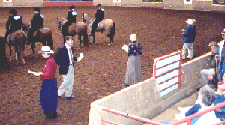
Originally
from “Stud Manager’s Handbook”, Vol. 2. Credit to
“Horse Lovers” Magazine Sept.-Oct. 1967; *edited for the
Paso Fino by Lynn Gallup
Many times
one hears a horse show judge criticized unmercifully. Perhaps in some
cases such criticism is justified. However, if the exhibitor or the
spectator would put themselves in the shoes of the person passing
judgment on a class, he might possibly see another side to the story.
There are
a number of important factors that the exhibitor, the spectator and
particularly the judge must take into consideration when preparing
for a show. The complete exhibitor, the knowledgeable spectator, and
the qualified judge will be all well versed in certain necessary areas.
Although this discussion will be made from the viewpoint of the judge,
the exhibitor and the spectator would in most cases, be less vociferous
in their discussions of the show if they took heed and followed some
of these
suggestions.
First of all,
the judge must have a clear picture of the ideal. This ideal may be
a * Bellas Formas Classic Fino, Performance, or Pleasure horse; but
in each class the qualified judge will know exactly what he is looking
for. They will observe each horse closely, comparing him with the
ideal. Their observations must be complete and they must be accurate.
When the comparisons made are based on complete and accurate observation,
a logical and correct conclusion can be made, and the class is placed
accordingly.
Now then,
let’s observe the exhibitor and the spectator while the class
is being judged. The exhibitor is showing his horse the best he can,
and has little time to properly evaluate the performance of his competitors.
His first and most important concern is showmanship, and not judging.
The spectator, on the other hand, has much time to watch the class
as does the judge. He can observe all the horses work and reach his
own decision. Maybe it will be a good one. He may, however, have had
some distraction from his neighbor or perhaps he has a friend or relative
showing one of the horses and he spends a little more time watching
that particular horse or person and misses something of importance,
or he just might not have an unobstructed view of the class at all
times.
The important
points are: The judge has only one thing on his mind, and that is
to place the class to the best of his ability. The judge is mentally
tuned to use a system to logicly determine placements of the class.
The judge has the best view in the house. Of course, he may miss something
when his back is turned, but if he/she is truly qualified and follows
definite procedures the things missed will be of little
consequence.
Knowledge
of the ideal for each class has been mentioned. The judge must also
have a complete understanding of the rules, qualifications, tack,
and attire governing each class. Most shows follow rules that can
be found in the Handbook published by the *USEF. In some local cases,
“local” rules of a specific association, may supersede
*USEF rules. In all cases, the judge is duty bound to become familiar
with these rules. By the same token, the exhibitor and the spectator
must know the rules. Many controversies could be avoided if everyone
concerned knew the rules of a particular class.
And finally
a good horse show will have:
- Good horses
- A good physical plan
- A qualified judge
- *Enthusiasm and good
sportmanship among exhibitors
The judge will be thoroughly
trained and will conduct their self in a manner that is a reflection
of the position they hold, one of professionalism and integrity. The
judge will attempt to satisfy:
- His/her own conscience
- The exhibitor
- The spectator
If the exhibitor and the
spectator train themselves as judges, and if they gain some appreciation
of the work that the judge does, our shows might become a truly educational
and rewarding experience.