

Other Resources to Explore / Ansel Adams Questionnaire / Scavenger Hunt for Design Elements Rubric Elements of Design Powerpoint Slide Show / Presentation of Photographic Portfolio Rubric
Introduction
Welcome to Ms. Benoit's Photography WebQuest.
This will be used as an introduction to a black and white photography project we will be doing in class with our digital cameras.
There are many elements involved in taking a good photograph.
A photograph is a piece of artwork, just like a painting, drawing or sculpture. A photograph captures the artist's unique viewpoint. The artist decides what he/she wants the viewer to see and how he/she wants it to look. Successful photographs can create feelings that make the viewer pleased, excited, entertained, saddened, inspired or disturbed.�
Composition, balance, focal point, lighting, contrast, and aesthetics are some of the elements involved in successful artwork. This WebQuest will introduce you to some successful professional photographers. What better way to become a successful photographer than to learn from the best.
The Task
1. Learn the basic design concepts that give a photograph good composition.
2. Go to assigned websites to view photographs taken by professional photographers.
3. Find examples to demonstrate understanding of the basic design concepts.
4. Work with your group to prepare and present a PowerPoint presentation of the examples you select that best illustrate the basic design concepts.
5. Work with your group to take your own digital photographs.
6. Work with your group prepare a portfolio of digital photographs that demonstrate
the elements of good design.
Resources
Note: Read The Process and obtain related worksheet before you begin exploring these sites.
http://dizzy.library.arizona.edu/branches/ccp/education/guides/aaguide/aainguid.htm�
Biographical information about the artist Ansel Adams and an explanation of his work within the context of the history of photography A brief explanation and illustration of the large-format camera Adams often used. A brief explanation of the Zone System, invented and used by Adams, which helped him to control the range of values from light to dark within his photographs. Suggestions for Discussing and Interpreting the Photographs: This exercise leads the viewer through a careful visual analysis of three images in this guide. These questions work in tandem with Learning to Look, a guideline for looking at and talking about photographs. It is designed to introduce concepts of aesthetics and critical thinking, to develop and improve observation skills, and to introduce the language of photography.
http://www.globalgallery.com/artist.bio.asp?idansel+adams.html
�A short biography of Ansel Adams and some popular examples of his work.
http://www.enn.com/features/1999/11/110299/ansel_5302.asp
Photos of the artist Ansel Adams.
http://www.historyplace.com/unitedstates/adams/index.html
The best of Ansel Adams.
http://www.washingtonpost.com/wp-srv/photo/poy/index.htm
Photography by Nancy Andrews, Carol Guzy, Micheal Williamson, Dudley Brooks. 1997 Pictures of the Year Awards.
Take the time to explore each artist.
Follow each link to each of the galleries under each artist.
There are 14 galleries altogether.
There are some great stories here.
http://www.phototripusa.com/
Welcome to the home of the PhotoTripUSA Showcase�, an independent resource for landscape and fine-art photographers with an interest for the American
West.
http://www.time.com/time/photoessays
Check out the Pictures of the Week, Thrills, Chills and Spills, The Attack on Pearl Harbor and any other topic that you find interesting.
You could get lost in this site for hours :)
The Process
1. There are many elements that combine to make a successful photograph. You are going to learn about basic design concepts that give a photograph good composition.
Composition - the ways the individual elements in the photograph are put together.
Balance - the way the photographer uses and arranges the photographic page. �����
Lighting - can create a feeling or force the viewer to focus on one area of the photo.
Focal point - What the artist wants the viewer's eye to be drawn to first.
Aesthetic - that special quality that makes the artwork interesting to look at, entertaining, or affects the viewer's emotions in some way.
Go to Ms. Benoit's Elements of Design in Photography Powerpoint Slide Show to learn vocabulary and see some basic examples.
2. The best way to learn about these elements is to investigate the work of recognized artists who use them everyday in their work. You will visit websites to become familiar with the work of Ansel Adams. While you are there fill out the
Ansel Adams Questionnaire.�
You will also visit websites of current professional photographers.
These are great sites with great photos and great stories.
Plan to spend some quality time viewing them.�
3. Use the Scavenger Hunt for Design Elements Rubric as you go through the sites. This will help you to organize and find examples to demonstrate your understanding. You will work in groups of 3 students to complete the Scavenger Hunt. You will be choosing photographs that you feel best meet the basic design concepts.�
4. Using Microsoft Powerpoint, you will copy, paste and describe the photographs that you find. See the Scavenger Hunt for Design Elements Rubric� for specifics on each group member's responsibilities and how you will be graded.
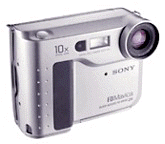
5. Last, but certainly not least, you will prepare a portfolio of your own photographs using a Sony Digital Mavica F75 camera to take digital photographs in black and white that demonstrate the elements of good design. You will work as a group, but will each be responsible for contributing at least four individual photographs to the group project. Your group will present this portfolio as a Powerpoint presentation to the class along with an oral summary of your work.
See the Presentation of Photographic Portfolio Rubric for specifics on each group members responsibilities and how you will be graded.
Evaluation
Here is the overall rubric for the project:
Ansel Adams Questionnaire - 10 points
Scavenger Hunt for Design Elements - 40 points
Presentation of Photographic Portfolio - 50 points
See the individual rubrics under each task for specific information.�
Conclusion
Now you are an educated photographer. You know the elements of a good photograph. You have seen some great photographs by great photographers. You have learned how to take a good photograph. Use your knowledge to appreciate and create great works of art !
Other resources to explore:
http://www.ocaiw.com/adams.htm
A comprehensive collection of photographs by Ansel Adams.
http://zpub.com/sf/history/adams.html
A biography and timeline of Ansel Adams.
http://www.masters-of-photography.com/summaries.html
Check out great photographers, esp. Dorothea Lange - who documented American poor during the Great Depression. These pages take a while to load but are worth it if you are patient.
http://www.visualdiving.com/
Bertrand Chauvel Photography. Great underwater stuff.
http://www.proframe.org/
Collection of travel, sport, nature and miscellaneous photography.
http://www.memphis-schools.k12.tn.us/admin/tlapages/on-line_powerpoint.htm
Instructions for preparing a slide show using Microsoft Powerpoint.
Last updated August 1, 2003