|
The History of the God & Goddess
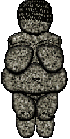
History shows us that the Mother Goddess has been worshipped as Divine Mother for as long as 35,000 years. The Ancient Peoples of the world revered Her as the "birthgiver"1; She who caused all life to come into being. She was depicted with "great swelling curves that embodied her gifts of abundance."1 This is evident artistically when we look at the Venus of Willendorf which was created some time between 28,000 and 25,000 BCE2.
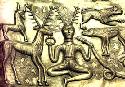
In addition to the Goddess there also was worshipped a Father God. He was the Horned Hunter who ensured the hunt which would bring forth food to feed the people. He is horned because the animals hunted were horned. "Paleolithic cave paintings found in France that depict a stag standing upright or a man dressed in stag costume seem to indicate that Cernunnos' origins date to those times." 5 To the left (bottom) is a panel from a piece of Celtic Art called the Gundestrup Cauldron which is thought to display Cernunnos amongst others. Constructed from 97% pure silver in either the first or the second century BCE, it was discovered buried in a peat bog in 1891.4
The Ancient Peoples would perform what is called "sympathetic magic"3, which is the physical depiction of an actual event that one wishes to come to pass. In other words, the Ancient Peoples would act out the stages of a mock hunt to ensure a successful real hunt. A central figure would wear the skins of an animal while others pursued him in "hunt", in the end successfully subduing the "beast". In this way the peoples intended for "like to attract like" and therefore cause their hunt for food to be successful.
As the Ancient Peoples evolved and discovered the ability to farm land, the Hunter God developed the aspect of the Lord of the Grain. The Lady remained the Goddess of the Land, the Earth Mother whose body held the seeds sown by the Green Lord. These cycles continued as warrior cultures developed who eventually conquered the matrifocal societies, marrying their Gods of War and Sky to the Goddesses of the Land.3
The traditions of the Pagan cultures evolved as the people did, changing to incorporate the many different aspects of the God and Goddess that had come to light as a result of the merging of different peoples. The traditional festivals of the Harvest and the Sun were celebrated, and the Christian Church tried to absorb the Pagan festivals by creating Christian ones that would take place on the exact same days as that of the Pagan. (See Our Traditions)
As the power of the Christian Church grew, their tolerance for differing faiths diminished. By 1484 The Inquisition was in full force against the Old Religion, and in 1486 with the publication of the Malleus Malleficarum (The Witches' Hammer, a guidebook on the discovery and torture of Witches) by Dominicans Kramer and Sprenger, the groundwork was laid for what is known as The Burning Times. Of an estimated 9 million executed, 80% were women, including children and young girls.1
What's sad is that most of the people murdered during the Burning Times may not even have been actual Witches. It took no more than an accusation from an annoyed neighbor to bring about the punishment of death. In Germany, "two villages were left with only a single female inhabitant apiece after the trials of 1585."1
|
|