

All velodromes are not the same. Some have very gentle banking; others are very steep. And although all are oval, some are elongated, with sharp turns, while others are almost round with short straight-aways. The intent of the track is to allow the cyclist to obtain and maintain the highest speed possible. All have lines painted on the track's surface. The band of blue, marks the tracks inner boundary. Riders may not ride on or below this line, except during slow-speed riding in sprint competition. The measurement line is used to measure the track. The sprinter's lane lies between the measurement line and the thin red line--a rider in this area is said to "own the lane" and may only be passed by a passing rider going up and over. The uppermost thin blue line, called the "stayer's line" marks the boundary between faster and slower traffic, with the speedsters below and the slower riders above, typically in the Madison.
INDIVIUAL PURSUIT
This event covers four kilometers for senior men, and three for senior women. Two riders start exactly opposite from each other on the track and literally chase each other around the track. A racer can win the race in one of two ways: 1) by catching the other rider or 2) recording a faster time. Times are posted when the rider reaches each half lap.
This race tests endurance and pacing of the rider's maximum effort to stay ahead of the other rider. Strategies vary according to the cyclist. Some decide to start out slow, lulling their competitors into a false sense of security, and then come on strong at the end. Others prefer to go out fast, trying to rattle the opponent and break his or her confidence.
To win the pursuit, riders must first ride in a qualifying round and from there they compete in a series of rounds to reach the finals. This requires stamina and a fast qualifying time. A fast qualifying time allows the rider to compete against the slower riders in the later rounds.
Indiviual pursuit is contested at the national, world and Olympic levels.
The team pursuit, which is four kilometers in length and is currently only contested by the men, follows the same guidelines as the indiviual pursuit, except that each team is represented by a group of four riders. The winner of the race is determined when the third member of the fastest team crosses the finish line, at which point the time is recorded. A team is considered "caught" when the third rider of one team draws even with the third member of the team that has been overtaken. If both teams have the same time at the finish, they will be placed according to the fastest lap time at the end of the event.
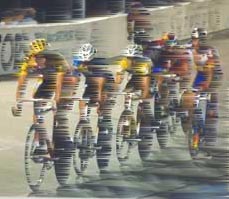
In team pursuit, the racers ride single file (pace line) and take turns leading the team around the track. At each turn the lead rider moves up the embankment, allowing the other three riders to pass underneath, and then drops down the track to the back of the "pace line." The lead rider is responsible for maintaining the pace, while other cyclist work inside the draft to keep their speed while recovering.
Team pursuit is a championship event for men at national and world championships and the Olympic Games.
The points race can seem confusing at first glance, but can be a fun event to watch. The riders cover a distance of from 15 to 40 kilometers, and the rider who accumulates the most points, or the rider furthest ahead by virtue of having lapped the field, regardless of his/her total points, wins the race. Points are awarded during lap sprints, evey fifth or sixth lap (two kilometers). five points are awarded to the sprint winner, three to second, two to third, and one to the fourth-place finisher. The final sprint is a bonus sprint, and the points awarded are doubled. When a rider laps the field, he or she must maintain this advantage throughout the race in order to be awarded the victory without having the highest point total. If more than one rider laps the field, the one with the most points is declared the winner.
The points race is a national, world and Olympic event for both men and women.
The race covers two to three laps, depending on the size of the track, and matches two or three riders against each other. The first one to cross the finish line wins. The final two hundred meters are timed.
Riders are seeded based on their 200 meter time trials. In the time trial each cyclist is allowed to build up speed and then give a full out effort over 200 meters for time. Since sprint competition is based on fastest against slowest, a good time trial is important to a sprinter because it keeps the rider from competing against the top-seeded opponents until later rounds.
In the finals of the match sprint itself, riders meet in a best-of-three competition. Riders are allowed to use the entire width of the track at slow and moderate speeds. The race usually starts out at a slow pace, with one rider required to lead the first lap. (A drawing prior to the first sprint determines which rider will have the lead position during the first lap. Thereafter, riders switch positions each race). The second lap is a positioning lap where riders prepare for the final lap, in what they hope is their favored position. Most riders prefer to be behind the opponent. The third and final lap is a sprint lap to the finish.
Match sprint is a national championship, world chalmpionship and Olympic event for both men and women.
The men's event is one of the most demanding of the track events in cycling. The kilometer time trial is an all-out race, where the cyclist rides as fast as possible for one kilometer. Results are easily determined; the fastest times wins.
Riders compete two at a time, starting on opposite sides of the track (one at a time at the world championships) and race against the clock. The challenge is for the rider to pace throughout the race, without going too slowly. If the rider is not careful, it is easy to "hit the wall." Many consider this race to be the ultimate challenge in cycling.
It is important for riders to hold to the inside of the track, particularly through the turns. Failure to keep a firm inside line increases the distance and thus the time it takes to complete the run. Mere one-hundreths of seconds separate the medalist.
Men compete in this event at the national championships, world championships and Olympic Games. The women compete in the 500 meter time trial at the national championships and world championships.
A mass start sprint event, the Keirin is a race of approximately two kilometers in length where a group of riders (men only) drafts behind a motorcycle slowly accelerating from 15 to 30 mph, until there are approximately two laps remaining. At that time, the motorcycle completes its acceleration and pulls off the track, leaving the riders to sprint for the finish.
The event originated in Japan where it is hugely popular. This will be a new event at the 2000 Olympic Games in Sidney.
A two-man event where teammates relay one another into contention, the Madison is a points race in that riders sprint for points every five to six laps.
The event, named for Madison Square Garden, where it originated, requires riders to switch off during the race by means of an exchange. Riders are required to draw even with there partner in order to replace them in the race. Top Madison competitors use a 'handsling' method to transfer their momentum to their partners. The event requires many different skills - sprinting, chasing, breaking away and sitting on the wheel. As these unique skills are required, many teams are formed with riders who are designated sprinters and pursuiters.
To the rest of the world, this event is known as the "American". It will debut as a men's event at the 2000 Olympic Games.
The Olympic sprint, another new men's event at the 2000 Olympic Games, is a variation on the team pursuit, but requires only three riders. The race consist of three laps by two teams of three riders, each of whom must lead for one lap. After leading for a lap, a rider will drop behind his teammates and then pull off the track. The third rider then finishes the race alone. This race is exciting because of the demand for maximum speed and teamwork.