Chloroplast
Chloroplast is the organelle that only plant cells have it, but not all plant cells possess it.
A chloroplast is wrapped with double layer of membrane. Inside the membrane is a fluid, called stroma. Stroma is a concentrated solution of chemicals required for photosynthesis.
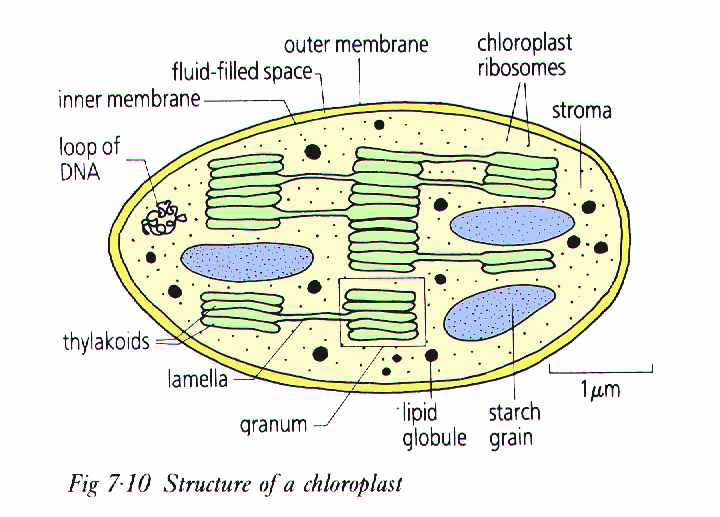
Suspending in the stroma are stacks of membranes, called lamella. Part of the lamella is thickened, because in this thickened part, the membrane is folded. This folded part of the lamella is called the thylakoid. Several pieces of thylakoids would be stacked together to form a column. This column of thylakoids is called a granum (grana in pleural form). Then, the lamella not included in the granum is called the intergranal lamella. The part included in the granum is called the intragranal lamella.
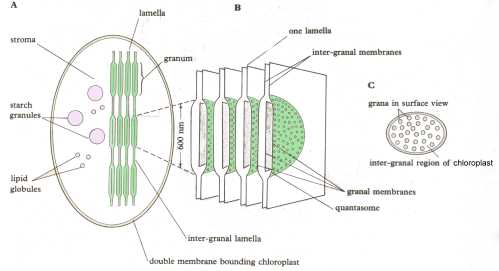
(Asopted from : Biology, A functional Approach, Low-Price Edition, 2nd Ed., by M.B.V.Roberts, The English Language Book Society and Nelson, pp. 150.)
The following is the detail diagram of a granum.

(Asopted from : Biology, A functional Approach, Low-Price Edition, 2nd Ed., by M.B.V.Roberts, The English Language Book Society and Nelson, pp. 148.)
In each piece of thylakoid, there are patches of chlorophyll, called quantasome. It is estimated that each chloroplast contains about 60 grana. Each grana contains about 50 phylakoids. Each piece of phylakoid contains about 500 quantasomes. Each quantasome contains about 230 chlorophyll molecules. That is, each chloroplast contains about 345,000,000 molecules of chlorophyll. The association among plant pigments and other molecules is shown in the following diagram.
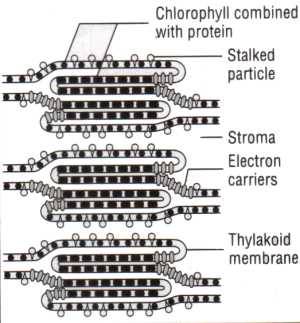
(Asopted from : Biology: Principles and Processes, by Roberts, Reiss and Monger, Nelson Press, pp. 296.)

(28.08.2006)