








Breed Standard


American Kennel Club Standard
 

Official Standard for the Irish Setter
Approved by the American Kennel Club, August 14, 1990

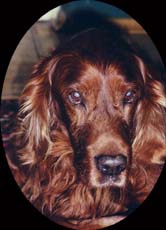
The Irish Setter is an active, aristocratic bird dog, rich red in color, substantial yet elegant in build. Standing over two feet tall at the shoulder, the dog has a straight, fine, glossy coat, longer on ears, chest, tail and back of legs. Afield he is a swift-moving hunter; at home, a sweet natured, trainable companion.

At their best, the lines of the Irish Setter so satisfy in overall balance that artists have termed it the most beautiful of all dogs. The correct specimen always exhibits balance, whether standing or in motion. Each part of the dog flows and fits smoothly into its neighboring parts without calling attention to itself.

Size, Proportion, Substance
There is no disqualification as to size. The make and fit of all parts and their overall balance in the animal are rated more important. 27 inches at the withers and a show weight of about 70 pounds is considered ideal for the dog; the bitch 25 inches, 60 pounds. Variance beyond an inch up or down is to be discouraged.

Proportion -
Measuring from the breast bone to rear of thigh and from the top of the withers to the ground, the Irish Setter is slightly longer than it is tall.

Substance -
All legs sturdy with plenty of bone. Structure in the male reflects masculinity without coarseness. Bitches appear feminine without being slight of bone.

Head
Long and lean, its length at least double the width between the ears. Beauty of head is emphasized by delicate chiseling along the muzzle, around and below the eyes and along the cheeks.

Expression
Soft, yet alert. Eyes somewhat almond shaped, of medium size, placed rather well apart, neither deep set nor bulging. Color dark to medium brown. Ears set well back and low, not above level of eye. Leather thin, hanging in a neat fold close to the head, and nearly long enough to reach the nose.

The skull is oval when viewed from above or front; very slightly domed when viewed in profile. The brow is raised, showing a distinct stop midway between the tip of the nose and the well-defined occiput (rear point of skull). Thus the nearly level line from occiput to brow is set a little above, and parallel to, the straight and equal line from eye to nose.

Muzzle
Moderately deep, jaws of nearly equal length, the underline of the jaw being almost parallel with the top line of the muzzle. Nose black or chocolate; nostrils wide. Upper lips fairly square but not pendulous. The teeth meet in a scissors bite in which the upper incisors fit closely over the lower, or they may meet evenly.

Neck, Topline, Body
Neck moderately long, strong but not thick, and slightly arched; free from throatiness and fitting smoothly into the shoulders.

Topline of body from withers to tail should be firm and incline slightly downward without sharp drop at the croup. The tail is set on nearly level with the croup as a natural extension of the topline, strong at root, tapering to a fine point, nearly long enough to reach the hock. Carriage straight or curving slightly upward, nearly level with the back. Body sufficiently long to permit a straight and free stride. Chest deep, reaching approximately to the elbows with moderate forechest, extending beyond the point where the shoulder joins the upper arm. Chest is of moderate width so that it does not interfere with forward motion and extends rearwards to well sprung ribs. Loins firm, muscular and of moderate length.

Forequarters -
Shoulder blades long, wide, sloping well back, fairly close together at the withers. Upper arm and shoulder blades are approximately the same length, and are joined at sufficient angle to bring the elbows rearward along the brisket in line with the top of the withers. The elbows moving freely, incline neither in nor out. Forelegs straight and sinewy, strong, nearly straight pasterns. Feet rather small, very firm, toes arched and close.

Hindquarters -
Hindquarters should be wide and powerful with broad, well developed thighs. Hind legs should be long and muscular from hip to hock; short and perpendicular from hock to ground; well angulated at stifle and hock joints, which like the elbows, incline neither in nor out. Feet as in front. Angulation of the forequarters and hindquarters should be balanced.

Coat
Short and fine on head and forelegs. On all other parts of moderate length and flat. Feathering long and silky on ears; on back of forelegs and thighs long and fine, with a pleasing fringe of hair on belly and brisket extending onto the chest. Fringe on tail moderately long and tapering. All coat and feathering as straight and free as possible from curl or wave. The Irish Setter is trimmed for the show ring to emphasize the lean head and clean neck. The top third of the ears and the throat nearly to the breastbone are trimmed. Excess feathering is removed to show the natural outline of the foot. All trimming is done to preserve the natural appearance of the dog.

Color
Mahogany or rich chestnut red with no black. A small amount of white on chest, throat or toes, or a narrow centered streak on skull not to be penalized.

Gait
At the trot the gait is big, very lively, graceful and efficient. At an extended trot the head reaches slightly forward, keeping the dog in balance. The forelegs reach well ahead as if to pull in the ground without giving the appearance of a hackney gait. The hindquarters drive smoothly and with great power. Seen from the front or rear, the forelegs, as well as the hind legs below the hock joint, move perpendicularly to the ground, with some tendency towards a single track as speed increases. Structural characteristics which interfere with a straight true stride are to be penalized.

Temperament
The Irish Setter has a rollicking personality. Shyness, hostility or timidity are uncharacteristic of the breed. An outgoing, stable temperament is the essence of the Irish Setter.

The Irish Setter Club of America, Inc. urges all interested parties in purchasing an Irish Setter to familiarize themselves with the "Standard for Irish Setters".

FCI Standard

FCI - Standard No. 120 / 02. 04. 2001 / GB

IRISH RED SETTER

COUNTRY OF ORIGIN : Ireland.

DATE OF PUBLICATION OF THE ORIGINAL VALID STANDARD : 13.03.2001.

UTILIZATION: Gun dog and family dog.

CLASSIFICATION FCI :
Group 7 Pointing Dogs.
Section 2 British and Irish Pointers and Setters with working trial.

BRIEF HISTORICAL SUMMARY : The Irish Red Setter was developed in Ireland as a working dog for hunting game. The breed is derived from the Irish Red and White Setter and an unknown solid red coloured dog. It was a clearly identifiable type in the 18th century. The Irish Red Setter Club was established in 1882 to promote the Breed. The club issued the Breed Standard in 1886, and has organised field trials and shows to set the Standard for the Breed since that time. In 1998 the club published the working style for the breed. The standard and working style together describes the physical form and working ability of the breed.
The Irish Red Setter has evolved down the years into a hardy, healthy, intelligent dog, possessed of excellent working ability and great stamina.

GENERAL APPEARANCE : Racy and athletic full of quality, kindly in expression. Balanced and in proportion.

BEHAVIOUR/TEMPERAMENT: Keen, intelligent, energetic, affectionate and loyal.

HEAD : Long and lean, and not coarse at the ears. Muzzle and skull of equal length and on parallel lines.

CRANIAL REGION :
Skull : Oval (from ear to ear), having plenty of brain room, and with well defined occipital protuberance. Brows raised.
Stop : Well defined.

FACIAL REGION:
Nose : The colour of the nose is dark mahogany, or dark walnut or black, the nostrils wide.
Muzzle : Moderately deep and fairly square at the end. From the stop to point of nose, long, flews not pendulous.
Jaws : Jaws of nearly equal length.
Teeth : Scissors bite.
Eyes : Dark hazel or dark brown ought not to be too large.
Ears : Of moderate size, fine in texture, set low and well back, hanging in a neat fold close to head.

NECK : Moderately long, very muscular, not too thick, slightly arched, no tendency to throatiness.

BODY: Proportionate to size of dog.
Chest : Deep chest, rather narrow in front, ribs well sprung, leaving plenty of lung room.
Loins : Muscular and slightly arched.
TAIL: Moderate length, proportionate to size of body, set on rather low, strong at root, tapering to fine point. Carried level with or below back.

LIMBS

FOREQUARTERS :
Shoulders : Fine at the point, deep and sloping well back.
Elbows : Free and well let down, not turned in or out.
Forelegs : Straight and sinewy, well boned.

HINDQUARTERS : Wide and powerful.
Hindlegs: Long and muscular from hip to hock; from hock to heel short and strong.
Stifle: Well bent
Hocks: turned neither in or out.

FEET: Small, very firm, toes strong, arched and close together.

GAIT/MOVEMENT: Free flowing, driving movement; head held high. Forelegs reaching well ahead but carried low. Hindquarters drive smoothly with great power. Crossing or weaving of legs unacceptable.

COAT

HAIR: On head, front of legs, and tips of ears, short and fine; on other parts of body and legs moderate length, flat and as free as possible from curl or wave. Feather on upper portion of ears long and silky; on back of fore and hind legs long and fine; fair amount of hair on belly, forming fringe which may extend onto chest and throat. Feet well feathered between toes. Tail having fringe of moderately long hair, decreasing in length as it approaches the point. All feathering straight and flat.

COLOUR: Rich chestnut with no trace of black; white on chest, throat, and toes; or small star on forehead or narrow streak or blaze on nose or face not to disqualify.

SIZE :
Height at withers:
Males 23 ins (58 cm) to 26.5 ins (67 cm).
Female 21.5 ins (55 cm) to 24.5 ins (62 cm).

FAULTS: Any departure from the foregoing points should be considered a fault and the seriousness of the fault should be in exact proportion to its degree.

NOTE: Male animals should have two apparently normal testicles fully descended into the scrotum.


1

This site is a member of WebRing.
To browse visit Here.

1


Hosted by www.Geocities.ws

1