Humanity
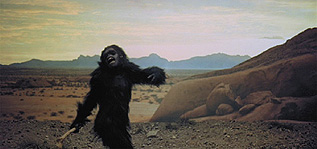 Humans are an evolving
consciousness in "2001." There are numerous visual and audio cues to remind us
that the movie is about the evolution of just one kind of being, regardless of how
different they seem. Moments after the Moonwatcher heaves his weapon into the sky, we see
Heywood Floyd with his arm in a similar position and his pen drifting out of his hand.
When Bowman arrives in the alien cage in "Beyond the Infinite," the camera
focuses on his shocked eyes and the sounds of monkeys howling goes on for several seconds.
There are numerous examples of the actions of the proto-humans in the "Dawn of
Man" sequence being repeated through to the last seconds of the film.
Humans are an evolving
consciousness in "2001." There are numerous visual and audio cues to remind us
that the movie is about the evolution of just one kind of being, regardless of how
different they seem. Moments after the Moonwatcher heaves his weapon into the sky, we see
Heywood Floyd with his arm in a similar position and his pen drifting out of his hand.
When Bowman arrives in the alien cage in "Beyond the Infinite," the camera
focuses on his shocked eyes and the sounds of monkeys howling goes on for several seconds.
There are numerous examples of the actions of the proto-humans in the "Dawn of
Man" sequence being repeated through to the last seconds of the film.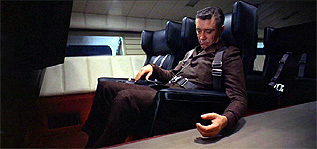 Kubrick
illustrates the history of human consciousness with four epochs. Each is heralded by a
dawn and a monolith. In the "Dawn of Man" human consciousness is united with
tools. "TMA-1" shows us the world that union created and ushers in an age when
humans are aware they are not alone. In "The Jupiter Mission," Man and his tools
fight to reach the next monolith. Man leaves the body and tools behind in "Beyond the
Infinite." Each epoch mirrors the others by having a central confrontation, a lie and
a murder.
Kubrick
illustrates the history of human consciousness with four epochs. Each is heralded by a
dawn and a monolith. In the "Dawn of Man" human consciousness is united with
tools. "TMA-1" shows us the world that union created and ushers in an age when
humans are aware they are not alone. In "The Jupiter Mission," Man and his tools
fight to reach the next monolith. Man leaves the body and tools behind in "Beyond the
Infinite." Each epoch mirrors the others by having a central confrontation, a lie and
a murder.�
| � | Confrontation Over | The Lie/To Hide | Results |
| The Dawn of Man | the waterhole | sucker punch/lethality of tools | civilization |
| TMA -1 | the Tyco monolith | the Clavius epidemic/the monolith | the monolith (the future) belongs to the Americans* |
| The Jupiter Mission | the mission | AE35 antennae failure/HAL's motive | humans forced to abandon tools |
| Beyond the Infinite | future evolution | the frailty of the body/potential of the mind | beginning of Star Child |
�
The action in each of these confrontations is a recasting of the same kind of event at each stage of the evolution of the human consciousness. So they are presented with visual continuity.
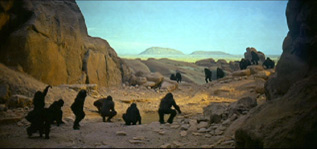
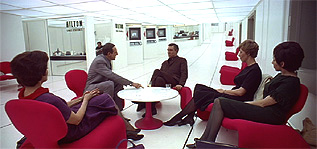
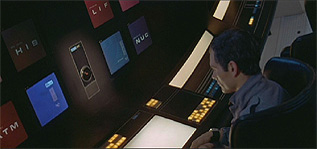
In each scene, someone is being deceived in order to hide something awfully important related to the monolith. The rival proto-human tribe is ignorant of what the business end of a tool feels like, the Russians are in the dark about what's really up with the Americans on the Moon, and Dave doesn't know that he's (apparently) jeopardizing the mission.
�
�
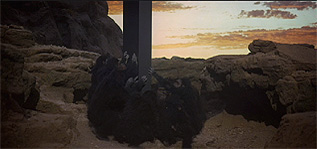 Individuality
That's human life in "2001" - struggle over resources, punctuated by encounters with the monolith that cause transformations in consciousness. The individual people are somewhat less important. I couldn't pick out Moonwatcher from a lineup of other proto-humans even though I've seen the movie a dozen times. The humans from the year 2000 are just as indistinguishable. This is because 1) Kubrick is painting in very broad strokes here - presenting a modern, mythic history of humanity. So the quirks of individual characteristics would only distract from his story. 2) The "TMA-1" sequence is a satire on technological conformity and 3) "The Jupiter Mission" is a Frankenstein story, where the monster has to come off as more sympathetic than the jerks who make it. I talk a lot about the last point in my page about HAL, here's a link to it.
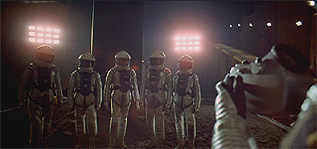 Kubrick
radically depersonalizes people in the parts of "2001" that occur on the space
station and much of life on the Discovery. Almost every emotion displayed by a modern
human up to the moment that Dave storms back onto the Discovery can be described as
"mildly _____." Smyslov is mildly irritated with Floyd for not cooperating.
Floyd is mildly happy to see his daughter. The Moon staff are mildly impressed with
Floyd's speech. The monolith is so mildly impressive that the modern folks gather around
and take a snapshot like a bunch of tourists. These people have no emotional depth. By the
time we get to the Discovery, we find people with exactly zero feeling
left in them. Frank doesn't register his birthday wishes, doesn't care that he lost a game
of chess, or think twice about unplugging one of his crewmates.
Kubrick
radically depersonalizes people in the parts of "2001" that occur on the space
station and much of life on the Discovery. Almost every emotion displayed by a modern
human up to the moment that Dave storms back onto the Discovery can be described as
"mildly _____." Smyslov is mildly irritated with Floyd for not cooperating.
Floyd is mildly happy to see his daughter. The Moon staff are mildly impressed with
Floyd's speech. The monolith is so mildly impressive that the modern folks gather around
and take a snapshot like a bunch of tourists. These people have no emotional depth. By the
time we get to the Discovery, we find people with exactly zero feeling
left in them. Frank doesn't register his birthday wishes, doesn't care that he lost a game
of chess, or think twice about unplugging one of his crewmates.�
�
|
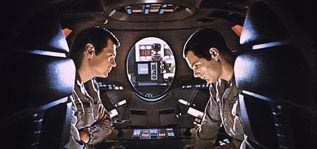
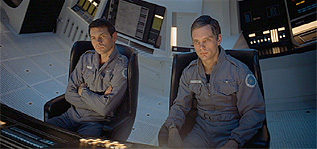
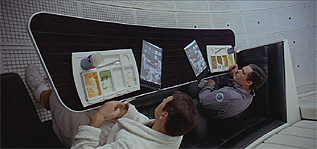
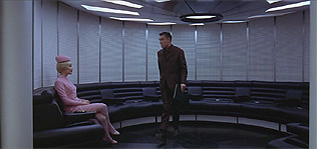
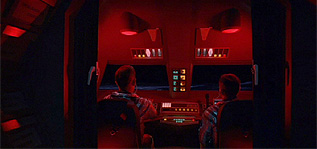
Twins Kubrick further depersonalizes the people of 2001 by making them into clones. Almost every character but has a twin (even HAL, though we never see it). The most obvious twins are Poole and Bowman - they have almost identical bodies, haircuts, clothing, voices and Kubrick frequently frames them in such a way as to take advantage of these similarities. There are many shots that begin with the two facing away from the camera, so that they are hard to differentiate. Numerous shots are mirror images of the two - an effect heightened by the fact that one is left handed and the other right. (A level of the film that has always eluded me - the portrayal of duality and the doppelganger. In scenes with just Bowman sitting talking to HAL, there are many shots that include Poole's empty chair - as if to always keep Poole in mind. This last screenshot on the left is a perfect mirror image of the same man at rest and at work. They work alternating shifts, so that one is active whilst the other is dreaming. Once you start looking at Poole and Bowman as symbolic aspects of one person, the whole rescue scene becomes a very weird experience to watch. (This use of the doppelganger is also central to "The Shining.")) � |
|
Poole and
Bowman are the most extreme example of emotionless twins who spend much of their
screentime looking into screens. As I said before, everyone in this movie has a twin.
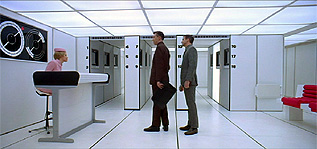
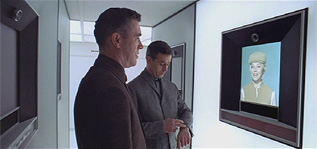
Heywood Floyd is welcomed to the station by a man who is almost his exact height, has the
same haircut and wears a similar suit. They walk in step down the station's main hall.
There are indistinguishable pilots in the Pan Am flight, lunar lander, and moon shuttle.
Each of these cockpits is presented as a symmetric mirror image. The stewardesses and the
space station receptionists are almost impossible to tell apart. Their bodies are
identically proportioned and the hair is either uniform (identically cut blonde bobs on
the station staff) or covered (the stewardesses). Our first glimpse of the station
includes a bunch of repairmen in the same blue uniform. Spacemen walking along the surface
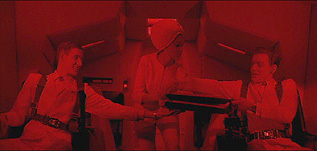
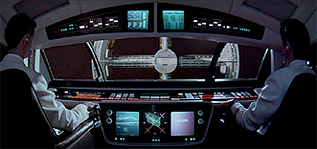
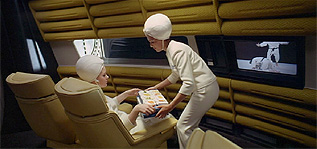
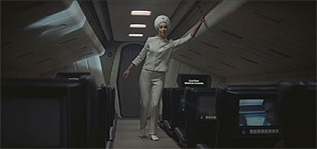
of the moon are shown facing away from the camera in anonymous, androgynous outfits. The point of all these identical people is that humans are moving away from being identified by their bodies. As we move further and further from the Moonwatcher to the Star Child, bodies become more and more vestigial until humanity is represented by the three frozen members of Discovery's crew. They have come very close to overcoming the body, existing only in a dream state with all their vital functions slowed to a crawl. But they are also indistinguishable from one another and encased in packages that look suspiciously like refrigerators, or coffins. Ultimately, the best person for that situation would be one with a body impervious to the elements - a floating intellect in space, like HAL. Compare the last shot of the stewardesses to anything you remember from the "Dawn of Man" sequence. These women are awfully cute - very deliberately so - as opposed to the raw filth of the proto-humans. Instead of living in fear of big cats, killing their own food, or beating an enemy to death, these two watch ritualized violence on TV. Instead of awkwardly rising on two feet, these two wear velcro shoes to keep their feet on the ground of their artificial earth (that's the import of all the lovely shots of the moon & earth & space station/lander - to visually assert an equivalence between the three). The rocky camp has giving way to padded walls and the terror of the night is banished by space people for whom there is no night and darkness is dispelled by spot lamps. All physical needs and privations have been taken care of by technology and they look like anonymous babies. � � |
| Second
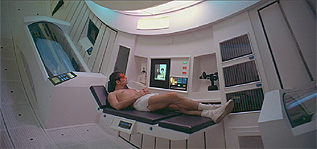
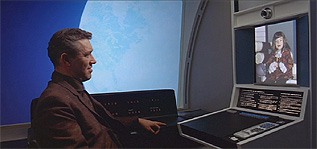
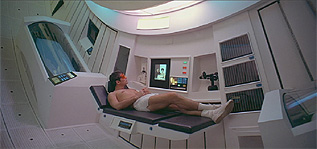
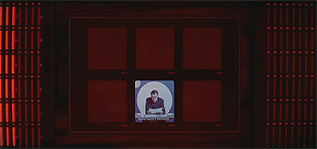
Hand Reality This anonymous, cerebral ideal that humans are shooting for in the year 2000 works thematically, but much of it is also satire. Throughout the movie, people watch TV. The screens are part of the tool driven world where machines do the work and then tell people things they have to know. It's one thing to read sums off a calculator, but what Kubrick is showing us is a stage of development where people are comfortable getting everything from a screen. The love of parents, the thrill of combat, and even death. Kubrick ultimately shows us humans that have reached a stage where the only reliable way to know if they're is alive is by looking at a screen. This is a small list of the screens we see in 2001:
In the screenshots on the right, notice how the first two are literally tunnels of screens. |
|
�
 home
home
�