HAL
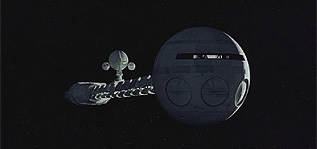
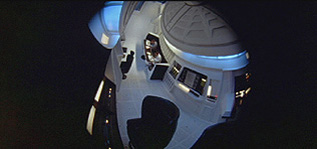
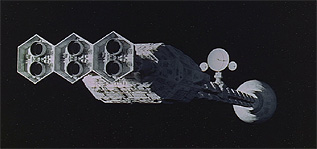
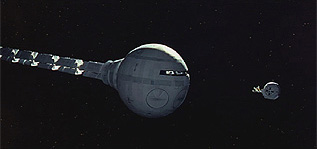
The HAL 9000 is a computer that has achieved self awareness. HAL's body is the Discovery space craft. The ship is very anthropomorphic in design. It's a head with naked spine trailing behind it with a large ear facing home. There are some rocket thrusters at the end of the Discovery, but we never see these used. This is both because the movie aims for a realistic portrayal of space travel (where actual rockets are fired only when the ship needs to build up momentum or change course) and also because HAL is a very cerebral being. As a floating intellect in space, we only ever see the head lit up. At the end of the movie, when Bowman leaves the ship, the lights in HAL's eyes have gone out.
HAL is also a Frankenstein monster. As a being made by overreaching humans, he of course turns on them and in the process inevitably shows himself to have more "human" qualities than his creators.
While I'm at it, HAL is the Cyclops in Homer's Odyssey as well as being a pretty straightforward representation of man creating God as found in Thus Spake Zarathustra.
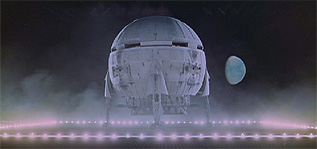
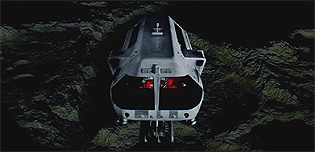
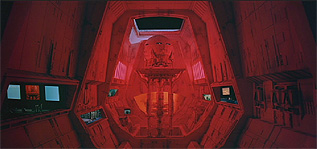
Like everything technological in 2001, HAL also has many monolith dimensions in his design, only more so. From the long tiles that make up his skin, to the rectangle housing his eye, and finally the thousands of tiny monoliths that make up his brain, HAL is the fulfillment of the first monolith encounter in the "Dawn of Man" sequence.
 ����
���� 
 ����
���� 
See a patern here?
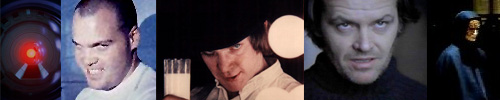
 While the Discovery is HAL's body, the physical object we most directly associate
with HAL during the movie is his red, unblinking eye. Kubrick focuses on it whenever HAL
speaks. If you know Kubrick, you'll remember the numerous other unblinking eyes I've
compiled in the sequence above (I'm missing Bullingdon for the moment). The look always
conveys pure evil - dark emotions brimming over all rational constraint. I'm certain that
HAL's gaze is meant to be taken in the same way as the rest of the Kubrick leers. Kubrick
even gives us numerous HAL POV shots that show HAL watching the astronauts, just to make
sure we know that he's staring at them.� When HAL says this during the BBC Interview "Let me put it this way� No 9000 computer has ever made a
mistake or distorted information. We are all, by any practical definition of the words,
foolproof and incapable of error" we get a POV shot of HAL watching Poole and
Bowman eating.� When HAL thinks of mistakes and distortion, he thinks of his crew.
While the Discovery is HAL's body, the physical object we most directly associate
with HAL during the movie is his red, unblinking eye. Kubrick focuses on it whenever HAL
speaks. If you know Kubrick, you'll remember the numerous other unblinking eyes I've
compiled in the sequence above (I'm missing Bullingdon for the moment). The look always
conveys pure evil - dark emotions brimming over all rational constraint. I'm certain that
HAL's gaze is meant to be taken in the same way as the rest of the Kubrick leers. Kubrick
even gives us numerous HAL POV shots that show HAL watching the astronauts, just to make
sure we know that he's staring at them.� When HAL says this during the BBC Interview "Let me put it this way� No 9000 computer has ever made a
mistake or distorted information. We are all, by any practical definition of the words,
foolproof and incapable of error" we get a POV shot of HAL watching Poole and
Bowman eating.� When HAL thinks of mistakes and distortion, he thinks of his crew.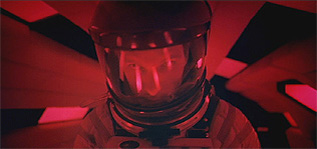 Later
on, Dave gets the Kubrick gaze.
Later
on, Dave gets the Kubrick gaze.
 The Crew
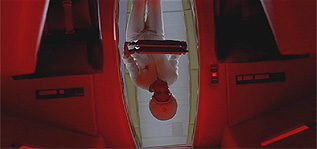
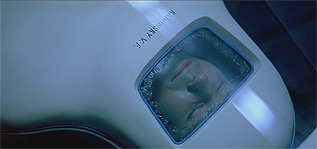
Three of Discovery's five crew members spend the movie either frozen in a state at the brink of death or actually dead. As this shot of one of them shows, you really can't tell the difference just by looking at them that HAL murdered them. Rather, you have to keep your eyes on the displays just to know they are still around. The two that are actually out of their refrigerator/coffins aren't much better. Both of them are boring people. They are boring because they are astronauts chosen to spend months in deep space with little to occupy them (since HAL does everything on Discovery). But they are also boring because humans have become boring in 2001. When Frank Poole watches his birthday broadcast from his parents on TV we see that he's bored by it. When he loses what looks like a very boring game of chess with HAL, he hardly seems to register the defeat. Poole can barely stop himself from treating HAL like a talkative appliance. He downright dismissive and rude when HAL wishes him a happy birthday.
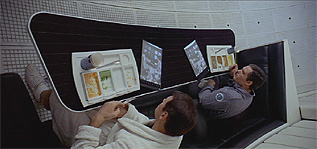
David Bowman is not much better. Poole and Bowman are never shown speaking during the film until they have mission related business to handle. They don't even watch TV or eat together. They are at the same table, eating the same thing, watching the same thing and yet do not acknowledge each other. This is part of why HAL is remembered so warmly by most people who have seen the movie. He's the one who asks questions and is polite in such a way as to suggest genuine consideration for people's feelings. HAL calls Dave over to have a look at the drawings he's doing. What's more, he's genuinely interested. HAL actually asked Dave to move in close so he can see the drawing and even recognizes who is it of. By the time this scene occurs, it's almost impossible to imagine Poole or Bowman showing this much humanity.
Useful Tools
Since HAL is the Discovery, Poole and Bowman are his
tools. The two astronauts are only awake to help HAL do things he can't do himself, like
work on his antennae. They are literally extensions of HAL's body when they climb in the
pods. Their jumpsuits look more like a repairman's outfit.
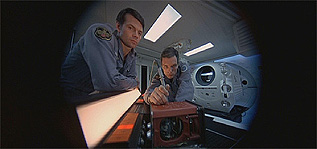 One of the things that HAL knows that we the audience are
never privy to is what the Jupiter Mission really is. What were those three scientist
going to do when they got to the second monolith? HAL knew... and he felt confident that
he could complete the mission on his own. He says as much to Dave after he's
killed the other scientists - "this mission is too important for me to allow you to
jeopardize it." It could be that HAL's as wrong about this assessment as he is about
Dave's chances of surviving later, but then again what is it that Dave finally does at the
end of the movie? He sheds himself of the last of his tools, then his body and is reborn
as a star child. Isn't HAL going about doing much the same thing, discarding his tools
(murder) and getting rid of his body (AE35 failure)? After all, from HAL's perspective, he
too was defending himself against tools that had turned against him.
One of the things that HAL knows that we the audience are
never privy to is what the Jupiter Mission really is. What were those three scientist
going to do when they got to the second monolith? HAL knew... and he felt confident that
he could complete the mission on his own. He says as much to Dave after he's
killed the other scientists - "this mission is too important for me to allow you to
jeopardize it." It could be that HAL's as wrong about this assessment as he is about
Dave's chances of surviving later, but then again what is it that Dave finally does at the
end of the movie? He sheds himself of the last of his tools, then his body and is reborn
as a star child. Isn't HAL going about doing much the same thing, discarding his tools
(murder) and getting rid of his body (AE35 failure)? After all, from HAL's perspective, he
too was defending himself against tools that had turned against him.
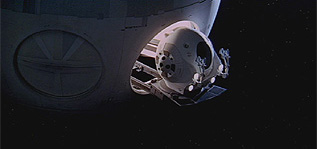 HAL is smarter than Poole and Bowman. From what we see, he could
even be more emotional. He's physically superior. Throughout the entire Jupiter Mission
episode we see the astronauts taking care of the miserable bags of water they call bodies.
They have to exercise, literally fight to keep them from atrophying into jelly. They have
to feed themselves unpleasant bricks of food. Over and over we hear them breathing their
precious oxygen. We see Poole soaking up what I assume is a Vitamin D treatment. The needs
of their bodies are so great that three of them have to shut down their bodies just
to travel in space! On top of all this, Kubrick gives us numerous shots of Discovery
sliding effortlessly through space - this is the environment HAL was designed for. Why
shouldn't HAL be rid of these puny beasts who are planning to kill him?
HAL is smarter than Poole and Bowman. From what we see, he could
even be more emotional. He's physically superior. Throughout the entire Jupiter Mission
episode we see the astronauts taking care of the miserable bags of water they call bodies.
They have to exercise, literally fight to keep them from atrophying into jelly. They have
to feed themselves unpleasant bricks of food. Over and over we hear them breathing their
precious oxygen. We see Poole soaking up what I assume is a Vitamin D treatment. The needs
of their bodies are so great that three of them have to shut down their bodies just
to travel in space! On top of all this, Kubrick gives us numerous shots of Discovery
sliding effortlessly through space - this is the environment HAL was designed for. Why
shouldn't HAL be rid of these puny beasts who are planning to kill him?
HAL is a study in loneliness. He's not quite one of a kind, but his twin is back on earth telling everyone that he's lying about the faulty AE-35 unit. A lot of his dialogue seems to be an attempt to connect with other people. And when first see him at the beginning of the "Jupiter Mission" sequence, he's sliding face-first into complete blackness to the sound of the "Gayaneh Ballet Suite" by Aram Khachaturyan - possibly some of the most desolate music I've ever heard. His claims to be incapable of error sound defensive after a while. And, of course, there's his bizarre and sad last words as he's lobotomized.
 Daisy, Daisy, give me your answer do.
I'm half crazy all for the love of you.
It won't be a stylish marriage,
I can't afford a carriage.
But you'll look sweet upon the seat
of a bicycle built for two.
Murder
I think I've gotten about as far as I can
without talking about why HAL kills Poole and the frozen crewmen. Kubrick shows us
how easy it would be for HAL to kill them. He shows us the source for many resentments.
Kubrick makes it clear that HAL knew things about the mission that we never will. There
was the secret he had to keep that we have to figure into all of this. We know that HAL
told a lie. He didn't malfunction and report the antennae was broken - that's too simple
(and ignores the theme of subterfuge that spans the movie). He deliberately lied about the
antennae that allowed communication with earth. He wanted to break with earth. Maybe he
was already planning to kill everyone.
 I think HAL is like the Mona Lisa or Hamlet. There is so much to
work with, but what it really boils down to is personal interpretation. What people are
really asking is "what was HAL's motive for his killing spree?" and the truth is
that we never really know anyone's motives. We never can have a clear enough picture. We
never know what someone is really thinking. In this case we can't even get our hands on
all the objective, relevant facts - the purpose of the Jupiter Mission. Did HAL really
think he could do it alone? Was that an honest assessment of his own abilities - or was he
wrong, like when he underestimated Bowman? Did HAL know that Beyond the Infinite was there
and was he making ready for it? Or had he just... you get the idea.
I think HAL is like the Mona Lisa or Hamlet. There is so much to
work with, but what it really boils down to is personal interpretation. What people are
really asking is "what was HAL's motive for his killing spree?" and the truth is
that we never really know anyone's motives. We never can have a clear enough picture. We
never know what someone is really thinking. In this case we can't even get our hands on
all the objective, relevant facts - the purpose of the Jupiter Mission. Did HAL really
think he could do it alone? Was that an honest assessment of his own abilities - or was he
wrong, like when he underestimated Bowman? Did HAL know that Beyond the Infinite was there
and was he making ready for it? Or had he just... you get the idea.
I don't know what motivated HAL to lie about the antennae and then start killing. I'm fairly certain that Kubrick set it up as a trap - leaving the viewer guessing the motivation for an action. It cannot be done. Motives are ultimately unknowable - even to ourselves. That's just life. It's a delicious conundrum - how many other attempts at depicting artificial intelligence actually leave audiences agonizing about the motives of the machine when they leave the theatre?
�
I do know how HAL fits into the tool user theme of 2001 though. HAL is the final tool of the apes. Humans have finally made a tool that actually treats it's creators as tools. It's not just ironic, it's a fight to the death. Because just like around the water hole in Africa, there is another kind of existence looming on the horizon. HAL isn't just the intellect and rationality that the tool has given the apes. Since he has a body and a mind in a very real sense, HAL is in the position of being able to compete with the apes. It's a race to Jupiter to see who can become the star child. The apes or their tools.
I'm not suggesting that HAL sees things this way. Bowman didn't. But then that first smart ape didn't think he was starting civilization either.
 home
home