| HOME | ORDER | AUTHOR | CONTACT AUTHOR | LINKS |
|
DEALING TIPS |
3 MISTAKES MOST PLAYERS MAKE
Money Management and Gambling
Make it as Simple or as Complicated as You Like
By Dale S. Yeazel
As a dealer people often ask me if I have a winning system for gambling. My advice is to always try to avoid the three scenarios that will cause them the most grief (and money). These suggestions may seem obvious, but I see people make them everyday, so they must not be obvious enough.
Scenario # 1:
After losing four bets in a row, you tell yourself that you are overdue for a winner so you continue to make larger and larger bets. Your logic is that you can’t possibly lose again. Wrong, you can lose again. You might win but you would only recover what you had invested in this losing streak. Ten or more losing bets are not uncommon for any casino game.
Solution:
Bet less after losing. Unless of course you betting the minimum already, in which case just keep grinding it out and weather the storm.
Scenario # 2:
You are a grinder by nature, just content to have a good time (nothing wrong with that). Then comes the realization that you have just won ten minimum bets in a row. Even if you are on vacation and your gambling budget is limited you shouldn’t let an opportunity like this go to waste. The money you could have won on that run, with even modest pressing (increasing) could have given you a cushion which would have enabled you to enjoy your trip even more.
Solution:
Always be thinking about betting strategies that will give you an opportunity to capitalize on winning streaks while still taking some profits along the way. One such strategy is pressing your bet one unit after each winner. Another is doubling your bet every second or third winner.
Scenario # 3:
After getting well ahead you get greedy and lose all your winnings back.
Solution:
Whenever I am winning I always plan how much I am willing to give back. For instance, let’s say I bought in twenty dollars and I now have ninety dollars in front of me. Some of you might be thinking;" Quit now while you are ahead!" Winning sessions are too rare and I will try to milk this one for what its worth without giving it all back. So I tell myself; "I will quit when I get down to seventy dollars." That way I have my original twenty plus fifty profit.
A few hands later I find I now have one hundred forty dollars. I now revise my plan to; "I quit when I am down to one hundred twenty dollars. I will continue to re-evaluate in this fashion every time I reach a new plateau. In this way I give myself the opportunity to win as much as possible without having to kick myself later that I didn’t quit a winner.
I believe that how much a person is willing to win before quitting is largely dependent on whether that person is a local or a tourist. If that person is a local it also matters if he is gambling as a form of recreation or is merely taking a shot.
Tourists ask me if I would have pressed a bet that had just won for them. My response to this is that I would have, but I’m not here on vacation. When I go busted I just go home. When they go busted all they can do is go look at the white tigers again. The same applies to the local recreational gambler. They don’t want to go busted (or home apparently) so they have to make their bankroll last. I gamble with the intention of either losing an inconsequential amount of money or parlaying some chump change into something that will alter my life style.
The kind of gambler you are will determine your maximum win / maximum loss ratio. If you gamble for recreation you are more concerned with maintaining your bankroll and increasing your chances for a modest win. For instance, if you start with a $100 bankroll you will have a better chance of succeeding if your goal is to quit a $50 winner instead of a $100 winner. You set this goal in advance and not deviate from it if want not to have more losing sessions that winning ones.
For the recreational gambler money management often extends into betting strategies. This is also true for the so-called "professional gambler" that believes betting strategies will overcome fixed percentage games.
Every so often someone blows the dust off of systems that are as old as gambling itself and far older than casinos. They then write a new book with these old ideas and promise the reader riches beyond their wildest dreams. As long as the house has a built in percentage of every bet a gambler makes, all systems are doomed to fail in the long run.
The following systems either re-iterate the principles I stated earlier or complicate the theories by demanding the gambler adhere to betting guidelines that are alleged to limit a player’s loses and increase his chance to win. Most systems for sale are these or variations of them.
If you think that my cynical view of betting systems suggest that using them is a waste of time I can assure you that the opposite is true. I believe in approaching gambling in as logical manner as possible, then hope for the best. I just don’t believe systems are a magic bullet that will cause the casinos to change the game rules or ban "professional gamblers."
The Martingale
The dreaded "Martingale" is for the seriously retarded gambler. It suggests that since the law of averages states that a gambler must win eventually, he should double his bet after every loss. This will insure that he wins his original bet.
The good news is that this system will work almost all the time. For it to fail will require losing 7 to 9 bets before hitting the house limit. "But that never happens, right?" Oh it happens. And when it does you will lose back all of those original bets and then some. Besides, if you think you will quit before you hit the limit, are you sure you will be willing to give back, say $300 worth of winnings? That’s a Hell of a lot of $5 bets to win to make up that loss.
Variations include added a fixed amount t (such as $5) to the amount of every bet following a loser.
Lose $5 bet $15
Lose $15 bet $35
Lose $35 bet $75
All this will accomplish is to hit the table limit faster.
The Anti-Martingale
This calls for doubling a bet after every win and reverting back to one unit after every loss. Now here’s a manly system that even I can embrace. The trouble with it is that if you are a recreational gambler it will go through your money faster that your wife does. Unless of course you hit a monster run and then your only decision is what color Cadillac you will be buying tomorrow.
A logical variation of this is to parlay a one-unit winning bet two or three times and then either bet the same amount or even take back the original bet.
Bet $5
Win Bet $10
Win Bet $20
Win Bet $35 (take back the original bet and gamble with the house’s money)
Win Bet $35 or $70
The D’Alembert
With this system you press your bet one unit when you lose and reduce it one unit when you win. It would seem as long as there are an equal number of winners and loser the bettor is guaranteed to win one unit for every bet won.
Bet $5 Lose -$5
Bet $10 Win +$5
Bet $5 Lose even
Bet $10 Lose -$10
Bet $15 Win +$5
Bet $10 Win +$15
There were three winners (and three losers) and the bettor is winning $15, instead of being even if he was betting $5 each time.
Where this system fails is when your session begins with a long winning streak followed by a protracted losing streak.
Bet $5 Win +$5
Bet $5 Win +$10
Bet $5 Win +$15
Bet $5 Lose +$10
Bet $10 Lose even
Bet $15 Lose -$15
Starting the session by betting more than one unit will not significantly alter the results in the long run.
The Contra-D’Alembert
If all of these systems are so great you may be wondering now why they all have opposites. Which brings me to something I was told a long time ago; "All systems are great, when the dice co-operate."
Of course the bettor now increases his bet one unit after each win and reduces it one unit after each loss. The main problem with this is you still fare worse in a short losing streak than if you had just returned to betting one unit after a loss like playing the Anti-Martingale.
The Lambouchere
This system requires the use of paper and pencil. Which is fine if you want to look like a geek (not that’s there anything wrong with that).
Start by writing a series of numbers such as: 1 2 3
Your first bet is the sum of the outside numbers, in this case 4.
If you win the bet cross-out the outside numbers: 1 2 3
Your next bet will be the number(s) in the center: 2
If you lost your first bet you would add it to the end of your series: 1 2 3 4
Your next bet would be the sum of the outside numbers: 5
If you won that bet, you would cross-out the outside numbers: 1 2 3 4
Your next bet would be the sum of the inside numbers: 5
Once you have successfully crossed-out all numbers in a line, your profit will be the sum of the original numbers.
Oscar’s Grind
This system is highly recommended in Tom Ainslie’s book "How To Gamble in a Casino." It certainly is better than most.
The object is to win one unit in a series. If the first bet of the series is won, it is pocketed and a new series begins. When a profit of one unit is reached in a series, the unit is pocketed and a new series begins.
In a losing series the bet following a losing bet is never increased. It stays the same as the last bet. But after a winning bet you increase the next bet by one unit. However you never increase the bet any larger than is needed to complete the series a one-unit winner.
I hope I have given you some information that will help you be an intelligent gambler. Good luck and don’t forget to tip the dealers.
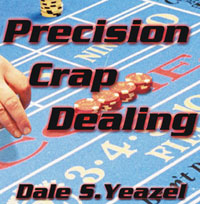
Dale S. Yeazel is a 23-year veteran of the casino industry. He has worked in a number of downtown and strip casinos in Las Vegas. He has recently returned to Vegas after working on riverboats in Illinois and Iowa as a supervisor and craps instructor. His instructional e-book "Precision Crap Dealing" is available at the Gambler’s Book Shop in Las Vegas. His new e-book "Anyone Can Play Craps" will be available in early 2001. www.geocities.com/lump450
Learn How to Deal Craps!
People in the gaming industry have called "Precision Crap Dealing" the most comprehensive and best-illustrated book on the subject of dealing craps that has ever been published.
This e-book on CD-ROM has 242 pages of detailed instruction, 145 full color photographs and 33 illustrations. Complete instructions on check handling and procedures. It contains simple to understand explanations of every bet. Whether you are a break-in, experienced dealer or a player that wants a complete understanding of the game, this book has something to teach you.
"Precision Crap Dealing" is available @ Gambler’s Book Shop 630 S. 11th St. (just northwest of Maryland Parkway and Charleston) or visit their website http://www.gamblersbook.com
$20 plus $5.50 shipping and handling for phone or on-line orders.
Click here to go to home page!
Click here for more ordering information!
|
|

